
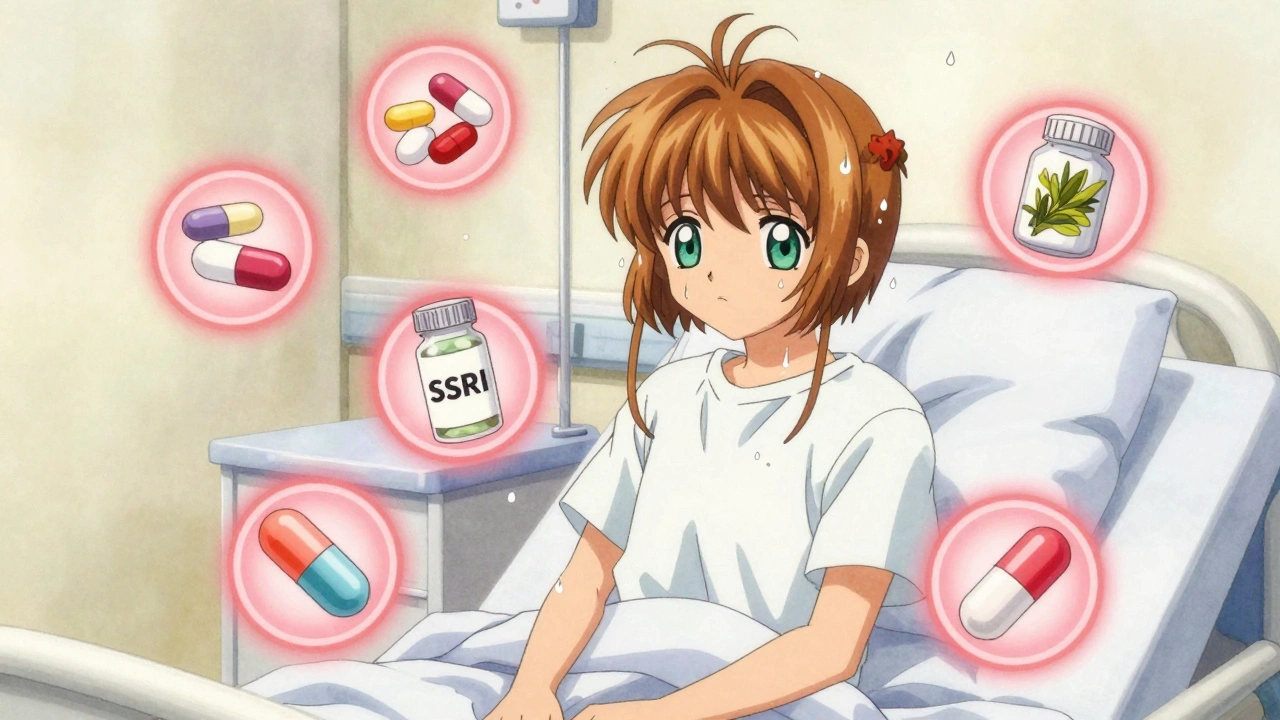
More than 1 in 8 U.S. adults take an SSRI antidepressant. That’s over 30 million people. And while these medications are generally safe, a quiet but deadly risk hides in plain sight: serotonin syndrome. It doesn’t happen often-but when it does, it can kill. And too often, it’s not caused by one drug. It’s caused by what happens when SSRIs mix with other common medicines, supplements, or even over-the-counter painkillers.
What SSRIs Actually Do
SSRIs-like sertraline (Zoloft), escitalopram (Lexapro), fluoxetine (Prozac), and paroxetine (Paxil)-work by blocking serotonin from being reabsorbed in the brain. More serotonin floating around means better mood, less anxiety, fewer obsessive thoughts. That’s why they’re prescribed for depression, panic disorder, OCD, and PTSD. But serotonin isn’t just a mood chemical. It’s also a key player in muscle control, body temperature, digestion, and nerve signaling. When too much builds up, the system goes haywire. That’s serotonin syndrome.How Serotonin Syndrome Happens
Serotonin syndrome isn’t a side effect. It’s a toxic reaction. It doesn’t come from taking too much of one SSRI. It comes from combining SSRIs with other drugs that also boost serotonin. The symptoms start fast-sometimes within hours. You might feel:- Shivering or tremors
- Heavy sweating
- Muscle stiffness or spasms
- Rapid heartbeat or high blood pressure
- Fever above 101°F
- Confusion, agitation, or hallucinations
The Worst Combinations
Not all drug interactions are equal. Some are dangerous. Others are risky. A few are outright deadly. MAOIs: Never MixMonoamine oxidase inhibitors (MAOIs) like phenelzine or selegiline are old-school antidepressants. They’re powerful-and deadly when paired with SSRIs. The FDA calls this combination contraindicated. Why? Because it can raise serotonin levels so high that death rates hit 30-50%. Even a two-week gap between stopping an SSRI and starting an MAOI isn’t enough if you’re on fluoxetine. Its metabolite sticks around for up to 15 days. That’s why doctors insist on a five-week washout. Tramadol, Dextromethorphan, Pethidine: Hidden Triggers
Tramadol is a common painkiller, often prescribed for back pain or arthritis. Many patients don’t realize it boosts serotonin. A 2023 study found people taking tramadol with SSRIs had nearly five times the risk of serotonin syndrome. Dextromethorphan-found in cough syrups like Robitussin DM-is just as dangerous. One Reddit user described going from mild cough to fever of 104.2°F and muscle rigidity within 12 hours of mixing sertraline and cough medicine. Linezolid: The Antibiotic You Didn’t Know Was Risky
Linezolid is an antibiotic used for tough infections like MRSA. It’s not an antidepressant. But it blocks serotonin breakdown. A 2022 study of older adults found those taking linezolid with SSRIs had nearly three times the risk of serotonin syndrome. Most doctors don’t screen for this. Patients don’t know to ask. That’s how it slips through. Herbal Supplements: St. John’s Wort Is a Silent Killer
St. John’s wort is sold as a “natural” remedy for depression. But it works like an SSRI. Mixing it with prescription SSRIs? That’s doubling down on serotonin. Dozens of case reports describe patients ending up in the ER after taking both. One user on Drugs.com wrote: “Three days on St. John’s wort with my Prozac-and I was shaking uncontrollably. The ER doctor said I had early serotonin syndrome.”
What About Other Antidepressants?
SNRIs like venlafaxine (Effexor) and duloxetine (Cymbalta) also raise serotonin. Combining them with SSRIs increases serotonin syndrome risk by over three times. That’s why the FDA added a black box warning in 2006. Yet, many primary care doctors still prescribe them together. Tricyclic antidepressants (TCAs) like amitriptyline? They’re less likely to cause this problem. Bupropion (Wellbutrin)? It doesn’t affect serotonin much-so it’s safer to combine. Mirtazapine and trazodone? Risk is moderate. But never assume safety without checking.What About Opioids?
Opioids are tricky. Most-like morphine, oxycodone, and codeine-are low risk. But some are serotonin boosters:- High risk: Tramadol, pethidine, dextromethorphan
- Medium risk: Methadone, fentanyl
- Low risk: Morphine, oxycodone, buprenorphine, codeine
Who’s Most at Risk?
It’s not just about what you take. It’s about who you are.- People over 65: 22% take five or more medications. One in five takes an SSRI. One in five takes an opioid. The mix is a ticking time bomb.
- People with chronic pain: Often on SSRIs for depression and opioids for pain. That’s the perfect storm.
- People on multiple antidepressants: Even if one is “mild,” stacking them is dangerous.
- People using herbal supplements: St. John’s wort, 5-HTP, L-tryptophan-all boost serotonin.
What to Do If You’re on SSRIs
If you take an SSRI, here’s what you need to do:- Make a full list of everything you take: Prescription drugs, OTC meds, supplements, even herbal teas. Write it down.
- Ask your pharmacist: “Could any of these cause serotonin syndrome with my SSRI?” Don’t assume they’ll catch it. Ask.
- Know the 5 S’s: Shivering, Sweating, Stiffness, Seizures (rare), Sudden confusion. If you feel any of these after starting a new drug, stop it and call your doctor.
- Never start a new medication without checking: Even if it’s “just a cough syrup” or “a natural supplement.”
- Don’t wait for symptoms to get worse: Serotonin syndrome can go from mild to deadly in hours.
What Doctors Should Do
Doctors aren’t ignoring this. But systems are failing them. Electronic health records now flag high-risk combinations. Epic Systems cut dangerous SSRI-opioid prescriptions by 32% after adding alerts. But many clinics still don’t use these tools. And many doctors don’t know the full list of risky drugs. The American Psychiatric Association says: Avoid MAOIs entirely with SSRIs. Avoid linezolid unless no other option exists. Avoid tramadol and dextromethorphan. Screen for herbal supplements. And always, always check for polypharmacy in older patients.The Bottom Line
SSRIs save lives. But they’re not harmless. The biggest danger isn’t the drug itself-it’s what you mix it with. Serotonin syndrome is preventable. But only if you know the risks. You don’t need to stop your SSRI. But you do need to be smart. Ask questions. Review your meds. Don’t assume safety. And if you feel strange after starting something new-don’t wait. Seek help immediately. The system is getting better. Pharmacists are catching more errors. EHRs are flagging more risks. But you’re still your own best defense.Can you get serotonin syndrome from just one SSRI?
No, serotonin syndrome almost never happens from a single SSRI taken at the correct dose. It’s caused by drug interactions-when another medication or supplement adds to the serotonin effect. Even high doses of SSRIs alone rarely cause it. The real danger comes from combining SSRIs with other serotonergic drugs like tramadol, MAOIs, or St. John’s wort.
How long does it take for serotonin syndrome to develop?
Symptoms usually appear within hours of taking a new drug or increasing a dose. In most cases, they start within 2 to 6 hours. Rarely, it can take up to 24 hours, especially with long-acting drugs like fluoxetine. If you’ve just started a new painkiller, cough syrup, or supplement while on an SSRI and feel suddenly unwell, don’t wait-get help.
Is serotonin syndrome the same as an allergic reaction?
No. Allergic reactions involve the immune system and usually cause hives, swelling, or trouble breathing. Serotonin syndrome is a neurological toxicity. It’s caused by too much serotonin in your brain and spinal cord. Symptoms include muscle rigidity, fever, tremors, and confusion-not itching or rashes. It’s not an allergy. It’s a drug interaction.
Can you survive serotonin syndrome?
Yes, most people recover fully if treated quickly. Mild cases often resolve in 24-72 hours with supportive care. Severe cases require hospitalization, IV fluids, muscle relaxants, and sometimes sedation. Death is rare but possible, especially if treatment is delayed. The key is early recognition. If you know the signs and act fast, survival rates are very high.
Are there any safe painkillers to take with SSRIs?
Yes. Morphine, oxycodone, and codeine are considered low risk for serotonin syndrome when taken with SSRIs. Acetaminophen (Tylenol) and NSAIDs like ibuprofen are also safe. Avoid tramadol, dextromethorphan, and meperidine entirely. Always check with your pharmacist before taking any new pain medication-even if it’s sold over the counter.
What should I do if I think I have serotonin syndrome?
Stop taking all non-essential medications immediately. Call your doctor or go to the ER. Don’t wait to see if it gets better. Serotonin syndrome can worsen rapidly. Tell them you’re on an SSRI and recently started another medication. The sooner you get help, the better your outcome. Bring a list of all your medications with you.
Comments
I took Zoloft for a year and never knew about this. My doctor just handed me the script and said 'take one a day.' No warnings, no list of what not to mix with. I once took Robitussin for a cold and felt like my muscles were turning to concrete. Thought I was just getting sicker.
This is so important. I’m a nurse and I’ve seen people come in shaking, sweating, and confused - and they had no idea their cough syrup was the culprit. Please, if you’re on an SSRI, keep a meds list in your phone. Share it with every new provider. You’re your own best advocate. You got this 💪
The distinction between serotonin syndrome and allergic reaction is critical. Many patients conflate the two, leading to delayed treatment. Serotonin syndrome is a pharmacodynamic toxicity, not an immunological event. This article correctly emphasizes the role of polypharmacy in elderly populations, where polypharmacy prevalence exceeds 40% in some cohorts.
I live in India and St. John’s wort is everywhere here - sold in every pharmacy like it’s tea. My aunt took it with her antidepressant and ended up in ICU. No one warned her. No one even knew it was dangerous. This needs to be taught in schools. People think 'natural' means safe. It doesn’t.
OMG I’m so glad someone finally said this!! I’ve been on Lexapro for 5 years and my back pain doc gave me tramadol like it was aspirin. I didn’t know until I read this that it was basically a serotonin bomb. I stopped it cold turkey and my tremors went away in 2 days. But why do doctors not know this?? I had to Google it myself. And why is dextromethorphan even still in cough syrup if it’s this dangerous?? 🤯
So let me get this straight - the FDA says don’t mix SSRIs with MAOIs, but somehow dextromethorphan is still in every CVS aisle? And we’re surprised people end up in the ER? This isn’t a medical issue. It’s a regulatory failure wrapped in corporate apathy.
I’ve read this entire post. It’s 98% accurate. The remaining 2%? You missed the fact that 5-HTP is even more dangerous than St. John’s Wort - and it’s sold as a 'sleep aid' in gummy form. People are popping these like candy. And then they wonder why they feel like they’re being electrocuted from the inside. This isn’t just negligence - it’s a public health disaster waiting for a headline.
Serotonin syndrome is underdiagnosed because symptoms overlap with infection, anxiety, and delirium. The diagnostic criteria are not universally applied. Clinicians require better education. The current literature suggests a diagnostic delay of 12 to 48 hours in 63% of cases.
I’m from the Philippines and I’ve seen this happen twice in my family. One cousin took Prozac and then started taking a traditional herbal tonic for 'nerves.' She ended up in the hospital with a fever of 105. They didn’t know what was wrong until the pharmacist asked about supplements. We need global awareness. This isn’t just an American problem. It’s a human problem. Let’s stop treating meds like they’re free candy.
You’re all missing the real issue. The pharmaceutical industry has known about these interactions for decades. They suppress the data. They market drugs like tramadol as 'non-addictive pain relief' while burying the serotonin risk in the 14-point font disclaimer. This isn’t ignorance - it’s profit-driven malfeasance. And you’re all just commenting like it’s a Reddit thread instead of a crime.
I just want to say thank you for writing this. I’m a retired paramedic and I’ve responded to too many cases where people were in distress and no one knew why. If this helps even one person ask their doctor a question before taking something new, then it’s worth it. You’re doing good work.
I work in a pharmacy in Mumbai and i see this all the time. People buy sertraline and then ask for 'something for anxiety' and we give them 5-htp or ashwagandha. No one tells them its dangerous. I try to warn them but they just say 'but its natural'. I wish we had better training and more time to talk.
Funny how we treat SSRIs like they’re vitamins. You don’t need a PhD to know that if you’re flooding your nervous system with serotonin from five different sources, something’s gonna break. But we’ve turned medicine into a consumer product - buy it, swallow it, forget it. The real tragedy isn’t the syndrome. It’s that we’ve normalized ignoring our own biology until it screams.