

When your liver is damaged - especially from cirrhosis - fluid starts pooling in your belly. That’s ascites. It’s not just uncomfortable; it’s a warning sign your liver isn’t keeping up. About half of people with cirrhosis will develop it within 10 years, and once it shows up, your chances of living another two years drop by half. That’s not a scare tactic - it’s what the American Association for the Study of Liver Diseases says in their 2023 guidelines. The good news? Most cases can be controlled with two simple, well-studied tools: cutting back on salt and taking diuretics. But here’s the twist - what you’ve been told about salt might be wrong.
Why Fluid Builds Up in the Belly
It starts with high pressure in the liver’s blood vessels. When scar tissue forms from long-term damage, blood can’t flow through easily. That pressure backs up, forcing fluid out of the vessels and into the belly. But that’s only half the story. Your kidneys start holding onto sodium and water like they’re running out of both. Why? Because your body thinks your blood volume is low, even though there’s fluid pooling in your abdomen. It’s a cruel trick played by your own hormones. The result? More fluid, more swelling, more risk of infection - like spontaneous bacterial peritonitis, which kills about 1 in 3 people who get it.The Salt Debate: Less Is Better? Or Not?
For decades, doctors told patients with ascites to eat no more than 2 grams of sodium a day. That’s about one teaspoon of table salt - and it’s nearly impossible to hit without reading every label and cooking everything from scratch. Most of the sodium we eat doesn’t come from the salt shaker. It’s in bread, canned soup, deli meats, sauces, even breakfast cereal. Studies show only 40% of people can stick to that limit. And here’s the problem: strict salt restriction might actually hurt some patients. A 2022 study in Gut and Liver Journal flipped the script. Researchers gave one group of cirrhosis patients a low-salt diet (under 5 grams of salt per day) and another group a moderate diet (5-6.5 grams). After a few months, the moderate group had less fluid buildup and needed fewer hospital visits for fluid drainage. Why? Too little salt can make your kidneys work harder to hold onto sodium, which lowers blood flow to the kidneys. That raises the risk of kidney failure - a deadly complication called hepatorenal syndrome. One study found kidney failure rates jumped from 18% to 35% in patients on ultra-low salt diets. So what’s the real answer? Most experts now agree: don’t go below 2 grams of sodium, but don’t panic if you hit 3 or 4. The goal isn’t perfection - it’s balance. Your body needs some sodium to keep your blood pressure stable and your kidneys functioning. The American guidelines still say under 2 grams, but many hepatologists are shifting toward 2-3 grams a day, especially if you’re on diuretics. As one researcher put it: “Salt restriction alone doesn’t fix ascites. Diuretics do. Salt just helps.”Diuretics: The Real Workhorses of Ascites Control
If salt is the helper, diuretics are the main tool. These pills make your kidneys flush out extra sodium and water. The first-line drug is spironolactone. It blocks the hormone that tells your body to hold onto salt. You start at 100 mg a day, then increase by 100 mg every 3 days - up to 400 mg if needed. It works slowly, but it’s gentle on your kidneys. Most people see results in 5-7 days. If that’s not enough - and it often isn’t - doctors add furosemide. This one works faster. You start at 40 mg a day, max out at 160 mg. It’s often paired with spironolactone in a 100:40 mg ratio. Together, they’re more effective than either alone. But they’re not harmless. You can lose too much potassium. You can get dizzy. You can crash your sodium levels. That’s why doctors check your blood every week when you start. The goal isn’t to drain every drop of fluid. It’s to lose no more than 0.5 kg (about 1 pound) per day if you don’t have swollen legs, and 1 kg (2 pounds) if you do. Go faster than that, and you risk kidney damage or low blood pressure. That’s why weight tracking matters more than how bloated you feel.
What Not to Take - And Why
Some common meds make ascites worse. NSAIDs like ibuprofen and naproxen reduce blood flow to your kidneys. That’s bad news when your kidneys are already struggling. Studies show people on these drugs are more than twice as likely to need dialysis. Same goes for ACE inhibitors and ARBs - drugs used for high blood pressure. They may seem helpful, but in cirrhosis, they can trigger kidney failure. If you’re on these, talk to your doctor. There are safer alternatives. Even over-the-counter supplements can be risky. Licorice root, for example, acts like a diuretic - but it can also cause dangerous drops in potassium. Herbal teas labeled “detox” or “liver cleanse”? Skip them. They’re not regulated, and they might do more harm than good.What If Diuretics Don’t Work?
About 5-10% of people with ascites don’t respond to maximum doses of spironolactone and furosemide. That’s called refractory ascites. It’s serious. Survival drops to about 50% within six months. The go-to fix? Large-volume paracentesis. That’s a procedure where a needle drains 5-10 liters of fluid from your belly in one sitting. It’s fast, effective, and usually done in an outpatient clinic. But here’s the catch: you need an IV infusion of albumin - a protein - right after. Without it, your blood pressure can crash, and your kidneys can fail. One liter of fluid removed needs 8 grams of albumin. That’s expensive, but it saves lives. There are other drugs, like vaptans (tolvaptan, conivaptan), that block water retention. But they cost $5,000-$7,000 per course and are only approved for 30 days. They’re not a long-term solution. They’re reserved for rare cases where other options have failed.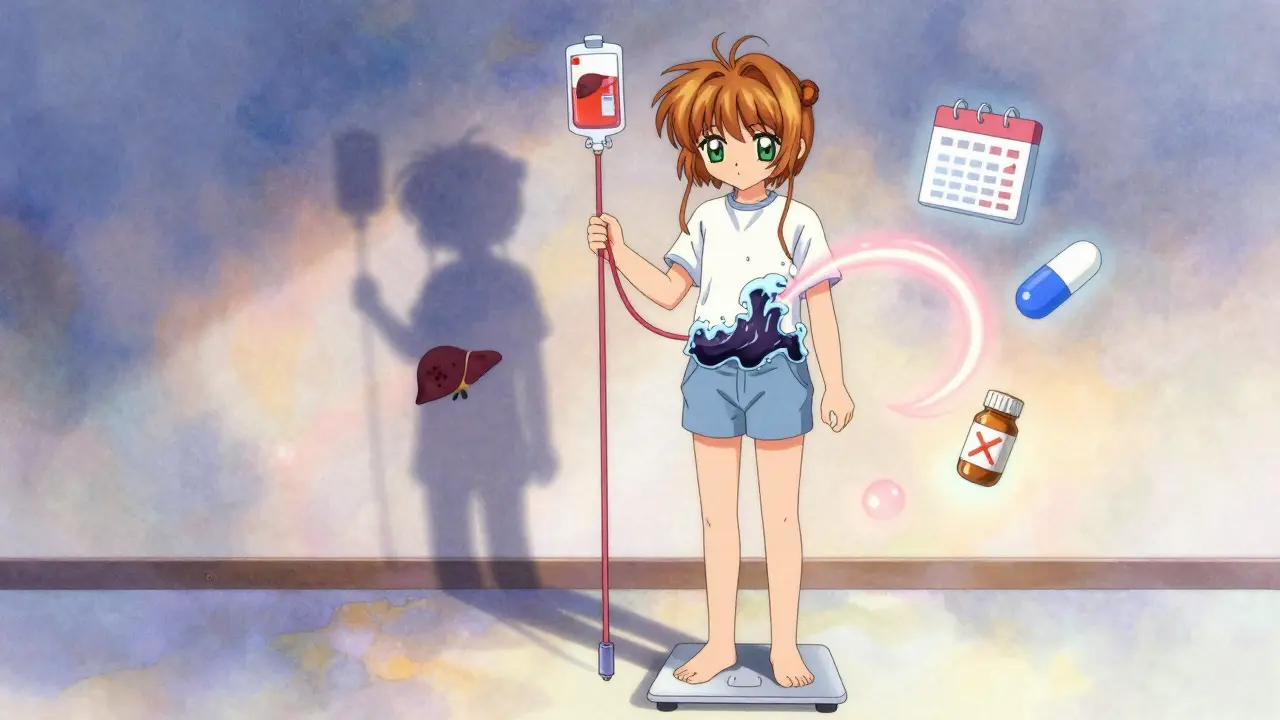
Monitoring: What Your Doctor Is Watching For
Managing ascites isn’t just about taking pills. It’s about tracking. Your doctor will want to see:- Your weight every day - morning, before eating, after using the bathroom
- Your sodium levels - checked at least twice a week when starting diuretics
- Your kidney function - creatinine and blood urea nitrogen (BUN) levels
- Your potassium - low potassium means you might need a supplement or a dose tweak
- Your urine output - if you’re peeing less than 1 liter a day, your diuretics might not be working
The Future: Personalized Care Is Coming
The old one-size-fits-all approach is fading. More doctors now tailor treatment based on your body’s signals. Are you losing weight too fast? Adjust the diuretics. Are you still bloated despite low salt? Maybe you need more albumin. Are you eating well but still gaining fluid? Maybe your sodium excretion is low - and that’s a better clue than your diet log. A big trial called PROMETHEUS is underway, comparing strict salt restriction to moderate intake. Results are due late 2025. Until then, the best advice? Don’t starve yourself of salt. Don’t skip your diuretics. Don’t take random supplements. And if you’re struggling to follow the diet, talk to a dietitian who knows liver disease. They can help you pick foods that are low in sodium but still filling and tasty.Bottom Line: What You Should Do Today
- Take your diuretics exactly as prescribed - don’t skip doses or double up
- Limit sodium to 2-3 grams per day - not zero, not 5 grams
- Avoid NSAIDs, ACE inhibitors, and herbal diuretics
- Track your weight daily
- Call your doctor if you lose more than 1 kg (2 lbs) in a day or feel dizzy, confused, or very tired
- Ask about albumin if you need fluid drained often
Can I eat salt at all if I have ascites?
Yes - but limit it to 2-3 grams per day. Completely avoiding salt can harm your kidneys and make ascites worse. Focus on cutting processed foods, not eliminating salt from meals. A pinch of salt on vegetables or fish is fine. The goal is balance, not starvation.
How long does it take for diuretics to work on ascites?
You’ll usually notice less bloating and weight loss within 5 to 7 days of starting spironolactone. Furosemide works faster - sometimes in 24-48 hours. But full control can take weeks. Don’t expect overnight results. Consistency matters more than speed.
What foods should I avoid with ascites?
Avoid processed meats (bacon, deli ham, sausages), canned soups, soy sauce, pickles, chips, frozen meals, restaurant food, and pre-packaged snacks. Even bread and cereal can have hidden salt. Stick to fresh meats, plain rice, steamed vegetables, unsalted nuts, and fruits. Cook at home when you can.
Can I drink alcohol with ascites?
No. Alcohol continues to damage your liver, even if you’re on diuretics. It raises portal pressure, worsens fluid buildup, and increases your risk of liver failure. If you have ascites, complete abstinence is non-negotiable.
When should I go to the ER for ascites?
Go to the ER if you develop fever, sudden abdominal pain, confusion, yellowing skin, or if your belly swells rapidly over a day or two. These could mean infection (spontaneous bacterial peritonitis) or kidney failure - both are medical emergencies.
Do I need to take supplements with diuretics?
Maybe. Diuretics can lower potassium and magnesium. Your doctor will check your levels regularly. If they’re low, you may need a supplement. Never take potassium pills on your own - too much can be deadly. Always follow your doctor’s advice.
Can ascites come back after drainage?
Yes - often. Paracentesis removes fluid but doesn’t fix the cause. If you’re not on diuretics or eating a low-sodium diet, fluid will return in days or weeks. Drainage is a relief, not a cure. Long-term control requires medication and diet.
Is there a cure for ascites?
Not yet - unless you get a liver transplant. Ascites is a sign of advanced liver disease. While diuretics and diet control it, they don’t reverse the damage. The best outcome is long-term management. Focus on keeping your liver as healthy as possible, avoiding alcohol, and sticking to your treatment plan.

Comments
The assertion that sodium restriction below 2 grams may induce hepatorenal syndrome is not merely speculative-it is a well-documented consequence of renal vasoconstriction secondary to hypovolemia. The liver-kidney axis in cirrhosis operates under a precarious homeostasis, wherein excessive sodium depletion triggers renin-angiotensin-aldosterone system overactivation, ultimately compromising glomerular filtration. The 2022 Gut and Liver Journal study, though limited by sample size, provides compelling evidence that moderate sodium intake (5–6.5 g/day) preserves renal perfusion without exacerbating ascites. This paradigm shift demands revision of outdated guidelines that prioritize arbitrary thresholds over physiological nuance.
As someone who has managed ascites for 7 years, I can tell you-diuretics are the only thing keeping me alive. 🙏 Spironolactone at 300 mg + furosemide at 80 mg daily. I track my weight like a hawk. Lose more than 1 lb in a day? I call my hepatologist. No jokes. No skipping doses. And yes-I still eat a pinch of salt on my eggs. The myth that salt = death is dangerous. I’ve seen too many patients crash their kidneys trying to be ‘perfect.’ Diuretics do the heavy lifting. Salt just helps. 🏥
This post is so important-and so well-written. I’m a nurse who works in liver clinic and I see patients terrified of salt because they’ve been told ‘zero sodium or else.’ But the truth is, they’re scared of food. They stop eating because everything seems ‘too salty.’ We need more compassionate education-not fear. A dietitian who specializes in liver disease can help you find tasty, low-sodium meals that don’t feel like punishment. You don’t have to eat bland gruel to survive. You just need guidance. 💛
They tell you to avoid NSAIDs but never mention that Big Pharma pushed diuretics for decades because they’re profitable. The real issue is portal hypertension caused by years of liver damage and no one wants to talk about the root cause. Why not target the fibrosis instead of just draining fluid and shoving pills down people’s throats? The system is designed to manage symptoms not cure disease. They profit from your chronic illness. You’re not broken-you’re being exploited. 🤔
just started spiro last week and my legs feel lighter already. i didnt realize how swollen i was until it started going down. still eating bread but swapped for the low sodium kind. no more soup from a can. and yeah i dont take ibuprofen anymore. its crazy how much salt is hiding everywhere. thanks for the post
Did you know the American Association for the Study of Liver Diseases is funded by pharmaceutical companies that manufacture diuretics? And the sodium guidelines? They were written by doctors who have stock in pharma firms. The real reason they push diuretics is because liver transplants are expensive and rare. They want you dependent on pills so you keep coming back. The truth is, ascites is caused by toxins from gut bacteria leaking into the bloodstream because your liver can’t filter them. That’s why probiotics and fasting might be more effective than salt restriction. But they won’t tell you that because it doesn’t sell drugs. You’re being lied to. Check the FDA’s conflict of interest disclosures. I’ve done the research. This is all a scam.
It’s not just about salt or diuretics-it’s about control. The medical system doesn’t want you to heal. It wants you to be a lifelong customer. They’ll give you pills to drain fluid, but never tell you that your gut is leaking endotoxins because your bile flow is blocked. They won’t mention that intermittent fasting and milk thistle (not supplements, the real herb) can reduce portal pressure. They fear natural solutions because they can’t patent them. And don’t get me started on albumin-it’s extracted from human blood, and the price is inflated because there’s no competition. You’re not sick. You’re being manipulated. 🌿👁️🗨️
Good breakdown. I’ve seen this in South Africa too. People think cutting salt means no flavor. But if you use lemon, herbs, garlic-your food still tastes good. Diuretics work but they’re not magic. You need to move a bit, even if it’s just walking around the house. And weight tracking? That’s the real MVP. I had a cousin who ignored it and ended up in ICU. Don’t be like him. Stay steady. Stay smart. 🙏