
Many people still believe that generic drugs are weaker, less safe, or not as effective as brand-name medications. This isn’t true - but it’s a myth that’s hard to shake. In fact, generic drugs make up over 90% of all prescriptions filled in the U.S. And yet, nearly half of Americans still think they’re inferior. That’s why community health presentations focused on public education about generics are more important now than ever.
What Exactly Are Generic Drugs?
Generic drugs are exact copies of brand-name medications - same active ingredient, same strength, same way of taking them. The FDA requires that every generic drug matches the brand-name version in dosage, safety, effectiveness, strength, stability, and how it’s taken. The only differences are in the inactive ingredients - things like color, shape, or flavor - which don’t affect how the drug works.
For example, the generic version of Lipitor (atorvastatin) works exactly the same way to lower cholesterol. The generic version of Prozac (fluoxetine) has the same impact on serotonin levels. The FDA doesn’t approve a generic drug unless it delivers between 80% and 125% of the active ingredient compared to the brand-name version - a range proven to be clinically identical.
And here’s the kicker: every generic drug on the market has gone through the same strict testing as the original. The FDA reviews about 1,000 generic applications every year. Each one must pass bioequivalence studies that measure how the body absorbs the drug - using blood tests to track concentration levels over time. If it doesn’t match the brand within that 80-125% range, it gets rejected.
Why Do People Doubt Generics?
The biggest reason? Appearance. If you’ve been taking a blue oval pill for years and suddenly get a white round one - even if it’s the exact same medicine - it feels wrong. A 2022 University of Michigan survey found that 23% of patients questioned whether a generic was real just because it looked different.
Another issue is the nocebo effect - the opposite of placebo. When patients are told they’re switching to a generic, they sometimes report side effects they never had before - even if they’re getting the same chemical. A 2021 study in Annals of Internal Medicine showed that patients who knew they were on generics were 18.7% more likely to stop taking their medication because they believed it wasn’t working.
Then there’s the lack of clear communication. Many patients never get a straightforward explanation from their doctor or pharmacist. They hear, “We’re switching you to a cheaper option,” and assume that means lower quality. But cost savings don’t mean compromised care. Generic drugs cost 80-85% less than brand-name versions. That’s not just good for your wallet - it’s good for the whole system. In 2022 alone, generics saved the U.S. healthcare system $377 billion.
How Do Community Health Presentations Help?
Community health centers, pharmacies, and local clinics are on the front lines of changing minds. The FDA’s Generic Drugs Stakeholder Toolkit gives these groups real tools: fact sheets in English and Spanish, videos, posters, and training guides. One of the most effective methods? The “Teach-Back” technique.
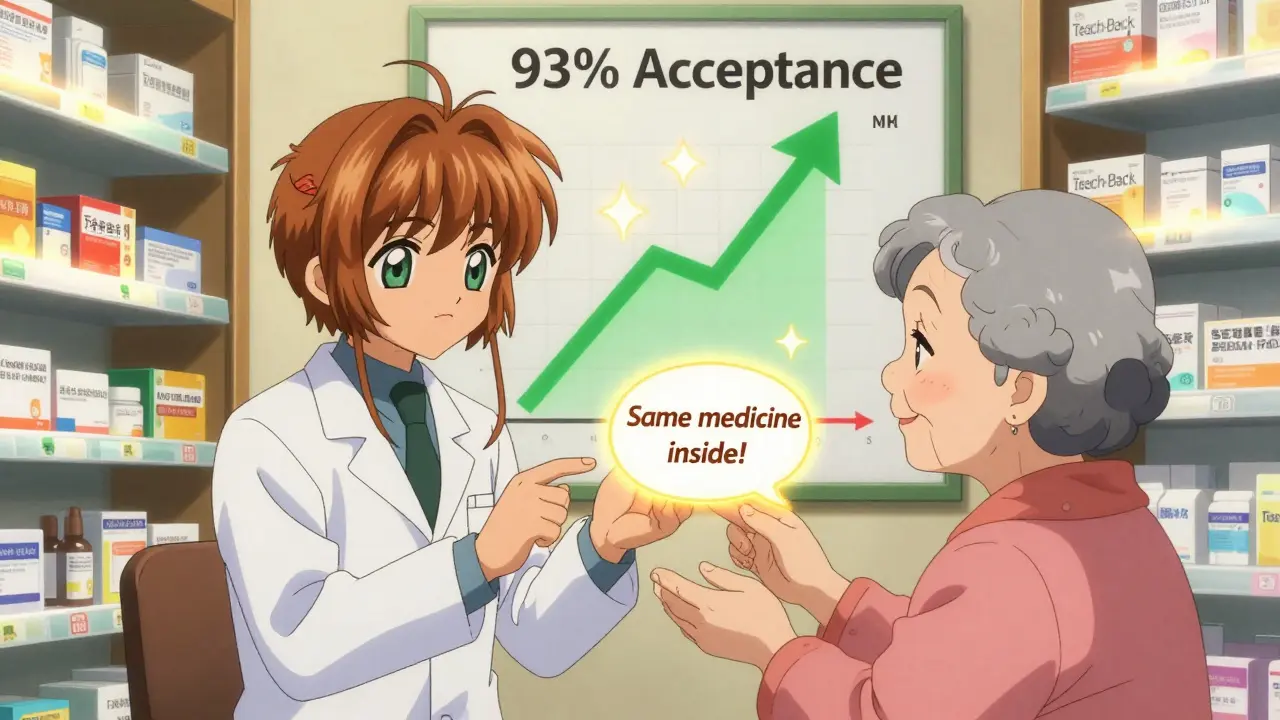
Instead of just saying, “This is a generic drug,” providers ask patients to repeat back what they understood. For example: “Can you tell me why this pill is just as safe as the brand-name one?” If the patient says, “Because it has the same medicine inside,” they’ve got it. If they say, “Because it’s cheaper,” that’s when the educator steps in with more detail.
Community Health Center of Burlington used this approach in 2021. Within six months, patient acceptance of generics jumped 37%. Why? Because they didn’t just hand out brochures - they talked, listened, and corrected misunderstandings in real time.
Where Generics Shine - And Where People Still Hesitate
Generics work just as well for most conditions. For heart disease, diabetes, and high blood pressure, over 95% of prescriptions are generics. These are drugs where the science is clear, the dosing is simple, and the outcomes are predictable.
But in mental health and neurology, acceptance drops. Only 68% of prescriptions for central nervous system drugs are generic, according to IQVIA data from 2023. Why? Because patients and even some doctors worry about tiny differences in absorption affecting mood or seizure control.
There’s one real exception: antiepileptic drugs. A 2023 study in Epilepsy & Behavior found a slightly higher chance of seizure recurrence when switching between generic and brand versions. But the American Academy of Neurology says this is rare - and likely due to inconsistent manufacturing between different generic brands, not because generics are inherently less reliable. For most people, switching is perfectly safe.
What matters most is consistency. If you’re stable on a generic, stay on it. If you’re stable on a brand, don’t switch unless your doctor recommends it. But don’t avoid generics out of fear - especially if cost is a barrier to taking your medicine at all.
Who’s Behind the Push for Better Education?
The FDA isn’t doing this alone. The American Medical Association passed a resolution in 2022 urging doctors to talk openly with patients about generics. The Academy of Managed Care Pharmacy says generics are “safe, cost-effective alternatives” with equal safety profiles. Even Medicare is stepping in: starting January 1, 2025, all Medicare Part D plans must give standardized education materials to every beneficiary.
Organizations like the Association for Accessible Medicines have distributed over 2.7 million brochures through community health centers. The FDA launched a “Generics 101” video series specifically for seniors - and early results show a 31% improvement in knowledge among viewers over 65.
And it’s working. In urban areas, 93% of prescriptions are generic. But in rural communities, that number drops to 78%. That’s a gap that community health presentations can close - by bringing the facts directly to people who need them most.
How Generics Improve Health Equity
Cost isn’t just a number - it’s a barrier to health. A 2021 study tracking 3.2 million patients found that switching to generics improved medication adherence by 22% among low-income populations. People who couldn’t afford their brand-name drugs were more likely to skip doses, delay refills, or stop entirely. Generics changed that.
The National Association of Community Health Centers made this official in 2024: every patient counseling session must include a discussion about generics. Why? Because when people can afford their medicine, they live longer, healthier lives.
This isn’t just about saving money. It’s about making sure everyone - no matter their income, zip code, or education level - has access to the same effective treatment.
What’s Next for Generic Drugs?
More than 287 brand-name drugs will lose patent protection between 2023 and 2028. That means more generics coming to market - including complex ones like inhalers, injectables, and topical creams. These aren’t as simple as a pill. They require more testing, more education, and more patience from patients.
The FDA’s 2023 survey found that 40% of patients were confused about how to use generic inhalers compared to brand-name ones. That’s a new challenge. But it’s also an opportunity - for community health workers to step in, demonstrate proper use, and answer questions before confusion turns into non-adherence.
By 2027, the generic drug market is projected to grow to $184.3 billion. That growth isn’t accidental. It’s the result of decades of science, strict regulation, and now, better education.
What You Can Do
If you’re a patient: Ask your pharmacist or doctor, “Is there a generic version of this?” Don’t assume there isn’t. And if you’re given a generic, ask for a quick explanation - not just a receipt.
If you’re a community health worker: Use the FDA’s free toolkit. Don’t just hand out flyers. Talk. Ask questions. Use the Teach-Back method. Make it personal.
If you’re a caregiver or family member: Help someone who’s skeptical. Remind them that the same FDA that approves the brand-name drug also approves the generic. The same lab tests. The same standards. The same oversight.
Generics aren’t second-rate. They’re the standard. And with the right education, more people will start treating them that way.
Comments
Generics saved my ass last year when I got hit with a $400 co-pay for my blood pressure med. Switched to the generic, paid $12, same results. Why are we still acting like this is some kind of gamble?
Let’s be real - the FDA’s bioequivalence range of 80-125% is a fucking joke. That’s a 45% swing in bioavailability. You think that doesn’t matter for narrow-therapeutic-index drugs? I’ve seen patients crash and burn because some generic manufacturer decided to tweak the excipients. This isn’t science - it’s corporate arithmetic dressed up in lab coats.
The ‘same active ingredient’ line is propaganda. The delivery matrix matters. The dissolution profile matters. The fucking coating matters. You think a 300mg tablet dissolving in 15 minutes is the same as one that takes 45? Not in a CNS patient. Not in someone with gastroparesis. Not in someone who’s been stable on brand for a decade.
And don’t get me started on the ‘cost savings’ narrative. Yeah, generics saved $377 billion. But how many ER visits, hospitalizations, and psychiatric admissions did that ‘savings’ trigger? You don’t account for downstream healthcare costs when you’re counting pennies on pills.
The ‘Teach-Back’ method? Cute. But when your patient is 72, on six meds, and can’t read the label because the font’s smaller than a mosquito’s eyelash, telling them to ‘repeat it back’ is just performative empathy.
And the myth that generics are ‘just as good’? That’s what they said about the Ford Pinto. The FDA doesn’t test for long-term neurological effects. They test for blood concentration at 2, 4, 6 hours. That’s it. That’s the entire standard.
Don’t be fooled. This isn’t about access. It’s about profit. And the people who lose? The ones who can’t advocate for themselves.
They’re hiding something. I read online that generics have mercury in them. My cousin’s neighbor’s sister took a generic and her hair fell out. The FDA is in bed with Big Pharma. Why do you think the pills look different? They’re changing the formula to make you dependent. They want you to keep buying them. I don’t trust any of it.
While the article presents a compelling case for the efficacy of generic pharmaceuticals, it fails to adequately address the regulatory lacunae inherent in the bioequivalence paradigm. The 80-125% confidence interval, while statistically permissible, is clinically indefensible in the context of psychotropic and antiepileptic agents. Furthermore, the conflation of cost-efficiency with therapeutic equivalence constitutes a fundamental category error.
One cannot equate financial utility with medical integrity. The assertion that ‘generics are the standard’ is not only misleading, but dangerously reductive. The standard, in fact, remains the innovator product - the generic is merely a cost-optimized substitute.
The ‘Teach-Back’ methodology, while pedagogically sound, presupposes a level of health literacy that is statistically absent in the majority of the U.S. population. To mandate such an approach without systemic support structures is to institutionalize performative healthcare.
Moreover, the omission of post-marketing surveillance data regarding adverse event clustering in generic-specific populations is a glaring omission. The FDA’s passive surveillance system is notoriously under-resourced and reactive - not proactive.
Until these structural and epistemological flaws are acknowledged, the rhetoric of ‘equivalence’ remains a neoliberal fiction.
Generics work fine. I’ve been on them for 10 years. No issues. Stop overthinking it. If your doctor says it’s good enough, it is.
Man, I used to be scared of generics too - thought they were like knockoff sneakers. Then I switched my statin and saved $300 a month. My cholesterol’s better than it’s been in years. No weird side effects, no magic pills. Just science. Honestly? The real villain here isn’t the generic - it’s the fear we let Big Pharma plant in our heads.
They’re selling us poison wrapped in a price tag. I used to take my antidepressant brand name - felt balanced, human, alive. Then they switched me to generic. I didn’t cry for three weeks. I didn’t laugh for six. I felt like a ghost in my own skin. My doctor said ‘it’s the same chemical.’ But chemicals don’t live in a vacuum. Our bodies aren’t test tubes. We’re not machines. And if you think this is just about money, you’ve never felt the weight of your own soul slipping away because a pill didn’t quite fit.
It is imperative to acknowledge that the regulatory framework governing generic drug approval in the United States diverges significantly from the stringent pharmacokinetic benchmarks enforced in the European Union and the World Health Organization’s guidelines. The bioequivalence range of 80-125% is not universally accepted as clinically acceptable. Furthermore, the absence of mandatory post-market pharmacovigilance for generic-specific adverse event clustering represents a critical oversight in public health policy.
It is also noteworthy that the economic argument for generics, while compelling, fails to account for the long-term societal costs associated with suboptimal therapeutic outcomes, particularly in populations with comorbid psychiatric and metabolic conditions.
Therefore, the uncritical promotion of generics as equivalent substitutes constitutes a form of epistemic injustice against vulnerable patient populations.
bro i switched to generic adderall and now i can't focus at all 😭 the brand one was my brain’s best friend. now i’m just a confused potato 🥔💊
I work in a community clinic and we’ve seen firsthand how generics change lives. One woman told me she was skipping her diabetes meds because the brand cost $200 a month. We switched her to generic - $12. She started checking her sugars daily. Lost 30 pounds. Now she teaches others how to ask for generics. It’s not about the pill. It’s about dignity. When people can afford to stay healthy, they do. And that’s the real win.
What’s fascinating here is the philosophical tension between equivalence and identity. We treat drugs as if they are pure substances, but in reality, they are embedded in a web of perception, expectation, and bodily memory. The active ingredient may be identical, but the patient’s relationship to the pill - its color, shape, brand logo, even the texture of the bottle - becomes part of the therapeutic ritual. To dismiss this as mere ‘nocebo’ is to reduce human experience to pharmacokinetics. The body doesn’t just absorb chemicals; it absorbs meaning. And when that meaning is stripped away - when the familiar blue oval becomes a white circle - the body grieves. It’s not irrational. It’s existential. So when we say ‘it’s the same,’ we’re not just talking chemistry. We’re asking someone to surrender a piece of their identity. And that’s not something a bioequivalence study can measure.
Generic drugs are a scam. The FDA lets them get away with it because they’re underfunded. I looked up the manufacturing plants - some are in India with zero inspections. You think your pill is safe? It’s a lottery. And they’re pushing this on seniors who can’t even read the label. This isn’t healthcare. It’s negligence dressed up as policy.
Let me break this down for the masses. The FDA’s 80-125% bioequivalence window is a regulatory loophole designed to allow foreign manufacturers to flood the market with substandard products. The ‘same active ingredient’ claim is technically true but functionally meaningless. Excipients vary. Dissolution profiles differ. Stability under heat and humidity? Unmonitored. The only thing consistent is the profit margin. This isn’t science - it’s a corporate shell game. And the ‘education’ campaign? A distraction. They don’t want you to understand - they want you to shut up and take it.
I’ve been a nurse for 22 years. I’ve seen people die because they couldn’t afford their meds. I’ve also seen people stabilize on generics who were on the edge of collapse. This isn’t about trust. It’s about survival. If you can’t afford your medicine, you don’t get to choose. The real failure isn’t the generic - it’s a system that makes you choose between food and your life.
Hey I just wanted to say I’m so proud of the work you’re doing with these community presentations! I’m a pharmacist and I’ve been doing the teach-back thing for years. It’s not easy but when someone finally says ‘oh so it’s really the same medicine?’ and their face lights up? That’s why I do this. You’re changing lives. Keep going!