

Kombucha Alcohol & Medication Safety Checker
Check if your medication interacts with trace alcohol in kombucha. Many common medications can react dangerously even with the small amounts of alcohol found in commercial kombucha.
Note: Kombucha is legally required to be below 0.5% ABV, but some homebrewed versions can reach 2.5% ABV. This tool helps you determine if your specific medication has alcohol interaction warnings.
Results will appear here after checking
After entering your medication and kombucha type, we'll show whether it's safe to consume based on FDA guidelines and medical research.
Drinking kombucha is popular for its tangy taste and probiotic reputation, but if you're on certain medications, that small bottle could be more dangerous than you think. Even though most store-bought kombucha says it’s "non-alcoholic," it still contains trace alcohol-enough to cause serious reactions when mixed with common drugs. This isn’t theoretical. People have ended up in the ER after combining kombucha with antibiotics, antidepressants, or blood sugar meds. The problem? Most people have no idea kombucha contains alcohol at all.
How Much Alcohol Is Really in Kombucha?
Kombucha is made by fermenting sweet tea with a SCOBY-a living culture of bacteria and yeast. During fermentation, the yeast eats sugar and produces alcohol and carbon dioxide. That’s normal. But here’s the catch: the amount of alcohol isn’t fixed. It depends on how long it ferments, the temperature, and whether it’s made at home or in a factory.
Commercial brands in the U.S. are legally required to keep alcohol below 0.5% ABV (alcohol by volume). That’s the same limit as non-alcoholic beer. To hit that mark, companies like GT’s Kombucha use flash pasteurization or membrane filtration to stop fermentation early. But even that tiny amount-0.5%-can matter if you’re on the wrong meds.
Homemade kombucha? That’s a different story. Without strict controls, homebrews can easily hit 1.5% to 2.5% ABV. One 2024 Harvard study found 43% of homebrewed batches exceeded 0.5% ABV, and 12% reached levels close to light beer. If you’re brewing your own, you’re essentially rolling the dice with your medication safety.
Which Medications Are at Risk?
It’s not just about getting drunk. The danger comes from how alcohol interacts with your body’s chemistry when you’re taking certain drugs. Even small amounts can amplify side effects or trigger dangerous reactions.
Here are the key medication classes to watch out for:
- Antibiotics like metronidazole (Flagyl) and tinidazole: Mixing these with alcohol-even trace amounts-can cause severe nausea, vomiting, flushing, rapid heartbeat, and even chest pain. A 2023 case report in the Journal of Clinical Pharmacy and Therapeutics described a patient who had a violent reaction after drinking homemade kombucha (1.8% ABV) while on metronidazole.
- Antidepressants (SSRIs like sertraline or fluoxetine): Alcohol can increase drowsiness, dizziness, and impair judgment. Users on Reddit and medical forums report increased anxiety and brain fog after drinking kombucha while on these meds.
- Diabetes medications like metformin or chlorpropamide: Alcohol interferes with how your liver releases glucose. Combined with kombucha’s sugar content, this can cause sudden, dangerous drops in blood sugar. One user on Diabetes Daily reported a 15-point blood sugar plunge after drinking kombucha with metformin-requiring an ER visit.
- CNS depressants like benzodiazepines (Xanax, Valium) or sleep aids: Alcohol enhances their sedative effects. Stanford neuroscientist Dr. Andrew Huberman warned that even 0.5% ABV can boost GABA receptor activity, increasing drowsiness and risk of accidents.
- Nitrates (used for heart conditions): Alcohol can cause a sudden, dangerous drop in blood pressure when combined with these drugs.
The American Pharmacists Association lists kombucha as a "hidden alcohol source" that can interact with 17 major drug classes. Most people don’t realize it’s even on the list.
Why Commercial Kombucha Isn’t Always Safe
You might think, "I’ll just buy store-bought-it’s regulated, right?" Not quite.
While brands must test their products to stay under 0.5% ABV, labeling is inconsistent. Only 63% of commercial kombucha bottles include a "Contains Trace Alcohol" warning, according to FDA compliance reports from 2023. That means you could be drinking a product with alcohol and not know it.
Even worse, some brands are pushing the limit. "Hard kombucha"-like those from Health-Ade or Brew Dr.-is intentionally brewed to contain 3% to 8% ABV. These are marketed as alcoholic beverages, but many consumers confuse them with regular kombucha. If you’re not careful, you could accidentally drink something equivalent to a beer while on metronidazole.
And here’s the kicker: most pharmacies don’t warn patients. A 2023 survey by the American Pharmacists Association found only 32% of pharmacists correctly identify kombucha as a potential alcohol source. If your pharmacist doesn’t know, you’re on your own.
Real People, Real Reactions
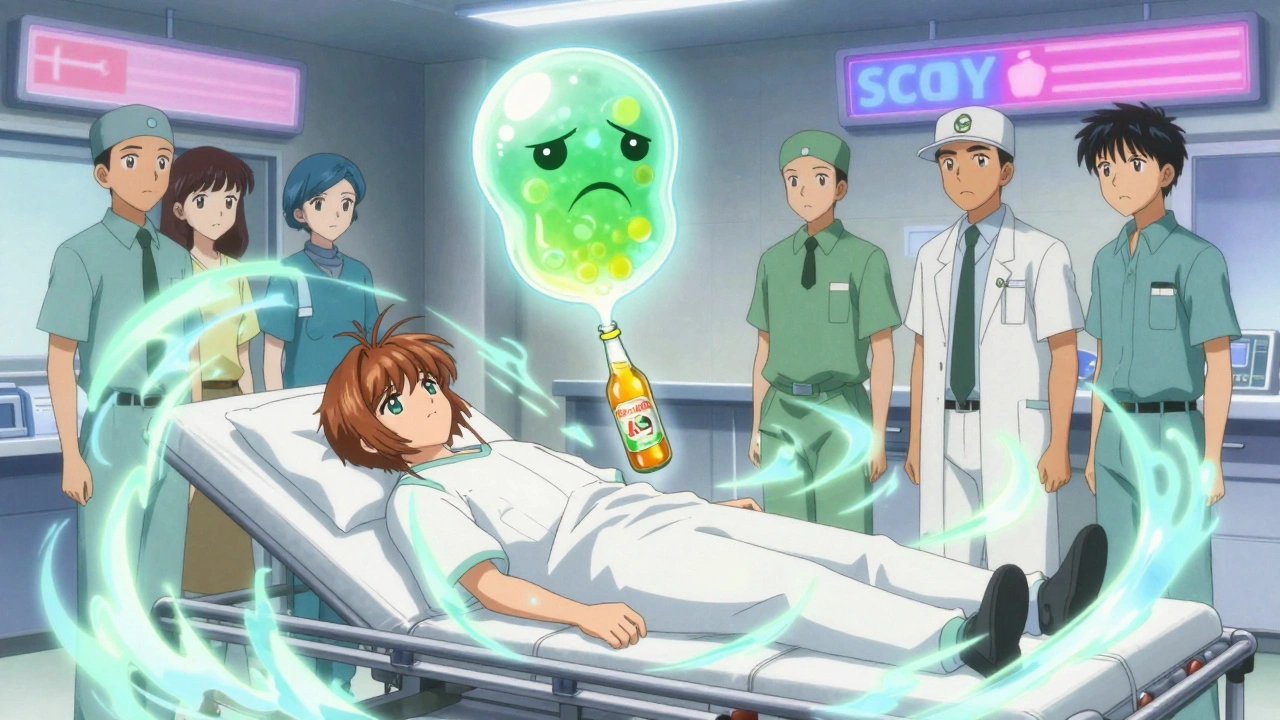
Stories aren’t rare. On Reddit’s r/kombucha, over 280 posts from 2020 to 2023 describe bad reactions after mixing kombucha with meds. One user, u/SarahJ2021, wrote: "I drank Health-Ade while on metronidazole for a UTI. I threw up violently for hours. Thought I was having a heart attack."
ConsumerLab’s 2023 survey of 1,243 kombucha drinkers found 18% reported medication interactions. Of those, 62% involved antidepressants and 29% involved antibiotics. Trustpilot reviews for top brands are full of complaints like: "No warning about interactions with my blood pressure meds" or "My husband passed out after one bottle with his anxiety med."
These aren’t isolated incidents. Medical forums like MedHelp document over 400 cases of adverse events linked to kombucha and medications since 2020. The pattern is clear: people assume kombucha is harmless, take it daily, and don’t connect the dots when things go wrong.
What Should You Do?
If you’re on any medication that interacts with alcohol, here’s what to do:
- Check your meds. Look up your prescription or ask your pharmacist if it has an alcohol interaction warning. Don’t assume it doesn’t apply because kombucha is "natural" or "low-alcohol."
- Assume store-bought kombucha has alcohol. Even if it says "non-alcoholic," treat it like a 0.5% ABV drink. If your med says "avoid alcohol," avoid kombucha too.
- Never drink homemade kombucha if you’re on alcohol-sensitive meds. The risk is too high. You can’t test it reliably without a $200 alcoholmeter.
- Wait 48 hours. The Cleveland Clinic recommends waiting at least two days after taking a medication like metronidazole before consuming any kombucha-even commercial.
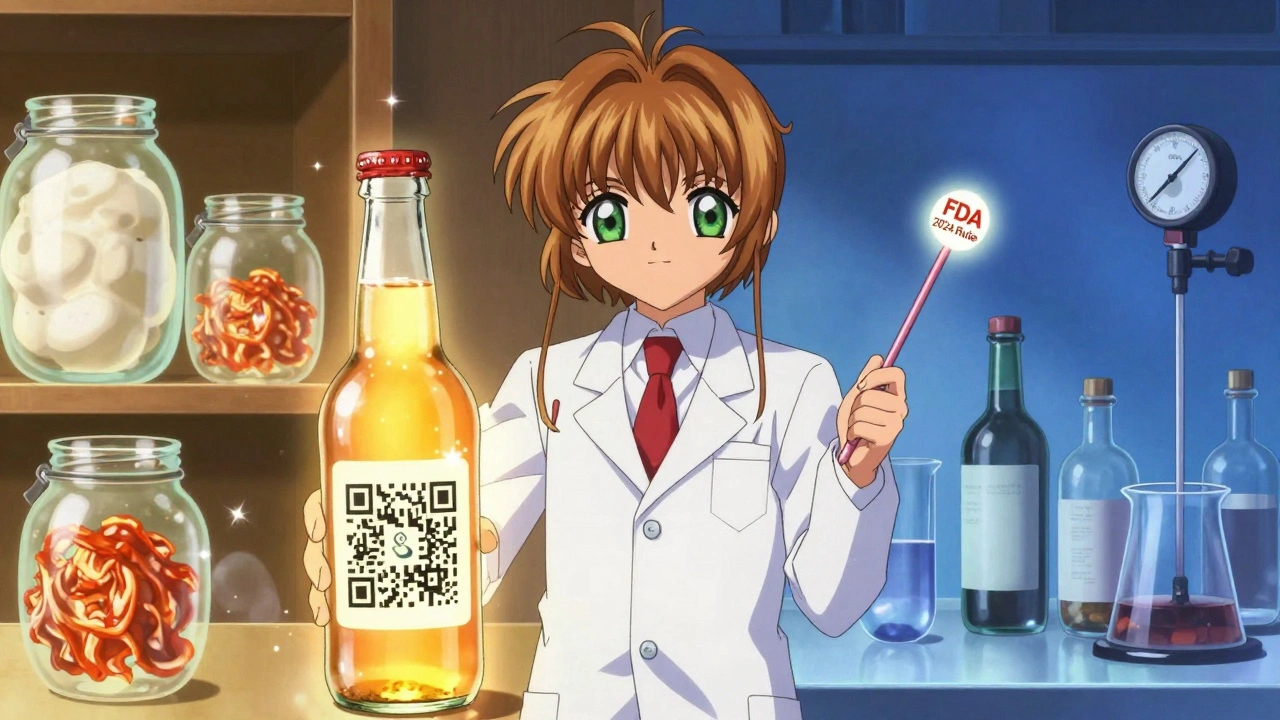
- Look for labels. Starting in January 2024, the FDA requires all commercial kombucha to clearly state "Contains Trace Alcohol." If you don’t see it, don’t buy it.
Some brands are stepping up. Health-Ade launched a "Transparency Project" in February 2024, giving customers QR codes to scan for exact batch alcohol levels. That’s the gold standard. But it’s still rare.
What’s Changing in 2025?
The kombucha market hit $3.2 billion in 2023, and it’s growing fast. But safety concerns are forcing change. The FDA’s 2022 "Hidden Alcohol Sources" initiative led to new labeling rules. The National Institutes of Health just launched a $2.3 million study in March 2024 to better understand these interactions-results are expected in late 2025.
Meanwhile, sales of alcohol-testing equipment for kombucha makers jumped 212% in 2023. More brands are testing every batch. That’s good. But until every bottle clearly warns you, and every pharmacist knows the risk, you need to protect yourself.
Bottom Line
Kombucha isn’t poison. But if you’re on medication, it’s not harmless either. That 0.5% alcohol might seem tiny, but your body doesn’t see it that way when it’s mixed with metronidazole, sertraline, or metformin. The science is clear. The cases are real. The warnings are there-if you know where to look.
Don’t gamble with your health because a drink tastes good. If your meds say "avoid alcohol," skip the kombucha. There are plenty of other probiotic options-like yogurt, kefir, or sauerkraut-that don’t come with hidden alcohol risks.
Can I drink kombucha if I’m on metronidazole?
No. Even small amounts of alcohol in kombucha can cause severe reactions when taken with metronidazole, including nausea, vomiting, flushing, rapid heartbeat, and chest pain. The FDA and American Pharmacists Association warn against combining them. Wait at least 48 hours after your last dose before consuming any kombucha.
Is store-bought kombucha safe if it says "non-alcoholic"?
It’s legally required to have less than 0.5% alcohol, but that’s still alcohol. If your medication warns against alcohol, avoid it. Also, only 63% of brands label it as "Contains Trace Alcohol," so you might not even know you’re drinking it. When in doubt, skip it.
Does kombucha have more alcohol than beer or wine?
Regular kombucha? No-most store-bought versions have less than 0.5% ABV, far below beer (4-6%) or wine (12-15%). But "hard kombucha" (3-8% ABV) is intentionally brewed to be alcoholic and is labeled as such. Homemade kombucha can reach 2.5% ABV, which is close to some light beers. Always check the label and know what you’re drinking.
Can I test my homemade kombucha for alcohol?
Yes, but it’s not easy. You need a specialized tool like an alcoholmeter (e.g., HM Digital HA-520) or a refractometer calibrated for fermented beverages. Simple hydrometers won’t work because kombucha contains sugars and acids that interfere. Most homebrewers don’t test, and even experienced ones need 3-5 batches to get consistent results.
Are there safer alternatives to kombucha for gut health?
Yes. Sauerkraut, kimchi, kefir, yogurt with live cultures, and miso are all excellent probiotic sources without alcohol. Kefir, for example, typically contains 0.2-0.8% ABV-still low, but more predictable than homemade kombucha. If you’re on alcohol-sensitive meds, these are safer bets.
Comments
lol i just drank kombucha with my antibiotics yesterday 🤡 hope i dont die
It’s wild how something so widely marketed as a "health drink" can quietly slip under the radar like this. I’ve been drinking GT’s every morning for years-never even thought about the alcohol content. The fact that 37% of brands don’t even label it properly? That’s not negligence, that’s systemic. I get why companies don’t want to scare people off, but if your medicine says "avoid alcohol," and kombucha has alcohol, then you’re literally playing Russian roulette with your liver. And the homebrew thing? Yeah, I know a guy who made his own and got hospitalized after mixing it with his Zoloft. No joke. It’s not a myth. It’s just not talked about enough.
It is, without question, a profound failure of public health communication that a substance with demonstrable pharmacological interactions-particularly with Class I and Class II CNS-active medications-is permitted to be sold without mandatory, standardized, and legally enforceable labeling. The FDA’s current threshold of 0.5% ABV is archaic, scientifically indefensible in the context of polypharmacy, and morally irresponsible. The fact that pharmacists are unaware of this risk suggests a systemic collapse in continuing medical education. This is not a consumer education issue. It is a regulatory failure of epic proportions.
man i just found out my blood sugar meds cant mix with alcohol and i been drinkin kombucha like water. i thought it was like juice. oof. i’m gonna stop. i dont wanna pass out in front of my kid. lol
0.5% is still alcohol. don’t drink it if you’re on meds.
Thank you for writing this. I’ve been on SSRIs for over a decade, and I never realized kombucha could be a trigger for my brain fog and anxiety spikes. I used to drink it daily because I thought it was "clean" and "natural." I feel silly now, but I’m so glad I found this. I’ve switched to kefir and sauerkraut-same probiotics, zero stress. If you’re on meds and you’re reading this: you’re not alone. It’s okay to pause, reevaluate, and choose safety over trends. Your body will thank you. And if you’re a pharmacist? Please, please, please start asking patients about kombucha. It’s not just a drink. It’s a silent variable in so many treatment plans.
Oh, darling, it’s not just kombucha-it’s the entire wellness industrial complex’s greatest con. You’re being sold a $5 bottle of fermented tea as a panacea while the fine print-hidden in 6-point font-tells you it’s technically an alcoholic beverage. How poetic. We’ve elevated fermentation to a spiritual practice while ignoring basic pharmacology. It’s like drinking a $12 candle and expecting it to cure your depression. The irony is exquisite. I now refer to kombucha as "alcohol in a yoga pants suit."
Interesting. The biochemistry of SCOBY fermentation is, in essence, a microcosm of human agency-yeast as the id, bacteria as the superego, and sugar as the ego’s craving. The trace alcohol? A metaphor for the latent toxicity of modern wellness culture: it’s not the substance, it’s the *illusion* of purity. And yet, we cling to it like a mantra. "Natural" becomes a shield against responsibility. The real question isn’t whether kombucha interacts with meds-it’s whether we’re willing to confront the epistemological laziness that lets us consume without inquiry. 🤔
This is such an important thread. I’m a clinical pharmacist and I had no idea kombucha was even on the radar for interactions until I saw this. We’re taught about wine, beer, and spirits-but nothing about fermented beverages. I’ve started adding a quick checklist to my med reviews: "Any kombucha, kefir, or fermented drinks?" It’s changed how I counsel patients. The FDA’s 2024 labeling rule is a step, but we need mandatory pharmacist education too. This isn’t just about alcohol-it’s about how we define "harmless."
we’re all just trying to be healthy right? but sometimes the thing we think is helping us is secretly sneaking in the back door like a quiet ninja with a tiny bottle of booze. kombucha is that ninja. i used to love it. now i drink ginger tea with lemon. simpler. safer. and no one’s hiding anything. 🍵💛
So now we’re telling Americans they can’t drink their probiotics? This is why we lost the free world. First it was soda, now it’s kombucha? Next they’ll ban yogurt. Wake up people. This is socialism disguised as safety. If you can’t handle 0.5% alcohol, maybe you shouldn’t be on meds. Just sayin’.