
What COPD Stages Really Mean
You’ve been told you have COPD. Maybe it was after a persistent cough, or after getting winded climbing stairs. You’re not alone-over 16 million Americans are diagnosed, and millions more don’t know they have it. But what does it actually mean when your doctor says you’re in mild, moderate, or severe COPD? It’s not just a label. It’s a roadmap for your health.
The Global Initiative for Chronic Obstructive Lung Disease (GOLD) sets the standard for staging COPD. It’s not based on how you feel alone. It’s based on a simple test: spirometry. That’s when you blow into a tube as hard and fast as you can. The machine measures how much air you can force out in one second-your FEV1. That number, compared to what’s normal for someone your age, height, and sex, tells your doctor your stage.
There are four stages. But most people only hear about three: mild, moderate, and severe. The fourth-very severe-is often lumped in with the third. But each stage brings different risks, different symptoms, and different treatments. Ignoring the differences can cost you years of your life.
Mild COPD (Stage 1): The Silent Progression
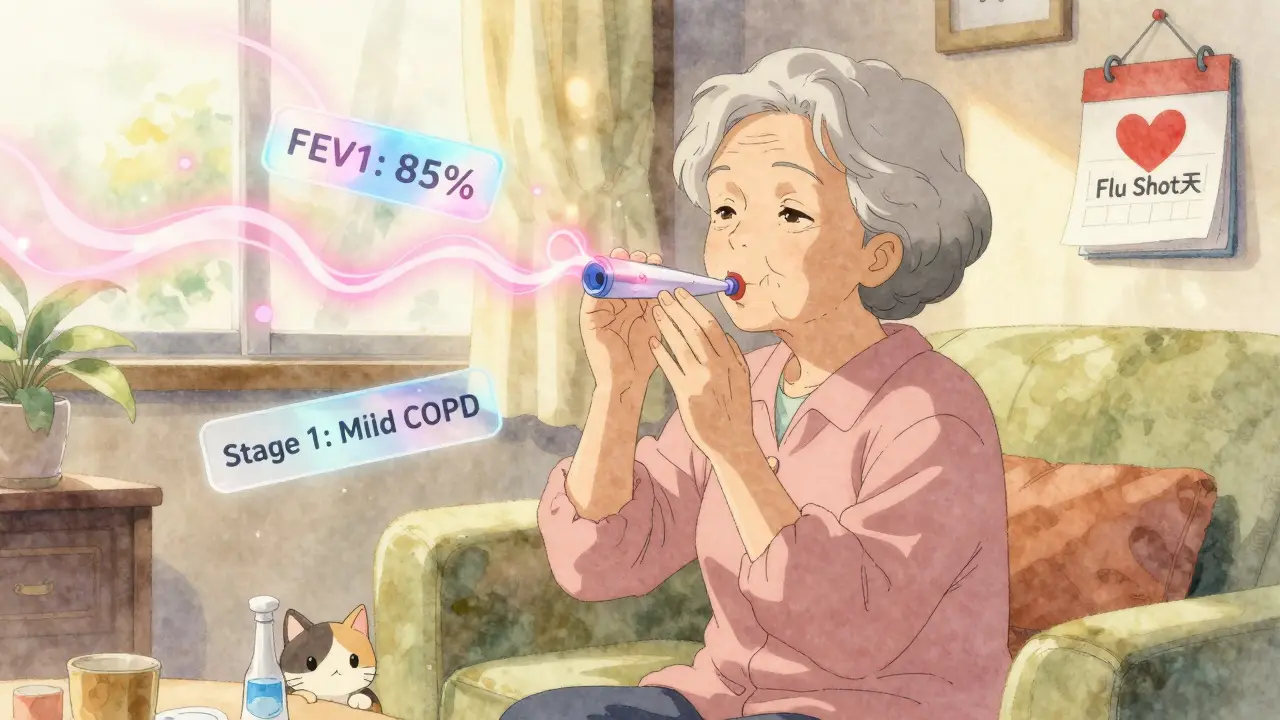
Stage 1 COPD means your FEV1 is 80% or higher of what’s predicted. Sounds fine, right? But here’s the catch: you might not even know you have it.
People in this stage often think their breathlessness is just because they’re out of shape, getting older, or they smoke a little too much. A 2021 study found that 65% of people with Stage 1 COPD only notice shortness of breath when walking fast or climbing a hill. Around 42% have a daily cough with phlegm-but they chalk it up to a "smoker’s cough," not a disease.
That’s the problem. By the time symptoms feel "bad enough" to see a doctor, the damage is already done. The good news? Stage 1 is your best shot at stopping COPD in its tracks.
Quitting smoking right now can cut your lung function decline in half. Smokers lose about 60 mL of lung function per year. Those who quit drop to just 30 mL. That’s not just slowing the disease-it’s nearly halting it. Pulmonary rehab, even just a few weeks, can help you walk farther and breathe easier. And yes, you still need the flu shot. Every year. It cuts your risk of flare-ups by 32%.
Don’t wait for the cough to get worse. If you’re over 40, you smoke or used to smoke, and you get winded doing normal things, get a spirometry test. Most primary care doctors don’t offer it. But you can ask. And if they say no, ask again.
Moderate COPD (Stage 2): The Turning Point
Stage 2 COPD hits when your FEV1 drops to 50-79%. This is where things start to change. You’re not just winded on hills anymore. You’re stopping to catch your breath every few minutes on level ground. You’re coughing more. Your chest feels heavy. You’re avoiding stairs, skipping walks, and canceling plans because you’re too tired.
Here’s what’s critical: Stage 2 is the last stage where you can still make a big difference. This is the point where most people finally get diagnosed-after an average of 5.2 years of ignoring symptoms, according to CDC data. That delay is dangerous.
Treatment shifts here. You’re no longer just using an inhaler when you need it. You’re on long-acting bronchodilators-either LABA or LAMA. These aren’t quick fixes. They’re daily tools to keep your airways open. On average, they improve your FEV1 by 100-150 mL. That might not sound like much, but it means you can walk to the mailbox without stopping. You can carry groceries. You can play with your grandkids.
Pulmonary rehab becomes essential. It’s not just exercise. It’s breathing techniques, nutrition advice, and learning how to manage flare-ups. People who complete rehab increase their 6-minute walk distance by 45 to 75 meters. That’s the difference between needing help to get to the bathroom and doing it on your own.
And don’t ignore the emotional side. A Reddit user in r/COPD shared: "I can’t make coffee without panicking. My FEV1 is 65%. My doctor says I’m ‘only’ moderate. But I feel like I’m drowning." That’s real. Symptoms don’t always match the numbers. Your feelings matter. Your struggle matters. If you’re feeling anxious or depressed, tell your doctor. Mental health is part of COPD care.
Severe COPD (Stage 3): The Point of No Return
Stage 3 COPD means your FEV1 is between 30% and 49%. This is where the disease starts to take over your life.
At this stage, 92% of patients report getting out of breath just getting dressed. Many need to sit down to wash their hair. Oxygen levels drop below 90% during normal activities. You’re not just tired-you’re constantly fighting for air.
Treatment gets more intense. You’re likely on a combination of two long-acting inhalers (LAMA + LABA). If your blood tests show high eosinophils (over 300 cells/μL), you might also get inhaled steroids. That reduces flare-ups by 25%. But steroids aren’t magic. They come with risks-higher chance of pneumonia, bone thinning, cataracts. Your doctor should monitor you closely.
Exacerbations become more frequent. A flare-up means you’re in the hospital. And each one carries a 22% risk of dying within the next year. That’s not a small number. That’s why prevention matters more than ever.
One of the most important tools now is the 6-minute walk test. It’s not fancy. You walk as far as you can in six minutes. It tells your doctor how your body is really holding up-not just your lung numbers. Do it every year. If your distance drops, your treatment needs to change.
And yes, people still dismiss this stage. A patient in the Cleveland Clinic’s registry said: "They keep saying I’m ‘only’ Stage 3. But I can’t walk 20 feet without stopping. I’m not exaggerating. I’m just dying slowly." That’s the gap between numbers and reality. Your experience is valid. Fight for care that matches your life.
Very Severe COPD (Stage 4): Living on Oxygen
Stage 4 is FEV1 under 30%. This is advanced COPD. You’re not just struggling to breathe-you’re surviving on oxygen.
89% of people in this stage need oxygen therapy for more than 15 hours a day. That’s not occasional. That’s constant. You can’t go out without your tank. You can’t sleep without it. You can’t shower without planning. And the cost? Even with Medicare, many pay $287 a month out of pocket. That’s not a luxury. It’s survival.
Non-invasive ventilation (NIV) becomes common. It’s a machine that helps you breathe while you sleep. It reduces hospital readmissions by 28%. But it’s not easy to use. The mask can feel claustrophobic. The noise keeps you awake. But for many, it’s the difference between breathing at night and gasping.
Survival rates drop sharply. Without oxygen, your one-year survival is 73%. With it, it jumps to 90%. That’s the power of consistent therapy. But oxygen alone isn’t enough. You still need medications. You still need rehab. You still need to avoid infections.
And the emotional toll? 44% of Stage 4 patients say social isolation is their biggest challenge. Friends stop visiting because it’s hard to talk. Family feels helpless. You stop going out because you’re afraid of having an attack in public. That’s not just physical. It’s a kind of grief.
There’s no cure. But there are ways to live better. Palliative care isn’t giving up. It’s getting support to manage pain, anxiety, and fatigue. It’s helping you live as fully as you can, even when your lungs are failing.
Why the GOLD System Isn’t Perfect
The GOLD staging system is the best tool we have. But it’s not perfect.
Here’s the problem: your FEV1 doesn’t always match how you feel. About 38% of people classified as "high risk" (GOLD Group D) have only Stage 2 COPD based on lung numbers. But they’re having frequent flare-ups and feel terrible. Their treatment should reflect that-not just their numbers.
And here’s another blind spot: heart disease. Dr. Don Sin’s 2023 study found that 65% of Stage 2 COPD patients also have heart problems. And heart issues cause 40% of COPD deaths. Yet most COPD clinics don’t check your heart. They check your lungs. That’s a gap. You need both.
Also, FEV1 has a "floor effect." Once it drops below 30%, the number doesn’t tell you much more. Two people with FEV1 at 25% and 20% might feel exactly the same. What matters more is how far they can walk, how much oxygen they need, and how often they end up in the hospital.
That’s why new tools are coming. Blood tests for fibrinogen (a marker of inflammation) can predict how fast your lungs will decline. AI is being trained to read spirometry results with fewer errors. And researchers are working on new drugs that target specific inflammation pathways.
But none of that matters if you don’t get tested early.
What You Can Do Right Now
If you have COPD, here’s what to do:
- Get your spirometry done every year. If your doctor won’t order it, ask for a referral to a pulmonologist.
- Quit smoking-today. No exceptions. Even if you’ve smoked for 40 years, quitting now still helps.
- Use your inhalers as prescribed. Not when you feel bad. Every day.
- Do pulmonary rehab. Even if it’s just 6 weeks. It changes your life.
- Get the flu shot and pneumonia vaccine every year.
- Track your symptoms. Keep a journal: when you get winded, how long you rest, what triggers it.
- Ask about oxygen if you’re struggling. Don’t wait until you’re gasping.
- Find support. Online groups, local COPD programs, counseling. You’re not alone.
If you’re at risk-over 40, smoked or live with smoke-get tested. Don’t wait for symptoms to get "bad enough." By then, it’s too late to stop the damage.
Frequently Asked Questions
Can COPD be reversed?
No, COPD cannot be reversed. The damage to your lungs is permanent. But you can slow it down-sometimes dramatically. Quitting smoking, using prescribed inhalers, and doing pulmonary rehab can stop or greatly delay progression. Many people with Stage 1 or 2 COPD live for decades without worsening if they manage it well.
Is COPD the same as asthma?
No. Asthma is usually reversible with medication and often starts in childhood. COPD is progressive, caused mostly by smoking or long-term exposure to irritants, and typically starts after age 40. The airflow blockage in COPD isn’t fully reversible, even with inhalers. Some people have both-called asthma-COPD overlap syndrome-but they need different treatment plans.
How long can you live with severe COPD?
There’s no set timeline. Life expectancy depends on how well you manage it. People with Stage 3 COPD who quit smoking, use oxygen as needed, avoid infections, and stay active can live 10-15 years or more. Those who continue smoking or ignore flare-ups may see their life shortened by 5-8 years. Stage 4 survival drops sharply without oxygen therapy, but with it, many live 5+ years with good quality of life.
Why do I feel fine one day and terrible the next?
COPD symptoms aren’t constant. Flare-ups-called exacerbations-are triggered by infections (like colds or flu), air pollution, cold weather, or even stress. On good days, your body compensates. On bad days, your lungs can’t keep up. That’s why tracking triggers and having an action plan with your doctor is so important.
Should I get a lung transplant?
Lung transplants are rare for COPD and only considered for very severe cases (Stage 4) in younger patients with no other major health problems. It’s a major surgery with lifelong risks-rejection, infection, needing strong immune drugs. Most people manage COPD with medications, oxygen, and lifestyle changes. Transplant is a last resort, not a first option.
Next Steps
If you’re in Stage 1 or 2: focus on stopping progression. Quit smoking. Get pulmonary rehab. Use your inhalers. Get tested annually.
If you’re in Stage 3: focus on preventing flare-ups. Take your combo inhalers. Use oxygen if prescribed. Get the pneumonia shot. Watch for signs of infection-fever, thicker mucus, more coughing-and act fast.
If you’re in Stage 4: focus on comfort and function. Make sure your oxygen is always ready. Talk to your doctor about palliative care. Build a support system. You’re not alone.
Whatever your stage, your life still matters. COPD doesn’t have to be a death sentence. It’s a challenge-but one you can manage, day by day, breath by breath.
Comments
I had Stage 2 for 3 years before I got pulmonary rehab. Honestly? It saved my life. I could barely walk to the fridge before. Now I can take my dog to the park without stopping. Don't wait like I did.
Just do it.
COPD isn't just a lung thing-it's a soul thing. The way your body betrays you, one breath at a time... it's like watching your own ghost fade in slow motion. And yet, here we are-still here, still fighting, still coughing through the silence of a world that thinks "just quit smoking" fixes everything. But no. It's not that simple. It's never that simple.
ok so i just got diagnosed with stage 2 and honestly?? i was terrified. but then i found this subreddit and realized i’m not alone. my doc said "you’re lucky it’s not worse"-like that’s supposed to make me feel better??
but then i started doing the breathing exercises from the video linked here and i swear i felt lighter after one week. not cured. just... less like i’m drowning. thank you to everyone who shared their stuff. you’re heroes.
FEV1 is a metric. Not a life sentence. Biomarkers like fibrinogen, IL-6, CRP-those are the real predictors of progression. Most clinics ignore them. You need a pulmonologist who runs a full inflammatory panel, not just spirometry. Stop letting numbers define your prognosis.
So let me get this straight. You’re telling me I can live longer if I just... breathe right? And do some fancy breathing exercises? And quit smoking? Wow. What a revolutionary idea. Next you’ll tell me water is wet.
I’m 56, Stage 3, oxygen 24/7. I lost my job because I couldn’t keep up. My kids don’t visit much because it’s "too hard." But I still cook dinner every night. I still laugh. I still watch my grandkids play. This disease doesn’t get to take my joy. And if you’re reading this and still smoking? I’m not mad. I’m just saying-I was you. And I wish someone had screamed it into my face: STOP. NOW.
This is why America’s healthcare is broken. You get a test, you get a label, you get a pamphlet. No one tells you how to afford oxygen. No one tells you how to keep your house warm without triggering a flare-up. No one tells you your insurance won’t cover the nebulizer. You’re just supposed to "manage" it. Like it’s a hobby.
I want to thank the author for writing this with such clarity and compassion. Too often, medical information is delivered like a textbook. This reads like a conversation with a friend who’s been there. The emotional honesty about isolation and grief? That’s what helps people feel seen. Please keep sharing these stories.
I’ve been doing pulmonary rehab for 8 months. It’s not glamorous. It’s not a miracle. But it’s the only thing that’s kept me out of the ER. If you think you’re too tired to go, you’re exactly the person who needs to go. Don’t wait for a crisis. Show up before you’re broken.
My dad had Stage 4. He hated the oxygen mask. Said it made him feel like a robot. But he wore it anyway. One night, he whispered to me: "I don’t want to die choking." That’s when I realized-this isn’t about lung numbers. It’s about dignity. We need more of that in care.
In India, we don’t have spirometers in every clinic. Many don’t even know what COPD is. They call it "lung weakness" and give cough syrup. My uncle died at 58 because no one tested him. This post? It’s a lifeline for people who don’t even know they’re drowning.
I’ve been reading every comment here and crying. I thought I was the only one who felt this way. The loneliness is worse than the breathlessness. Thank you for saying it out loud. You’re not alone. I’m here.
stage 3. oxygen at night. still work part time. dont ask me how. i do it. if you think you cant, you can. just start with one step. then another. breathe. repeat.
I’ve read this entire thing. And I’m convinced: COPD is just capitalism’s way of making old people pay for their own deaths. You get a diagnosis, then a bill. A mask, then a debt. A rehab program, then a waiting list. They don’t want you to live. They want you to buy your way out. And the worst part? We’re all still playing along.