

Bringing a medication action plan to your doctor’s visit isn’t just paperwork-it’s a lifeline. Too many people walk into appointments with a bag full of pills, half-remembered doses, and confusion about what they’re supposed to be taking. By the time they leave, nothing’s clearer. But with a simple, filled-out Medication Action Plan (MAP), you turn chaos into control. This isn’t optional for people on multiple meds. It’s essential.
What a Medication Action Plan Actually Is
A Medication Action Plan is a standardized form that lays out exactly what medications you’re taking, why, when, and what to do if things go wrong. It’s not just a list. It’s a living tool used during every visit to catch errors, track changes, and make sure everyone-your pharmacist, your doctor, your family-knows the same story. It’s required under Medicare Part D for patients getting Medication Therapy Management (MTM) services. In Germany, it’s law for anyone taking three or more prescriptions. The CMS1245776 form is the official U.S. template used by pharmacies and clinics. But even if you’re not on Medicare, the same structure works. You can download a free version from the CDC or use one from your pharmacy. The core pieces? They’re simple:- Your name and date
- Every medication-prescription, over-the-counter, vitamins, supplements
- Dose, frequency, and reason for each (e.g., "Lisinopril 10mg once daily for high blood pressure")
- What you’re supposed to do next (action steps)
- What you’ve actually done (adherence tracker)
- Questions you want to ask
- Follow-up plan and provider contact info
Why This Works Better Than Just Telling Your Doctor
People think they remember their meds. They don’t. A 2016 NIH study showed 87.5% of patients using a standardized plan found critical info on the first try. Without it? That number dropped to under 50%. Here’s the real problem: doctors have 15 minutes. They’re juggling charts, insurance codes, and your other conditions. If you say, "I think I’m taking too many pills," they don’t know which ones. But if you hand them a filled-out MAP, they see right away that you’re on two blood pressure drugs that shouldn’t be combined-or that you stopped your statin six months ago but never told anyone. Studies show MAPs cut medication errors by up to 41.7% during care transitions. One patient in Ohio caught a dangerous drug interaction before it landed her in the hospital. That’s not luck. That’s a template.How to Prepare Before Your Visit
Don’t show up with a crumpled piece of paper. Do this the night before:- Collect every pill bottle-prescription, OTC, supplements. Don’t trust your memory.
- Write down the name, dose, and reason for each. Use both brand and generic names. Example: "Lipitor (atorvastatin) 20mg, for cholesterol."
- Cross out any meds you stopped. Write the date you stopped and why. "Stopped metformin on 12/1/2025-doctor said no longer needed."
- Fill out the "What I did and when I did it" section. Did you miss doses? Skip weekends? Take extra when you felt bad? Write it down. Honesty here saves lives.
- Write down 2-3 questions you want to ask. "Should I still take this painkiller with my new heart med?" "What happens if I forget my blood pressure pill?"
What Happens During the Visit
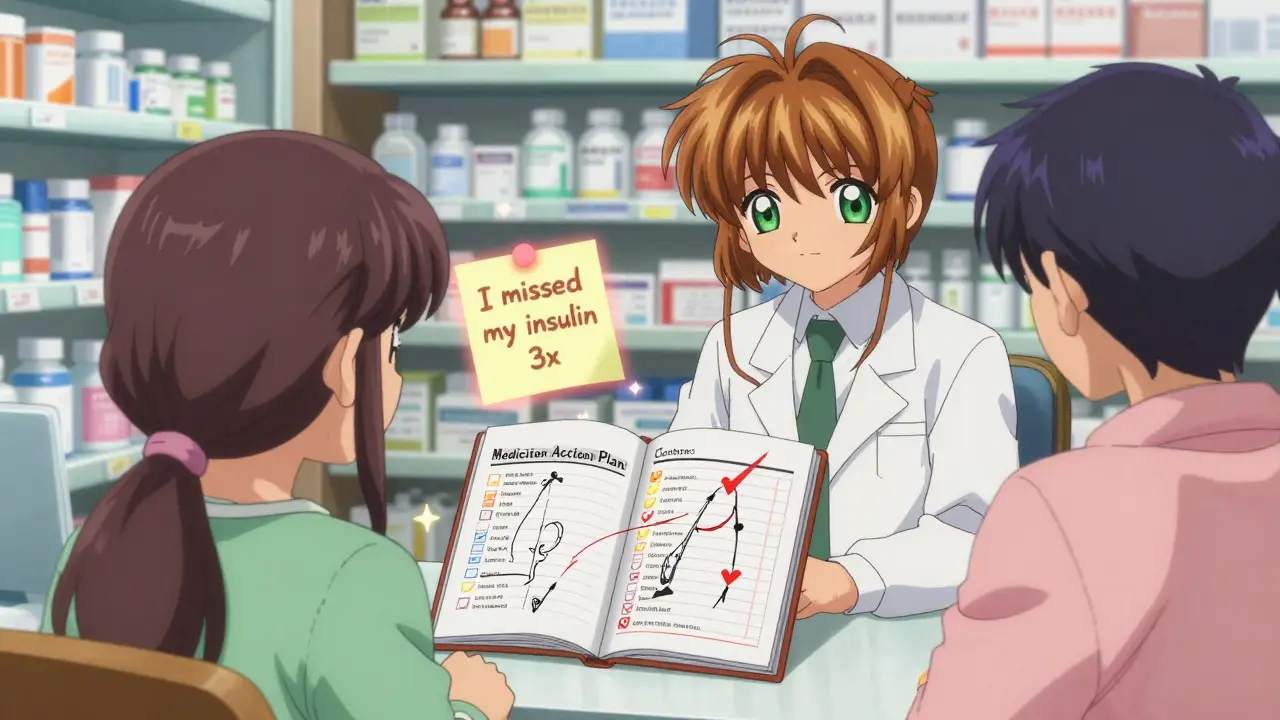
The first 5-7 minutes should be spent reviewing the MAP. Don’t let your provider skip this. Say: "I brought my action plan. Can we go through it together?" Your provider should:- Check for duplicates or dangerous combinations
- Confirm why each med is still needed
- Update the plan right then-cross out discontinued meds, add new ones with start dates
- Ask about the "What I did" section. "You said you missed your insulin three times last week. What happened?"
- Document exact discontinuation dates-not just "a few months ago." CMS requires the exact date.
What Makes a Good Action Plan
Not all templates are equal. The best ones have clear, specific instructions. Bad: "Take metformin as directed." Good: "Take metformin 500mg with breakfast and dinner. If you skip a meal, skip the dose." Bad: "Call if you feel dizzy." Good: "If you feel dizzy more than twice a week, or if you faint, call your doctor within 24 hours. Don’t drive." The Burlington, NC template even includes symptom-based instructions: "If Sally has a rash and is scratching it, apply this ointment. Wait at least 6 hours before reapplying." This level of detail reduces confusion. It’s not just about taking pills-it’s about knowing when, why, and what to do if something’s wrong.After the Visit: Keep It Alive
The MAP is useless if it sits in a drawer.- Get a signed copy from your provider. Keep it with your other medical records.
- Give a copy to a family member or caregiver. If you’re hospitalized or have an emergency, they can hand it to staff immediately.
- Update it after every pharmacy visit, ER trip, or specialist appointment.
- If you get a new prescription, write it in right away-even if it’s just a sticky note on the form until you can rewrite it.

Common Mistakes and How to Avoid Them
Most failures aren’t because the template doesn’t work. They’re because people use it wrong.- Mistake: Not writing down when you stopped a med. Solution: Always note the exact date and reason. This is the #1 cause of reconciliation errors.
- Mistake: Using vague language. Solution: Replace "as needed" with "take only if your pain is above a 6 on a scale of 1-10."
- Mistake: Keeping it digital-only. Solution: 68.3% of patients over 65 prefer paper. Print it. Laminate it. Keep it in your wallet.
- Mistake: Not sharing it. Solution: Give copies to your pharmacy, your primary doctor, your specialist, and your caregiver. The NIH found patients who shared their MAP had 22.8% fewer duplicate prescriptions.
What If Your Provider Doesn’t Use It?
You’re still in charge. You can bring the template. You can ask them to use it. You can even print a blank one from the CDC website and say: "I’ve been using this to stay on track. Can you help me fill it out today?" Many clinics still don’t integrate MAPs into their electronic records. But that doesn’t mean you can’t use it yourself. In fact, patients who insist on using their own MAPs report fewer errors and better communication. The American College of Clinical Pharmacy says the MAP should be treated as a living document-not a one-time form. If your provider resists, say: "I want to make sure I’m safe. Can we use this to avoid mistakes?"Final Thought: This Isn’t Just for Seniors
You don’t have to be 70 to need this. If you take three or more medications, you’re at risk. If you’ve been hospitalized recently. If you’ve had a change in your health. If you’re caring for someone else. The data is clear: MAPs reduce hospitalizations, prevent overdoses, and cut down on dangerous drug interactions. They don’t require fancy tech. Just a piece of paper, honesty, and the courage to ask: "Did I get this right?" Start today. Print a template. Fill it out. Bring it next time. You’re not just handing over a form. You’re handing over your safety.Do I need a Medication Action Plan if I only take one or two pills?
Even if you’re on just one or two medications, a Medication Action Plan helps you track changes, avoid interactions, and communicate clearly with providers. If you’ve had recent health changes, started a new drug, or are seeing multiple doctors, the plan gives you control. It’s not just for people on ten meds-it’s for anyone who wants to avoid mistakes.
Can I use a digital version instead of paper?
Yes, but paper is still the most reliable. Many older adults and people with limited tech access prefer physical copies. Digital apps can sync with your pharmacy, but they often don’t include the critical "What I did" and "Questions I want to ask" sections. If you use a digital version, make sure it allows you to print a clean copy for visits. Always bring a printed backup.
What if I forget to bring my Medication Action Plan to my appointment?
Don’t skip the visit. Bring your pill bottles and write down everything you can: names, doses, times, reasons. Even a rough list is better than nothing. Ask your provider to help you fill out the plan during the visit. Then, take it home and update it properly afterward. The goal is to make it a habit-not to be perfect every time.
Who can help me fill out a Medication Action Plan?
Your pharmacist is your best ally. Most community pharmacies offer free Medication Therapy Management (MTM) sessions where they’ll review your meds and help you complete the plan. Your primary care provider, nurse, or care coordinator can also help. If you’re on Medicare, you’re entitled to a free Comprehensive Medication Review-ask for it.
How often should I update my Medication Action Plan?
Update it after every change: new prescription, stopped med, dose change, side effect, or hospital visit. Even if you don’t have an appointment, write the change on the form right away. Revisit and rewrite the whole plan every 3-6 months, or whenever you see a new provider. Treat it like your medical GPS-it needs constant updates to guide you safely.

Comments
So let me get this straight... the government wants us to fill out a paper form so doctors don't kill us with bad prescriptions? 🤔 I bet the real plan is to track us. Next they'll embed a chip in the template. 🧪💊 #MedicareMindControl
This is why America still leads the world in healthcare. You people in other countries are still using sticky notes and hope. I saw a guy in Germany with a MAP and he looked like a NASA engineer. That's the difference. We don't wing it here. We document. We standardize. We WIN.
I tried this after my mom had a bad reaction to her new blood pressure med. I filled out the MAP with her, wrote down when she missed doses (oops, forgot 3x last week), and brought it to the doc. They actually paused and said 'wow, this is the first time someone's come in with this.' Saved her from a hospital trip. 🙌
In my village in Kenya, we just tell the nurse what we take. But I brought my MAP to my US clinic last month and the pharmacist cried. Said she'd never seen one so complete. I'm proud. 🇰🇪❤️🇺🇸
I just started taking 4 meds after my stroke and I was terrified. I printed the CDC template, sat with my daughter, and filled it out together. We even added a little doodle of a heart next to my insulin. Now I feel like I'm in charge. Not the pills.
I don't need a form. I remember my meds. I'm not some old lady. My doctor just rolled his eyes and said 'cool' when I handed him my napkin with scribbles. He didn't even look at it. Why are we doing this again?
This whole thing is a scam. They want you to think you're safe so you stop asking questions. That 'action plan'? It's just a form to make them look good. Meanwhile, your insurance is still denying your refills. You're not in control. You're just filling out paperwork for their liability.
I printed the CDC template... I filled it out... I brought it... and my doctor said 'We don't use that here.' I asked again. She said 'We have our own system.' I said 'But your system doesn't include the 'what I did' section!' She sighed and said 'You're too much.' I'm too much? I'm alive because I'm too much.
Wow. A paper form. In 2025. What's next? Faxing your prescriptions? I use an app that auto-syncs with my pharmacy, sends alerts, and flags interactions. This? This is like using a rotary phone to call 911.
In India, we have a tradition called 'dawa ki kahani' - the story of the medicine. We tell it to our families. This MAP is just that - written down. I showed my father's MAP to his new doctor in Chicago. The doctor said, 'This is better than our EHR.' I smiled. Sometimes the old ways are the smartest.
I'm not doing this. My meds are simple. I take one pill. Why make it a project?
I tried the MAP thing once. Got halfway through and just gave up. Too much writing. My wife said I'm lazy. Maybe I am. But I'm also not a nurse.
The entire premise of this article is predicated on a flawed assumption: that patients are rational actors capable of accurately self-reporting adherence. The data cited is cherry-picked from studies funded by pharmaceutical interest groups. The real issue is systemic fragmentation of care - not a lack of paper. This template is a Band-Aid on a hemorrhage.
I used to use this. Then I realized my doctor never looked at it. My daughter had to call and ask if they'd reviewed it. They said 'Oh, we just scan it.' Scanned. Not read. So now I just bring the bottles. Less paperwork. More silence.
This isn't about medicine. It's about control. The state wants you to believe that if you fill out this form, you're not a victim. But you are. You're a data point in a system that profits from your confusion. The MAP gives you the illusion of agency. The truth? You're still just a patient.