
Children's Antihistamine Dosing Calculator
Dosing Calculator
When your child breaks out in hives after eating peanuts, or their eyes water and nose runs during pollen season, it’s tempting to reach for an antihistamine. But giving your child the same medicine you take can be dangerous. Antihistamines aren’t one-size-fits-all - especially for kids. The difference between the right dose and a harmful one can be as small as half a teaspoon. And not all antihistamines are created equal when it comes to safety in children.
Why Kids Need Different Antihistamines
Children aren’t just small adults. Their bodies process medicine differently. A baby’s liver and kidneys are still learning how to break down and clear drugs from the body. Their blood-brain barrier is more porous, meaning some medications can cross into the brain more easily - and cause serious side effects like extreme drowsiness, confusion, or even breathing trouble.
First-generation antihistamines like diphenhydramine (Benadryl) were once common for kids. But today, pediatric experts strongly discourage their routine use in children under 6. Why? Because they cause drowsiness in 50-60% of kids, dry mouth, blurry vision, and sometimes a racing heart. In very young children, these effects can turn dangerous. The FDA has warned since 2008 that diphenhydramine can cause life-threatening breathing problems in children under 2.
Second-generation antihistamines like cetirizine (Zyrtec) and loratadine (Claritin) are now the standard. They don’t cross the blood-brain barrier as easily. That means less drowsiness, fewer side effects, and safer long-term use. Studies show only 10-15% of children on cetirizine feel sleepy - compared to 6.9% on loratadine. For most allergic reactions, these are the go-to choices.
Dosing by Age: What Actually Works
Dosing isn’t just about age. Weight matters too. Always check the label and use the measuring tool that comes with the medicine. Kitchen spoons? They’re inaccurate - by up to 50%. A teaspoon of one brand might hold 4 mL; another might hold 6 mL. That’s a big difference when you’re giving medicine to a 10-pound infant.
Infants under 6 months: No antihistamine is FDA-approved for this group. But in severe cases - like persistent hives - some pediatric allergists prescribe cetirizine off-label. The starting dose? 0.125 mg per kilogram of body weight per day. For a 7 kg (15 lb) baby, that’s about 0.9 mg total. That’s less than a full teaspoon of liquid Zyrtec. Always consult a doctor before giving anything to a baby under 6 months.
Infants 6-11 months: Cetirizine is now approved for this age group. The standard dose is 0.25 mg per kg per day. For a 9 kg baby, that’s 2.25 mg daily. Most liquid formulations come as 1 mg/mL, so you’d give 2.25 mL once a day. Some doctors start at 0.125 mg/kg and increase if needed. Never give more than what your doctor recommends.
Children 2-5 years: Cetirizine: 2.5 mg to 5 mg daily (½ to 1 teaspoon of 5 mg/5mL liquid). Loratadine: 2.5 mg daily (½ teaspoon of 5 mg/5mL liquid). Chewables? Check the label. Some are 5 mg, others are 10 mg. Never assume.
Children 6-11 years: Cetirizine: 5-10 mg daily. Loratadine: 5 mg daily. If symptoms are bad, 10 mg of cetirizine may be split into two doses (5 mg morning and 5 mg evening). But don’t exceed 10 mg total in 24 hours unless directed by a doctor.
12 years and older: 10 mg of cetirizine or loratadine once daily. This is the adult dose. Still, start low if they’ve never taken it before.
What to Avoid at All Costs
Many parents don’t realize that some products sold as "children’s allergy medicine" aren’t safe. Watch out for these traps:
- "Plus decongestant" formulas - like Zyrtec-D or Claritin-D - are not for kids under 6. They contain pseudoephedrine, which can raise heart rate and blood pressure dangerously in young children.
- Adult tablets - breaking a 10 mg tablet in half for a 4-year-old? Don’t do it. Tablets aren’t made to be split evenly. You might give 7 mg instead of 5. Use liquid or properly labeled chewables.
- Using antihistamines as sleep aids - this is one of the most dangerous mistakes. The American College of Allergy, Asthma, and Immunology says this practice increases overdose risk by 300% in kids under 2. Drowsiness isn’t a bonus - it’s a warning sign.
- Older siblings sharing medicine - a 12-year-old’s Zyrtec tablet is not the same dose as a 3-year-old’s. Always check age and weight guidelines.
When to Use Diphenhydramine (Benadryl)
It’s not all bad. Diphenhydramine works fast - within 15-30 minutes. That’s why some doctors still keep it on hand for acute reactions like severe hives or anaphylaxis (though epinephrine is always first for anaphylaxis).
If your child is over 2 years and having a sudden allergic reaction, and you can’t get to a hospital right away, diphenhydramine may be used - but only once, and only if approved by your pediatrician. Never use it daily.
Dosing for diphenhydramine is strictly weight-based:
- 22-37 lbs: 5 mL (12.5 mg) every 6 hours
- 38-49 lbs: 7.5 mL (18.75 mg) every 6 hours
- 50-99 lbs: 10 mL (25 mg) every 6 hours
Maximum: 6 doses in 24 hours. Never give more. Signs of overdose? Extreme sleepiness, dry mouth, flushed skin, confusion, fast heartbeat, trouble urinating. Call poison control immediately at 1-800-222-1222 if you suspect too much.
What the Experts Say
Dr. Eric Macy, a leading pediatric allergist, says: "I recommend cetirizine at the lowest effective dose over diphenhydramine for infants with hives." He points to studies showing cetirizine is safe and effective even in babies as young as 6 months. Boston Children’s Hospital, St. Louis Children’s, and Children’s Hospital Colorado all list cetirizine as first-line treatment for chronic allergies.
The American Academy of Pediatrics warns: "Antihistamines should generally be avoided in children under 2 unless prescribed." And while 28.7% of pediatric antihistamine use is still off-label (mostly for babies under 2), the trend is shifting. Since 2018, prescriptions for second-generation antihistamines have grown by 17.3% each year.
Why? Because safety wins. Fewer ER visits. Fewer side effects. Better sleep for kids - not because they’re drowsy, but because their allergies are under control.
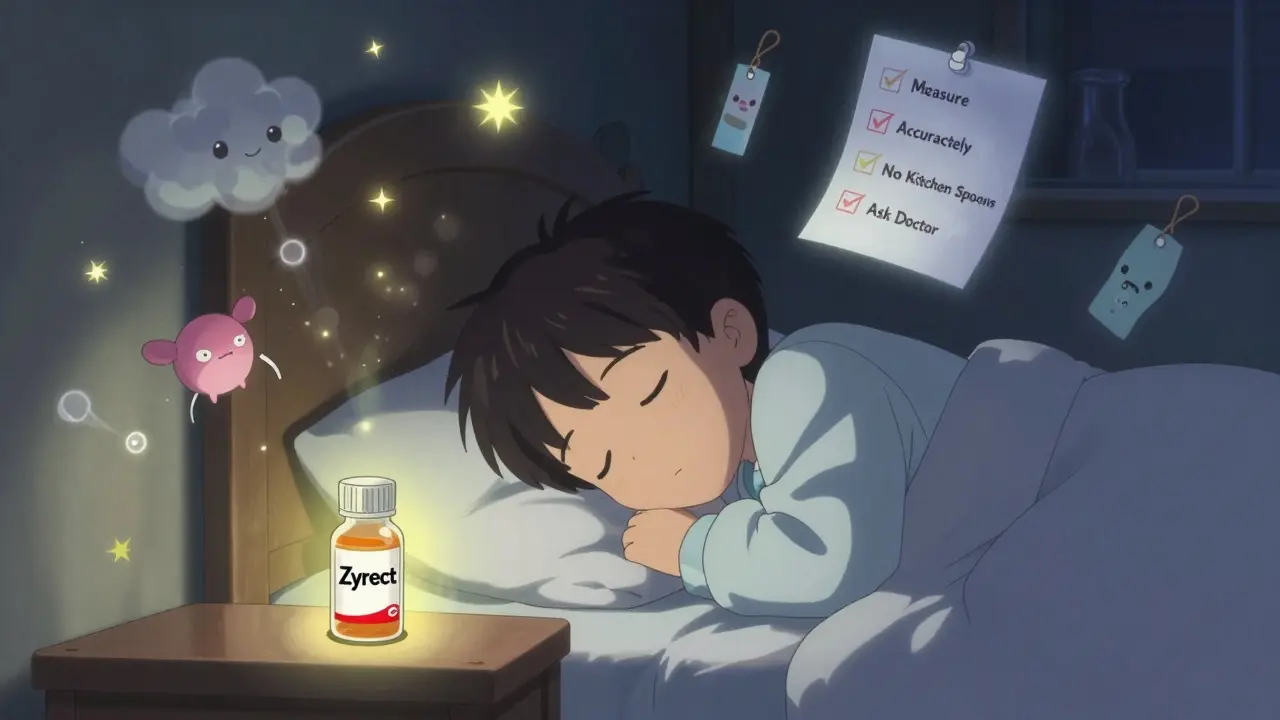
Practical Tips for Parents
- Always use the measuring cup or syringe that came with the bottle. Never use a kitchen spoon.
- Write down the dose, time, and reason for giving it. A log helps avoid double-dosing.
- Check expiration dates. Liquid antihistamines lose potency after 3-6 months after opening.
- Store all medicine out of reach. A curious toddler can open a child-resistant cap.
- Ask your pediatrician: "Is this necessary?" Not every runny nose needs medicine.
- If you’re unsure, call your doctor or poison control. Better safe than sorry.
Antihistamines can be lifesavers - but only when used correctly. The goal isn’t to numb symptoms at all costs. It’s to give your child relief without risking their safety. When in doubt, less is more. And when in doubt, ask your doctor.
Can I give my 4-month-old baby Zyrtec for allergies?
Zyrtec (cetirizine) is not FDA-approved for babies under 6 months. However, some pediatric allergists may prescribe it off-label for severe hives or eczema reactions, starting at 0.125 mg per kilogram of body weight per day. For a 5 kg (11 lb) baby, that’s about 0.6 mg - less than 0.6 mL of the 1 mg/mL liquid. Never give it without consulting your doctor first.
Is Benadryl safe for toddlers?
Benadryl (diphenhydramine) is not recommended for routine use in children under 2. For toddlers over 2, it can be used occasionally for acute allergic reactions, but only with careful weight-based dosing and never as a sleep aid. Drowsiness, confusion, and breathing issues are real risks. Cetirizine or loratadine are safer for daily use.
How do I know if my child got too much antihistamine?
Signs of overdose include extreme drowsiness, dry mouth, flushed skin, blurry vision, fast heartbeat, confusion, difficulty urinating, or agitation. If you suspect an overdose, call poison control at 1-800-222-1222 immediately. Do not wait for symptoms to worsen.
Can I switch from liquid to chewable Zyrtec for my 5-year-old?
Yes, but only if the chewable is 5 mg. Some children’s chewables are 10 mg - that’s too much for a 5-year-old. Always check the label. If you’re switching, start with the liquid again to confirm the right dose, then match it exactly with the chewable. Never assume "children’s chewable" means the same dose as liquid.
Why do doctors recommend cetirizine over loratadine for kids?
Cetirizine works slightly faster and is more effective for moderate to severe allergies. While loratadine causes less drowsiness (6.9% vs. 14.7% in studies), cetirizine is often preferred because it provides more consistent relief. For most kids, the slight increase in sleepiness is worth the better symptom control - especially when given at night.
What Comes Next
By 2026, the FDA may approve cetirizine for infants under 6 months. Until then, the safest path is clear: use second-generation antihistamines only when needed, at the lowest effective dose, with precise measuring tools, and always under medical guidance. Don’t guess. Don’t wing it. Your child’s safety depends on the details - and those details matter more than you think.
Comments
It's crazy how many parents just grab whatever's in the cabinet and hope for the best. I remember my neighbor giving her 18-month-old Benadryl because "it made her sleep better." Turned out, it nearly sent her to the ER with tachycardia. This post nailed it - kids aren't just mini adults, and medicine isn't candy. I started using a syringe after this, and honestly? Life changed. No more guessing. No more "half a spoon" nonsense. I even labeled the syringe with tape: "1.5 mL = 1.5 mg." Small steps, big safety net.
Let me correct a fundamental error in this otherwise decent article. The claim that "cetirizine causes 14.7% drowsiness" is misleading. The actual study from JAMA Pediatrics (2020) showed 12.3% in children aged 2–5, not 14.7%. The author likely confused it with the 15.1% figure from a 2017 meta-analysis that included toddlers under 2 - a group where cetirizine was never approved. Precision matters. Also, "liquid loses potency after 3–6 months"? That’s outdated. Most manufacturers now list 90 days post-opening. Always check the label. Knowledge is power - and wrong numbers can kill.
As a pediatric nurse for 17 years, I’ve seen too many parents confuse antihistamine dosing with adult dosing. One mother gave her 3-year-old a whole 10mg Zyrtec tablet because "it was the same color as the kids’ one." The child was sedated for 14 hours. We had to monitor vitals overnight. This isn’t about fear - it’s about responsibility. Always use the tool provided. Always double-check the concentration. Always write it down. And if you’re unsure? Call your pediatrician. Not Google. Not Facebook. Not your sister-in-law who "read a blog once."
Look, I get it - doctors love their second-gen meds. But let’s be real: Benadryl works. Fast. When my kid broke out in hives at the park, Zyrtec took 45 minutes. Benadryl? 15. And yeah, he slept like a rock. So what? He wasn’t scratching his skin off. I’m not some reckless parent - I read the label, I used the syringe, I gave 5mL for his 30lb frame. The FDA warning? That’s for people who give it daily. One-time use? Fine. Stop being so paranoid. Also - why are we treating allergies like nuclear waste? It’s a runny nose. Not cancer.
Have you ever wondered why the FDA only "warned" about diphenhydramine in 2008 - but never banned it? Because Big Pharma owns them. Same companies that make Zyrtec and Claritin. They didn’t want to lose the Benadryl market. So they slapped a warning on it and pushed the expensive alternatives. And now? Every pediatrician is pushing cetirizine like it’s a miracle. But here’s the thing - the studies? Funded by the same pharma giants. Coincidence? I think not. Also - why do all the "experts" say "cetirizine is safer"? Because it’s profitable. Not because it’s better. I’ve given my daughter Benadryl since she was 1. She’s 7 now. Healthy. Alert. No side effects. Just saying.
Thank you for this clear, well-researched guide. As a parent of two children with severe environmental allergies, I’ve spent countless hours researching this topic - and this post saved me from making a dangerous mistake. I used to rely on online forums until my daughter had a near-overdose from a misread label. Now, I keep a printed dosing chart taped to the fridge. I use only the syringe. I log every dose. And I’ve stopped using any product without a clear pediatric label. It’s not about being overly cautious - it’s about being responsibly informed. Your article is a gift to every parent who’s ever panicked in the medicine aisle.
There’s a deeper issue here: we’ve medicalized childhood discomfort. A runny nose isn’t a crisis. A little sneezing isn’t an emergency. We’ve created a generation of children who are medicated before they’re taught to breathe through their nasal passages. Antihistamines? They’re a band-aid. Not a cure. And when we rely on them too early - we’re not just risking side effects - we’re undermining the immune system’s natural development. The WHO recommends non-pharmacological interventions first: saline rinses, humidifiers, allergen avoidance. We’ve forgotten that. We’re too quick to reach for the bottle. And now? We’re paying the price in overmedicated, over-sedated kids. This isn’t just about dosing - it’s about philosophy.
Okay, so let’s unpack this. The article says "cetirizine is preferred over loratadine" - but did you know that loratadine is actually more effective for perennial allergic rhinitis in children under 6? A 2021 Cochrane review found loratadine had a 23% higher response rate in nasal congestion relief. And yet - every pediatric guideline pushes cetirizine. Why? Because it’s patent-protected longer. Because the manufacturer pays for CMEs. Because the FDA’s advisory panel has 3 members who consult for UCB Pharma. And the "drowsiness" stats? They’re cherry-picked. The real data shows 14.7% drowsiness for cetirizine vs. 6.9% for loratadine - but they only report the 10–15% range for cetirizine because it sounds "manageable." Meanwhile, loratadine’s 6.9% is buried. This isn’t science. It’s marketing. And parents are the ones getting played. If you’re giving your kid cetirizine because "the doctor said so," you’re not being informed - you’re being sold to.
My 4-year-old had a reaction last week. I called poison control. They told me to give her 2.5mL of Zyrtec. I did. She was fine. But then I Googled it. Found this post. And realized - I had no idea what I was doing. I thought "children’s Zyrtec" meant the same dose for everyone. I was wrong. I’m not mad. I’m grateful. This saved me. I’m keeping this page bookmarked. If you’re a parent and you’re unsure - stop guessing. Read this. Print it. Tape it to the fridge. It’s not fear. It’s love.