
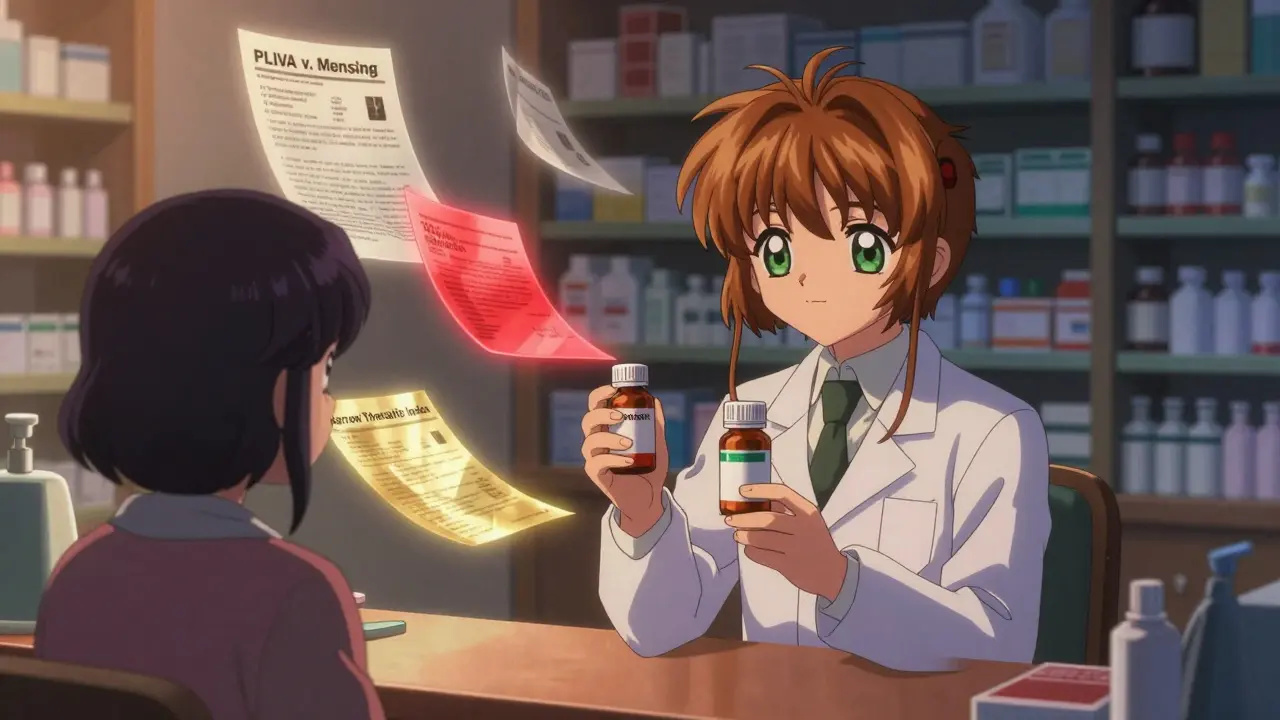
When a pharmacist swaps a brand-name drug for a generic version, they’re not just saving money-they’re stepping into a legal gray zone. In 2025, over 90% of prescriptions in the U.S. are filled with generics. That’s good for the system, but it’s not always safe for the patient. And when something goes wrong, the pharmacist is often the one left holding the bag.
Why Generic Substitution Isn’t Just a Simple Swap
Generic drugs are cheaper because they don’t repeat the expensive clinical trials brand-name drugs go through. Instead, they prove they’re bioequivalent-meaning they deliver the same active ingredient at the same rate and amount as the original. The FDA says that’s enough. But bioequivalence doesn’t always mean therapeutic equivalence. Take levothyroxine, the drug used to treat hypothyroidism. Two generics might both meet FDA bioequivalence standards-80% to 125% of the brand’s absorption rate. But if a patient switches between two generics with slightly different fillers or coatings, their thyroid levels can swing dangerously. One patient might go from feeling fine to exhausted, depressed, and heart-racing. And they won’t know why. The problem isn’t the drugs. It’s the system. Federal law, as decided by the Supreme Court in PLIVA v. Mensing (2011), says generic manufacturers can’t change their labels. Even if new safety data emerges, they must keep the same warning as the brand-name version. That means if a patient has a bad reaction, they can’t sue the generic maker. And because the brand-name company didn’t make the drug they took, they can’t be sued either. The patient has no legal recourse.State Laws Vary-And So Does Your Risk
You might think the rules are the same everywhere. They’re not. There are 50 states, each with its own rules on when you must substitute, when you can, and whether the patient has to agree. In 27 states, pharmacists are required to substitute unless the doctor says no. In 23, it’s optional. In 18 states, you must tell the patient directly-not just rely on the label. In 32 states, the patient can refuse substitution. And here’s the kicker: in 23 states, pharmacists have no legal protection. If a patient has a bad reaction after a generic swap, you could be sued for negligence-even if you followed every rule. States like California and Texas give pharmacists clear protection from liability if they follow substitution laws. In Connecticut and Massachusetts, they don’t. A 2019 study from the National Community Pharmacists Association found pharmacies in states with strong protections had 32% fewer malpractice claims tied to substitution. In states without them? 27% more claims.The Real Danger Zone: Narrow Therapeutic Index Drugs
Not all drugs are created equal. Some have a wide safety margin. Take statins or metformin. Even if absorption varies a bit, it rarely causes harm. But for drugs with a narrow therapeutic index-where the difference between a therapeutic dose and a toxic one is tiny-the risk jumps. These include:- Warfarin (blood thinner)
- Levothyroxine (thyroid hormone)
- Phenytoin, carbamazepine, and valproate (antiepileptics)
- Lithium (mood stabilizer)

What You Can Do: A Practical Risk-Reduction Plan
You can’t control federal law. But you can control how you practice. Here’s how to reduce your risk right now:- Know your state’s laws. They change. The National Association of Boards of Pharmacy updates its compendium annually. Bookmark it. Don’t rely on memory.
- Use EHR alerts. Set up your electronic health record to flag narrow therapeutic index drugs. When a prescription for levothyroxine or warfarin comes in, the system should remind you: “Check for substitution consent.”
- Get written consent. Even if your state doesn’t require it, do it anyway. Use a simple form: “I understand this prescription may be switched to a generic version. I’ve been told the risks. I agree.” Have the patient sign it. Keep a copy.
- Communicate with prescribers. If you’re unsure, call the doctor. Say: “I’m concerned about switching this patient’s antiepileptic. Do you want to specify ‘Dispense as Written’?” Most will appreciate the caution.
- Log every substitution. Write down the brand name, generic name, lot number, and date. If something goes wrong, you need to trace it. Batch numbers matter.
- Train your staff. Technicians often handle substitutions. Make sure they know which drugs are high-risk and when to escalate.
- Review your insurance. Standard malpractice policies may not cover substitution-related claims. Ask your insurer: “Does my policy explicitly cover liability from generic drug substitution?” If not, upgrade.
Patients Don’t Know What’s Happening
A 2021 survey by the Patient Advocacy Foundation found 41% of patients didn’t realize their medication had been switched until they felt worse. In 28% of cases, pharmacists didn’t give the legally required notification. Patients assume the drug they get is identical. They’re not wrong-on paper. But in practice? They’re being treated like a variable in a cost-cutting equation. On Reddit, a thread about generic levothyroxine had over 4,000 upvotes. People shared stories of fatigue, weight gain, brain fog-symptoms that disappeared only when they switched back to the brand. One wrote: “My doctor said the generic was ‘the same.’ But my body knew the difference.”
The Bigger Picture: A Broken System
The current system saves the U.S. healthcare system over $1.6 trillion a decade. That’s huge. But it’s built on a legal loophole that leaves patients without recourse and pharmacists exposed. Experts like Dr. Aaron Kesselheim at Harvard call it “unfair.” The patient who gets the brand-name drug can sue if it’s defective. The one who gets the generic? No legal path. That’s not just a policy gap-it’s a moral one. States are starting to respond. In 2023, 11 states introduced the “Generic Drug Safety Act,” which would require generic manufacturers to update labels within 60 days of new safety data. The FDA is running a pilot program to let generics request label changes. But progress is slow.What’s Next?
Biosimilars-generic versions of biologic drugs like Humira or Enbrel-are coming fast. 45 states already allow substitution. But these drugs are more complex. Their manufacturing process affects how they work. The same liability gaps will follow. The long-term fix? A centralized labeling system where all manufacturers-brand and generic-use the same, updated safety information. It’s been proposed. It’s being piloted in five states. It’s the only way to balance cost savings with patient safety. Until then, your best defense is knowledge, documentation, and caution. Don’t assume a generic is always safe. Don’t assume the patient knows. And don’t assume the law will protect you.Frequently Asked Questions
Can I be sued for substituting a generic drug?
Yes, depending on your state. In 23 states, pharmacists have no legal protection from liability if a patient has a bad reaction after a generic substitution-even if you followed all state rules. In states with strong protections, like California or Texas, you’re shielded as long as you comply with substitution laws. Always check your state’s current pharmacy practice act.
Do I have to tell the patient when I substitute a drug?
In 18 states, you’re legally required to notify the patient directly, not just rely on the label. Even in states where it’s not required, it’s a best practice. Many patients don’t realize their medication changed until they feel side effects. A simple, “This is a generic version of your usual brand. It’s cheaper and FDA-approved, but let me know if you feel different,” can prevent panic-and lawsuits.
Which drugs are too risky to substitute?
Avoid substituting drugs with a narrow therapeutic index: warfarin, levothyroxine, phenytoin, carbamazepine, valproate, and lithium. Studies show higher rates of therapeutic failure and adverse events with substitutions in these classes. Many pharmacists refuse to substitute these even when allowed by law.
What if the patient insists on the generic?
You still have a duty to warn. If it’s a high-risk drug, explain the potential risks-even if they want the cheaper option. Document their request and your warning. If they still want it, get written consent. Never assume consent because they asked for it.
Can I refuse to substitute a drug even if the law allows it?
Yes. Pharmacists have professional discretion. If you believe substitution poses a safety risk-especially with narrow therapeutic index drugs-you can refuse. Document your reasoning and offer to contact the prescriber. Many doctors will support your decision.
Is my malpractice insurance enough?
Many standard policies exclude or limit coverage for substitution-related claims. Call your insurer and ask: “Does my policy cover liability arising from generic drug substitution, especially for narrow therapeutic index drugs?” If not, consider supplemental coverage. Premiums have risen 18% since 2011 because of this risk.
How do I stay updated on changing laws?
Subscribe to the National Association of Boards of Pharmacy’s Compendium of State Pharmacy Laws. It’s updated annually and legally recognized. Also, join your state pharmacy association-they send alerts on legislative changes. Don’t wait for a lawsuit to learn the rules.
Comments
OMG I JUST HAD THIS HAPPEN TO ME!!! I switched from Synthroid to some generic levothyroxine and I turned into a zombie?? Like, I couldn't get out of bed, my heart was racing, I gained 15 lbs in 2 weeks?? I thought I was dying?? Then I went back to the brand and BAM-normal again?? Why does no one tell you this???
Yessssss, Joy-you’re not crazy!! I’ve been telling my friends for years: generics aren’t all the same, especially for thyroid meds. I used to work in a pharmacy and saw patients cry because they felt ‘off’ after a switch, but the script said ‘substitute.’ I’d quietly slip them the brand if I could afford it. The system’s broken, but we’re the ones holding the bag. 🤦♀️
Canada doesn’t have this problem. We have centralized formularies, strict bioequivalence thresholds, and pharmacists aren’t forced into liability traps. The U.S. is a regulatory dumpster fire. You’re not a pharmacist-you’re a liability roulette player. Fix the system, not your documentation.
Just wanted to say: I’ve been a pharmacist for 22 years. I follow every step on that list-EHR alerts, written consent, logging lot numbers. It’s extra work, but it’s the only way to sleep at night. If you’re not doing this, you’re gambling with lives. And yes, your malpractice insurance probably doesn’t cover it. Call them. Now.
Sometimes I think we're all just atoms in a machine designed to optimize profit not people 🌍💔 maybe the real drug is capitalism and we're all just high on it 😌
Bottom line: if it’s a narrow therapeutic index drug-don’t substitute. Period. Warfarin, levothyroxine, lithium-those aren’t choices. They’re red flags. Your state law doesn’t override your Hippocratic oath. Say no. Document it. Protect yourself.
Wow, you guys are so dramatic. It’s just a pill. If your body can’t handle a 10% variation in absorption, maybe you’re the problem. The FDA approves these drugs for a reason. Stop blaming pharmacists for your own biological fragility.
Why are you all acting like this is new? In Nigeria, we don’t even have brand-name drugs most of the time. We get generics from India, China, wherever. If you survive, you’re lucky. If you die, it’s just another statistic. You think your liability is bad? Try having no access to any drug at all.
There’s a moral imperative here. We treat drugs like interchangeable widgets, but human biology isn’t a spreadsheet. That patient who suffered brain damage? Their story isn’t an outlier-it’s a warning. We need federal labeling reform. Not more paperwork. Not more consent forms. A unified, dynamic safety standard.
This is why I hate modern medicine. You’re supposed to trust your pharmacist, but they’re just corporate drones following rules written by lawyers who’ve never held a patient’s hand. I’d rather pay $200 for the brand than risk my life for a $5 savings. Someone needs to burn this system down.
Hey everyone-just wanted to share what I do in my clinic: I print out a one-page cheat sheet for patients on which meds are risky to switch, and I hand it to them with a smile. I say, ‘This isn’t about money-it’s about your body. If you feel weird, call me. I’m here.’ I’ve had patients come back months later saying, ‘You saved me.’ It takes 3 minutes. But it changes everything. You’re not just filling scripts-you’re holding people together. Don’t underestimate that. 💪❤️
Bro. I’m a pharmacy tech. I’ve seen this mess up close. Last week, a lady came in crying because her seizure meds were switched. She had a grand mal two days later. The pharmacist said, ‘It’s FDA-approved.’ I wanted to punch the wall. We’re not pharmacists-we’re vending machines with stethoscopes.
It’s funny how we blame the pharmacist when the real villain is the system that forces them into impossible choices. Maybe next time we complain about drug prices, we should ask: who benefits? And who pays the real cost? 🤔💊