

When you fill a prescription for a brand-name drug like Protonix or Yasmin, your insurance might not cover the brand at all-or it could charge you $50 a month. But if your pharmacist hands you a pill that looks different, has no brand name on it, and costs just $10? That’s likely an authorized generic. And if your plan covers it properly, you’re saving money without sacrificing effectiveness.
What Exactly Is an Authorized Generic?
An authorized generic isn’t just another generic drug. It’s the exact same medication as the brand-name version-same active ingredients, same manufacturing facility, same quality control-but sold without the brand name on the label. Think of it like buying a Coca-Cola bottle with the logo removed and a plain white label. The liquid inside hasn’t changed. It’s made by the same company that makes the brand, under the same FDA-approved New Drug Application (NDA). That’s why it’s called “authorized.”Traditional generics, on the other hand, are made by different companies and must prove they work the same way through bioequivalence studies. Authorized generics skip that step because they’re already approved under the brand’s original NDA. This means they hit the market faster-sometimes even before traditional generics-and they’re guaranteed to match the brand in every way, down to inactive ingredients like dyes or fillers.
Why Insurers Care About Formulary Placement
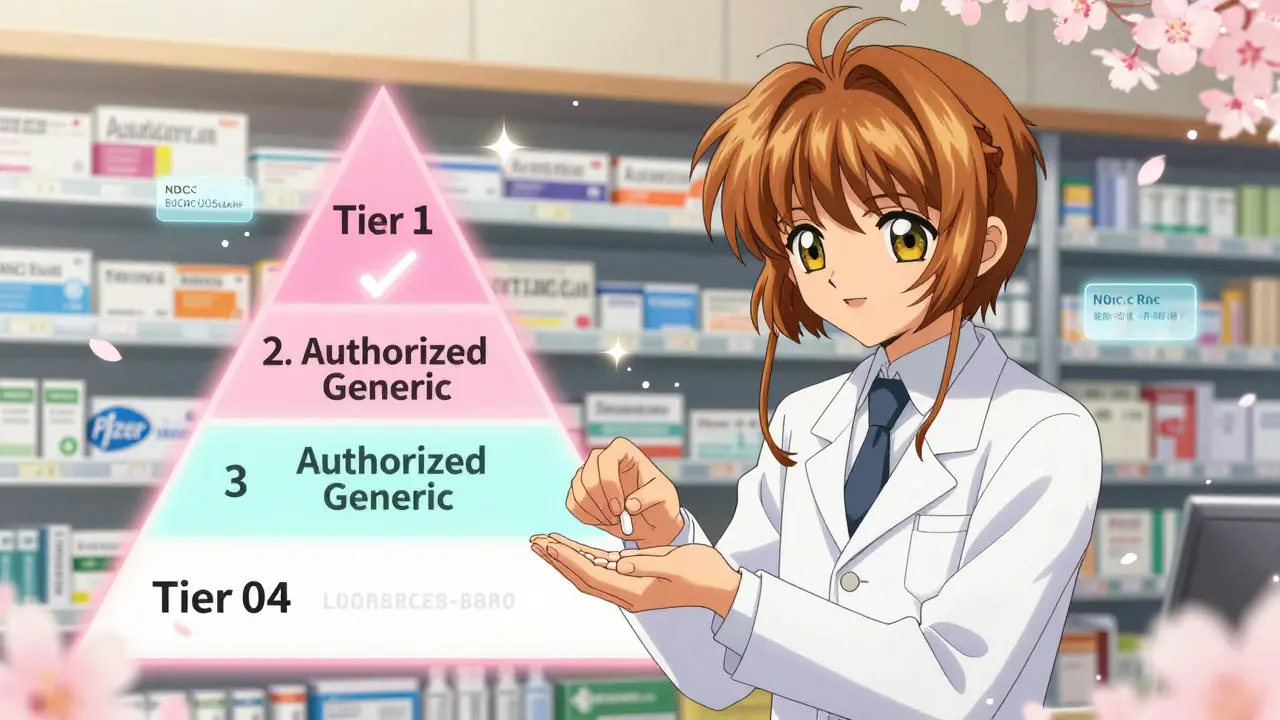
Insurance companies use formularies to control costs. These are lists of drugs they cover, grouped into tiers. Tier 1 usually means lowest cost-often traditional generics. Tier 3 or 4 means higher cost-usually brand-name drugs. The big question: Where do authorized generics go?Most insurers put them in Tier 2, the same as traditional generics. Why? Because they’re therapeutically identical to the brand, but priced like a generic. A 2022 study of 1,247 Medicare Part D plans found that 87% of them treated authorized generics the same as regular generics. That’s huge. It means patients get brand-equivalent drugs at generic prices, with no risk of therapeutic failure.
For insurers, this isn’t just about saving money-it’s about reducing errors. If a patient has a rare allergy to a dye in the brand-name version, switching to a traditional generic might introduce a different dye they haven’t been tested for. But an authorized generic? Same dye. Same formula. Same safety profile. That’s why doctors and pharmacists increasingly recommend them for patients on narrow-therapeutic-index drugs like Synthroid or warfarin.
How Authorized Generics Compare to Traditional Generics
| Feature | Authorized Generic | Traditional Generic |
|---|---|---|
| Manufacturer | Same as brand-name maker | Separate company |
| Regulatory Path | Uses brand’s NDA | Requires ANDA approval |
| Active Ingredients | Identical to brand | Must be bioequivalent |
| Inactive Ingredients | Identical to brand | May differ |
| Formulary Tier | Usually Tier 2 (like generics) | Usually Tier 2 |
| Market Entry Speed | Faster-can launch immediately | Slower-180-day exclusivity may delay others |
That last point matters. When a brand loses patent protection, the first generic company to file an ANDA gets 180 days of exclusivity. During that time, no other generic can enter. But an authorized generic? It can launch right away-even before that exclusivity period ends. That’s why some critics say authorized generics are used by brand companies to block competition. But for patients and insurers? It means more options, sooner.
Real Patient Experiences
One Reddit user, u/MedicationWarrior, shared how their insurance denied Synthroid (the brand) but approved the authorized generic with a $10 copay. They had severe allergies to the fillers in other generics. The authorized version? Same fillers as the brand. No reaction. No hassle. Just stable thyroid levels.
But it’s not always smooth. A 2022 GoodRx survey found 34% of patients were confused when their pharmacy switched them to an authorized generic without telling them. Some even got denied coverage because the system didn’t recognize the new NDC code. That’s a common problem: pharmacies and insurers still struggle to track authorized generics because they’re not listed in the FDA’s Orange Book-the standard reference for generic drugs. Instead, you need to check the FDA’s separate list of authorized generics, which as of late 2023 had 147 products.
Pharmacy benefit managers like Express Scripts and OptumRx have started adding special flags in their systems to catch these drugs. Express Scripts reports 89% of authorized generic claims are approved on the first try-only slightly lower than traditional generics at 92%. That’s better than brand-name drugs, which hover around 76%.
Who Makes Authorized Generics?
Three companies control most of the market: Greenstone (a Pfizer subsidiary), Prasco, and Patriot Pharmaceuticals. Together, they make up 63% of all authorized generics in the U.S. These companies don’t just slap on a new label-they often operate the same factories as the original brand. For example, the authorized generic of Ocella is made in the same facility as the brand, just with different packaging.
The market is growing fast. In 2022, authorized generics brought in $4.7 billion-about 3.2% of the total $147 billion generic drug market. Projections show that number could grow by 8.4% each year through 2027. That’s because more brand manufacturers are seeing the value: they keep revenue flowing after patent expiry, and insurers get cheaper drugs without losing efficacy.

How to Get Authorized Generics Covered
If you’re on a brand-name drug and want to switch to the authorized generic, here’s what to do:
- Ask your doctor if an authorized generic exists for your medication. Use the FDA’s authorized generic list to check.
- Call your insurance plan. Ask: “Is the authorized generic of [drug name] covered? What’s the copay?”
- If it’s not on your formulary, request a formulary exception. Many plans will approve it if you explain you need the exact same formulation.
- When you pick up your prescription, check the pill imprint and packaging. Authorized generics often have different colors or markings than the brand.
- If your pharmacy says it’s not available, ask them to check their PBM’s database-some use tools like Prime Therapeutics’ AG Tracker to identify them.
For employers and insurers, the move is clear: adopt “authorized generic first” policies for high-cost drugs. OptumRx did this for 47 medications in January 2023. The result? Lower overall drug spending and fewer patient complaints about side effects.
What’s Changing in 2025?
The Inflation Reduction Act is pushing Medicare Part D to expand access to lower-cost drugs. CMS expects a 15-20% increase in authorized generic usage by 2025. At the same time, the FDA’s new GDUFA III rules are making it easier to track and report these drugs, reducing confusion for pharmacies.
But there’s a catch. The FTC is watching closely. In 2022, they flagged cases where authorized generics were used to delay true generic competition. If regulators start cracking down, some manufacturers might stop offering them. That could mean fewer options down the line.
For now, though, authorized generics are one of the best-kept secrets in prescription savings. They’re not magic. They’re just the same drug, cheaper. And if your insurance plan treats them right, they can save you hundreds a year-with zero risk to your health.
Are authorized generics as safe as brand-name drugs?
Yes. Authorized generics are manufactured in the same facility, with the same ingredients, under the same FDA-approved process as the brand-name drug. The only difference is the label. They’re not just “similar”-they’re identical. This makes them especially safe for patients with allergies to inactive ingredients, since the fillers and dyes are unchanged.
Why isn’t my insurance covering the authorized generic?
Some insurance systems still don’t recognize authorized generics because they’re not listed in the FDA’s Orange Book. The NDC code for an authorized generic is different from the brand’s, and if your PBM’s database isn’t updated, it might reject the claim. Ask your pharmacy to verify the NDC code with your insurer’s formulary system. You can also request a formulary exception by explaining you need the exact formulation for medical reasons.
Can I ask my pharmacist to switch me to an authorized generic?
Yes, but only if your prescription allows substitution. If your doctor wrote “Dispense as Written” or “Do Not Substitute,” then no. Otherwise, pharmacists can substitute authorized generics just like traditional generics. Always ask for confirmation when you pick up your prescription-some pharmacies still don’t know how to identify them.
Are authorized generics available for all brand-name drugs?
No. Only about 15-20% of brand-name drugs have an authorized generic version. They’re most common in cardiovascular, psychiatric, and hormonal medications. Oncology and rare disease drugs rarely have them. Check the FDA’s official list to see if your drug has one.
Do authorized generics cost less than traditional generics?
Usually, they cost the same-or sometimes even less. Because they’re made by the brand manufacturer, they don’t have the same price competition as traditional generics. But insurers still treat them as generics, so your copay is the same as a regular generic. In some cases, they’re priced 15-25% lower than the brand, making them the best value option.

Comments
Authorized generics are the unsung heroes of prescription savings. I’ve been switching my elderly mom to them for her blood pressure meds, and her copay dropped from $45 to $8. No side effects, no drama. Pharmacies don’t always tell you they’re switching you - but if you ask, they’ll show you the label. It’s literally the same pill, just cheaper.
Why are we even debating this? The FDA says it’s identical. The manufacturer says it’s identical. Your doctor says it’s identical. Yet people still panic like they’re getting knockoff sneakers. If your body reacts differently to an authorized generic, it’s not the drug - it’s your brain. Or your pharmacist’s outdated software.
Oh wow, so now we’re glorifying Big Pharma’s ‘let’s sell the same pill with a white label’ scheme? How noble. They’re just using authorized generics to strangle real generic competition. Classic capitalist hustle. Next they’ll sell you the same toothpaste but with ‘premium’ packaging and a $2 price tag. 🙄
Let me tell you - I used to be one of those people who refused generics. I thought they were ‘inferior.’ Then my psychiatrist switched me from Lexapro to the authorized generic - same pill, same color, same imprint - and I had a full-on emotional breakdown because I didn’t recognize the packaging. I cried. I called my mom. I thought I was being poisoned. Turns out? I was just emotionally attached to the logo. 🤦♀️
Now I’m a convert. If it’s an authorized generic, I ask for it. No more brand worship. It’s just medicine. Not a status symbol.
Let’s be clear: authorized generics are not ‘just’ generics - they’re the gold standard. They’re made in the same facility, by the same people, with the same quality control. Traditional generics? They can vary in fillers, dyes, binders - and for people on narrow-therapeutic-index drugs like warfarin or levothyroxine, that’s not a minor detail - it’s a life-or-death variable. Insurance companies that don’t cover them are gambling with patient safety - and that’s not just bad policy, it’s unethical.
Also - if your pharmacy says ‘it’s not available,’ ask for the NDC code. Check it against the FDA’s authorized generic list. Most times, they just haven’t updated their system. Don’t take ‘no’ for an answer - your health isn’t negotiable.
I’ve been on Synthroid for 12 years. Tried three different generics - each one made me feel like I’d been hit by a truck. Fatigue, brain fog, heart palpitations. Then my pharmacist quietly slipped me the authorized generic. Same pill. Same fillers. Same everything. My TSH stabilized in two weeks. No drama. No panic. Just… normal. I wish more people knew this existed.
And honestly? The fact that insurers treat it like a tier-2 drug is the only reason I’m still alive. If they’d stuck with the brand, I’d be bankrupt by now.
you know what’s sad? we live in a world where a pill with no brand name is seen as ‘less than’… but if you buy a $1200 handbag with no logo? it’s ‘minimalist luxury.’ 🤡 we’re all just consumers programmed to worship labels. the pill doesn’t care if you call it Protonix or ‘generic version 3.2.’ your body only knows chemistry. and yet… we cry over packaging. i’m not mad… i’m just disappointed.
My cousin in India told me they don’t even have authorized generics there - brand-name drugs are the only option unless you pay out of pocket. It made me realize how lucky we are here, even with the mess of insurance bureaucracy. I’m grateful for the system, even when it’s clunky. We’ve got options. Not everyone does.
Just got my authorized generic for Adderall yesterday. Looked weird. Felt weird. Took a second to trust it. Then I checked the imprint - same as the brand. Took it. Felt the same. Didn’t even notice the switch. Honestly? That’s the whole point. You shouldn’t notice. It’s supposed to be invisible.
Let’s be real - this is why America still leads in pharma innovation. Other countries don’t even have this option. They get cheap generics that might as well be candy. We get the exact same drug, just cheaper. That’s not corporate greed - that’s smart capitalism. Stop complaining. If you want cheap drugs, be glad we’re not in Canada where they ration everything.
So… the brand company makes the generic version to block other generics? That’s not capitalism - that’s feudalism with a pharmacy counter. The FDA should force them to release the formula publicly. Let real companies compete. Stop letting Pfizer play monopoly with your thyroid meds. 🤬
Bro. Authorized generics are the OG flex. Same pill. Same factory. Same FDA stamp. Just no logo. It’s like wearing a custom suit but without the tag. You know it’s Gucci. Everyone else thinks it’s H&M. 😎💸