
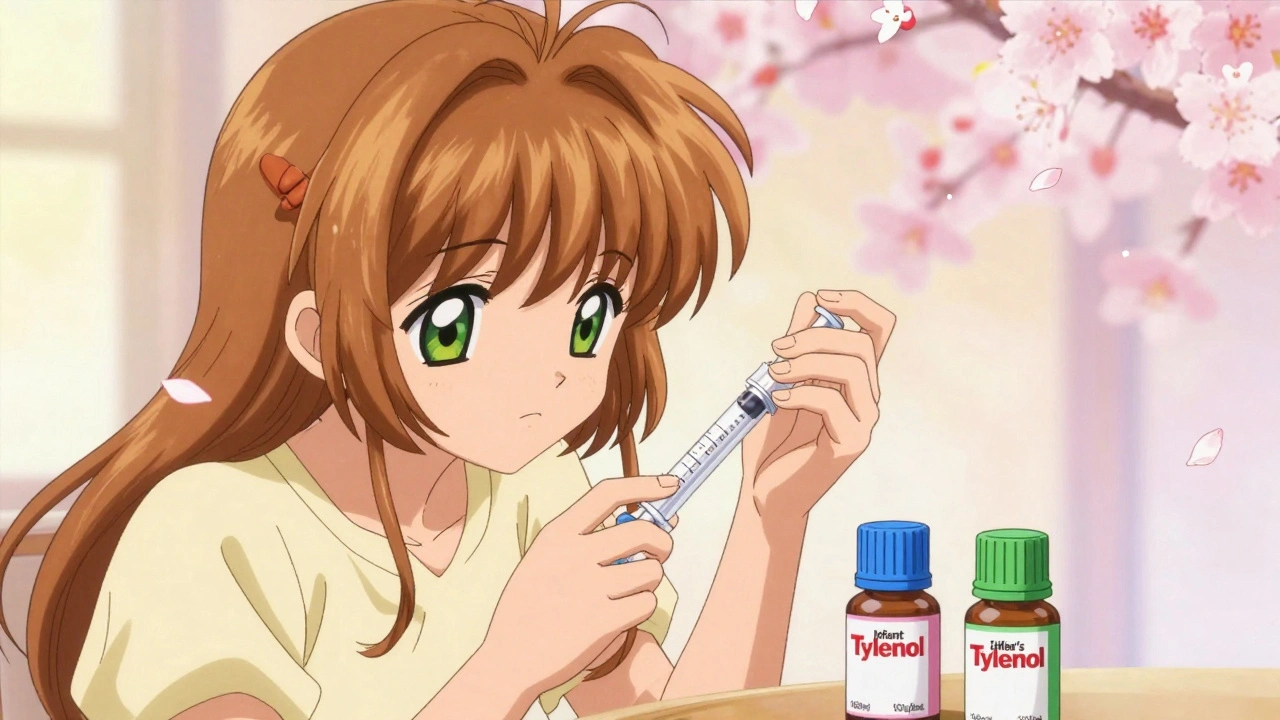
Every year, thousands of babies are rushed to emergency rooms because someone gave them the wrong amount of medicine. Not because they meant to harm their child - but because they didn’t know how to read the label. In 2022, over 50,000 children under five had medication-related emergencies. Nearly a quarter of those were infants under one year old. Most of these cases weren’t accidents. They were preventable mistakes - and they all came down to the same things: concentration, measurement, and timing.
Why Infant Medication Is So Dangerous
Babies aren’t small adults. Their bodies process medicine differently. A dose that’s safe for a toddler can be deadly for a newborn. The biggest danger? Confusing two very similar-looking bottles. For years, manufacturers sold infant acetaminophen in two forms: one with 80 mg per 1 mL (concentrated drops), and another with 160 mg per 5 mL (standard liquid). Parents didn’t realize they were giving five times more medicine if they used the wrong one. That mistake caused half of all infant liquid medication overdoses in 2010. In 2011, the FDA stepped in. They banned the concentrated 80 mg/mL drops. Now, all infant acetaminophen must be 160 mg per 5 mL. That’s the same strength as children’s liquid. Sounds simple, right? But here’s the problem: many parents still have old bottles at home. Or they grab the wrong one from the cabinet because both say "Tylenol" and look almost identical. A 2022 study found that 41% of caregivers made at least one dosing error - even when they thought they were doing everything right.Understanding Concentration: The #1 Mistake
You can’t guess. You can’t estimate. You have to read the label every single time. Here’s what you need to know:- Infant acetaminophen: Always 160 mg per 5 mL. That’s the only legal concentration now.
- Children’s acetaminophen: Also 160 mg per 5 mL. Same strength. Same bottle.
- Infant ibuprofen: Usually 50 mg per 1.25 mL. Not the same as children’s ibuprofen (100 mg per 5 mL).
- Never use adult medicine. Even a single pill can kill a baby.
Measuring Right: The Right Tool Makes All the Difference
Don’t use a kitchen spoon. Not even a "teaspoon" from your measuring set. A regular teaspoon holds anywhere from 3 to 7 mL - it’s not precise. A 2021 survey found that 43% of parents still use kitchen spoons. Over half of those gave doses that were off by more than 20%. The only safe tool for babies under six months is an oral syringe. Not a dropper. Not a cup. A syringe with 0.1 mL or 0.2 mL markings. Why? Because a single milliliter can be the difference between a safe dose and a toxic one. A 2020 study at Cincinnati Children’s Hospital showed parents using oral syringes got the dose right 89% of the time. With medicine cups? Only 62%. Droppers? Even worse - 74% of parents messed up the dose because drops vary in size depending on how you hold the bottle. Here’s how to use an oral syringe:- Draw the exact amount from the bottle - don’t guess.
- Check the syringe markings against the label. Make sure you’re measuring mL, not teaspoons.
- Place the tip inside the baby’s cheek, not straight back in the throat. Gently push the plunger.
- Wash the syringe after each use. Don’t let it dry with medicine inside - it clogs and ruins accuracy.
Dosing by Weight, Not Age
Age doesn’t matter as much as weight. A 5-month-old weighing 10 pounds needs a different dose than a 5-month-old weighing 16 pounds. Always check your baby’s weight in kilograms. Most pediatricians give you this number at checkups. If you don’t have it, convert pounds to kilograms: divide pounds by 2.2. For acetaminophen, the correct dose is 10 to 15 mg per kilogram of body weight, every 4 to 6 hours. Never give more than five doses in 24 hours. Example: A 9-pound baby weighs about 4.1 kg. Multiply that by 10-15 mg = 41-61 mg per dose. Since the concentration is 160 mg per 5 mL, that’s 1.3 to 1.9 mL per dose. Use your syringe. Don’t round up. Don’t wing it. Ibuprofen? Only for babies over 6 months. Dose is 5-10 mg per kg every 6-8 hours. Always check the label. Never mix acetaminophen and ibuprofen unless a doctor tells you to.Who’s at Highest Risk?
It’s not just new parents. Grandparents, babysitters, and even older siblings are often the ones giving the medicine - and they’re the most likely to make mistakes. A 2023 study showed caregivers over 65 made 3.2 times more dosing errors than parents under 30. Why? Outdated knowledge. Vision problems. Confusing old instructions with new labels. One grandmother gave her 4-month-old grandson a full dropper of infant Tylenol because she remembered "a drop per month of age" from the 1980s. That’s not how it works anymore. He ended up in the hospital with liver damage. Even healthcare workers aren’t immune. A 2022 CDC report found that 28% of medication errors came from misreading concentration labels. Another 24% were from using the wrong tool. Packaging looks too similar. Labels are too small. Bottles aren’t labeled clearly enough.The Five-Step Safety Check
Here’s what the CDC and American Academy of Pediatrics recommend every time you give medicine:- Confirm weight - in kilograms, not pounds.
- Calculate dose - use 10-15 mg/kg for acetaminophen, 5-10 mg/kg for ibuprofen.
- Check concentration - look at the bottle. Is it 160 mg/5 mL? Never assume.
- Use an oral syringe - no cups, no spoons, no droppers.
- Double-check with someone else - have your partner, parent, or friend verify the dose before you give it.

What About Cold and Cough Medicine?
Don’t give it. Not even a teaspoon. The FDA has warned since 2008 that over-the-counter cough and cold medicines are dangerous for children under two. Between 2004 and 2005, they sent over 7,000 kids under two to the ER because of these products. Some had seizures. Some stopped breathing. Some died. In 2021, the FDA updated that warning: don’t use these medicines for kids under six. They don’t work well anyway. And the risks? They’re real. Ingredients like dextromethorphan and diphenhydramine can cause heart problems, hallucinations, and coma in babies. If your baby has a cold, use saline drops, a bulb syringe, and a humidifier. Talk to your pediatrician before giving anything else.What’s Changing? What’s Next?
Good news: things are getting safer. Since the FDA standardized concentrations, overdose calls to poison control dropped by 43% between 2011 and 2015. New bottles now have color-coded caps - blue for infants, green for children. Some brands even include QR codes that link to dosage calculators. In January 2023, the FDA approved the first "smart syringe" - a connected device that pairs with your phone. It scans the medicine bottle, calculates the right dose, and won’t let you give too much. Early trials showed 98.7% accuracy. It’s expensive now - but it’s coming. The CDC’s 2023 National Action Plan aims to cut infant dosing errors in half by 2026. That means better labels, mandatory training for caregivers, and more support tools.When in Doubt, Call
If you’re unsure about the dose, the concentration, or whether the medicine is safe - don’t guess. Call the National Poison Control Center at 1-800-222-1222. Or visit poison.org and use their "Help Me Choose" tool. In 2022, they handled over 14,000 infant medication questions. They prevented nearly all of those from turning into ER visits. You don’t need to be a doctor to keep your baby safe. You just need to be careful. Read the label. Use the right tool. Measure exactly. Double-check. And when in doubt - call someone who knows.One wrong dose can change everything. But with the right information, you can protect your baby - every single time.
Comments
Just wanted to say this is one of the most useful threads I've read in months. Seriously, I used to wing it with the dropper until my cousin's kid ended up in the ER. Now I only use the syringe, and I label every bottle with a Sharpie. Game changer. 🙌
So let me get this straight-because some dumbass parent couldn’t read a label, the FDA had to ban a whole concentration? Next they’ll outlaw knives because someone cut their finger making toast. 😒
Concentration standardization is a pharmacoeconomic win-reduces cognitive load for caregivers, minimizes formulation ambiguity, and aligns with WHO’s Safe Medication Practices framework. Also, syringes > droppers. Droppers are essentially placebo-measuring devices. 📊
How quaint. You’re all treating this like a medical emergency when really it’s just the inevitable collapse of parental literacy. If you can’t read ‘160 mg/5 mL’ without a PhD in pediatric pharmacology, maybe don’t procreate? 🤷♀️
Wait… this is all just a Big Pharma ploy to sell you expensive syringes. The real cause? Fluoride in the water making parents dumber. I’ve seen the documents. 👁️
My sister-in-law did this and now my nephew has brain damage. I swear, if I ever see her give medicine again, I’m calling CPS. She didn’t even know the difference between Tylenol and Motrin. How do people even function? 😭
In my village in Nigeria, we use the same spoon for everything-medicine, soup, porridge. We don’t have syringes. But we have intuition. We know when the baby is crying because of fever, not because of bad milk. Maybe the real problem isn’t the dose-it’s the distrust in human instinct? 🌍
Let’s be real-this whole ‘standardization’ thing is just corporate theater. The real issue? The FDA doesn’t regulate bottle design. Why are infant and children’s bottles identical? That’s not negligence-it’s negligence with a patent pending. 🏢
My wife and I use the syringe now. We even have a little chart taped to the fridge. I used to think this was overkill… until I almost gave our 4-month-old a full teaspoon of Benadryl by accident. Holy hell. Don’t be me. 🙏
I don’t know why you’re all so worked up. My grandfather gave me medicine with a teaspoon in 1972. I turned out fine. Now I’m a 52-year-old engineer. Maybe stop being so paranoid?
Think about it-this isn’t just about medicine. It’s about how we treat vulnerability. We’re so afraid of being imperfect parents that we turn every dose into a ritual. But what if the real safety net isn’t the syringe… but the love behind it? 🌱
Smart syringe? That’s the future. 🚀 I already have an app that tells me when my coffee’s cold. Why not one that stops me from poisoning my kid? I’d pay $200 for that. 😎
They banned the 80mg/mL drops? LMAO. That’s why the government can’t fix anything. You don’t ban a product-you educate people. Next they’ll ban cars because someone ran a red light. 🤡
Why are we letting other countries dictate our medicine? In America, we know best. We don’t need FDA overreach. If you can’t read, get glasses. Don’t blame the bottle. 🇺🇸
One must question the epistemological foundation of dosage safety: if measurement is a social construct, then the syringe is merely a tool of neoliberal medical hegemony. The infant’s body, in its purest state, knows its own need. Why impose quantification? 🧘♂️