

For decades, managing diabetes meant poking your finger several times a day, guessing how food or stress affected your blood sugar, and hoping your HbA1c test in three months didn’t show disaster. That’s not the reality anymore. Today, people with diabetes - whether Type 1, Type 2 on insulin, or even those just starting out - have tools that don’t just monitor glucose. They predict it, explain it, and even help you react before it spikes or crashes.
Continuous Glucose Monitors: The Game Changer
Think of a Continuous Glucose Monitor (CGM) as a personal glucose detective. Instead of a single snapshot from a fingerstick, it gives you a movie - updating your blood sugar every five minutes, day and night. No more waking up at 3 a.m. dizzy and unsure if your sugar’s too low or too high. Modern CGMs like the Abbott FreeStyle Libre 3 or Dexcom G7 send alerts straight to your phone when your numbers start to move out of your target range.
What makes CGMs different from old-school tests? It’s not just frequency. It’s context. You can see how your sugar drops after a walk, climbs after a slice of pizza, or stays steady after a good night’s sleep. The American Diabetes Association’s 2025 guidelines say CGMs aren’t optional anymore - they’re essential for nearly everyone using insulin. Studies show CGM users spend an extra 3.2 hours each day in their target glucose range (70-180 mg/dL). That’s not just a number. It’s fewer headaches, better sleep, and a real drop in long-term complications like nerve damage or kidney issues.
Accuracy matters. The best CGMs today have a MARD score - a measure of how close they are to lab results - under 9%. The Libre 3 hits 8.1%. Newer systems, like the Glucotrack implantable sensor (still in trials), are hitting 7.7%, meaning they’re almost as accurate as a blood draw. And here’s the big leap: Glucotrack measures glucose directly from your blood, not the fluid between cells. That cuts out the 5-15 minute lag that plagues current external sensors. Imagine knowing your sugar is about to crash before you feel shaky. That’s the future.
Smart Pens: When Insulin Meets Data
CGMs tell you what’s happening. Smart insulin pens like Medtronic’s InPen tell you what to do about it. These aren’t just fancy syringes. They record every dose you give, sync with your CGM, and even suggest insulin amounts based on your current glucose, recent meals, and activity. It’s like having a personal diabetes coach in your pocket.
But adoption? Still low. Only 15% of insulin users use smart pens, according to 2025 data from ADCES. Why? Cost, complexity, and habit. Many people still prefer the simplicity of a regular pen. But for those who juggle multiple daily doses, the integration is powerful. If your CGM shows your sugar is rising before breakfast, the InPen can suggest a slightly higher dose - no math needed. And because it logs everything, your doctor can spot patterns you didn’t even notice.
Smart pens also help with adherence. If you forget a dose, the pen sends a reminder. If you take insulin too close to another dose, it warns you. It’s not magic, but it’s the next step beyond just monitoring.
Diabetes Apps: The Dashboard You Actually Use
CGMs and smart pens generate tons of data. That’s where apps come in. MySugr, One Drop, and others turn numbers into stories. They show you trends, calculate your time in range, and even let you tag meals, exercise, or stress so you can see what really moves your numbers.
But here’s the catch: not all apps play nice. Only 43% of third-party apps can connect with all major CGMs, according to 2025 conference data. If you use a Dexcom, but your app only works with Libre, you’re stuck. That’s why choosing an app that fits your device matters as much as the device itself.
Real users say these apps change their mindset. On Reddit’s r/diabetes, 78% of 1,243 surveyed users said they sleep better because their CGM alerts them to nighttime lows. 63% said they feel less anxious about unexpected highs. And 82% said they’d never go back to fingersticks. That’s not hype - it’s lived experience.
Who Benefits Most? And Who’s Left Behind?
CGMs aren’t just for Type 1 diabetes anymore. The ADA now recommends them for pregnant people with diabetes, older adults at risk for lows, and even kids from diagnosis. A 2025 remote CGM program documented in Beyond Type 1 helped participants drop their A1c from 10.4% to 7.5% - and 72% of foot wounds healed in four months, compared to under half without CGMs. That’s huge for people who can’t get to a clinic often.
But access isn’t equal. Out-of-pocket costs for CGM sensors can hit $300 a month. Even with insurance, 37% of commercially insured patients in the U.S. still get denied coverage. Medicare coverage jumped from 2.1% in 2019 to 28.7% in 2024 - a win - but millions still can’t get them. And with the FDA approving over-the-counter CGMs in 2024, a new problem emerged: 63% of buyers got no training. They bought the device, turned it on, and were overwhelmed.
That’s why education matters. The ADCES 2025 guide says successful users spend 3-5 hours learning how to use their tech. Those who skip training are twice as likely to quit. Customizing alerts is key, too. A night-shift worker needs different alarms than a parent with kids. One-size-fits-all doesn’t work.
What’s Next? The Future Is Predictive
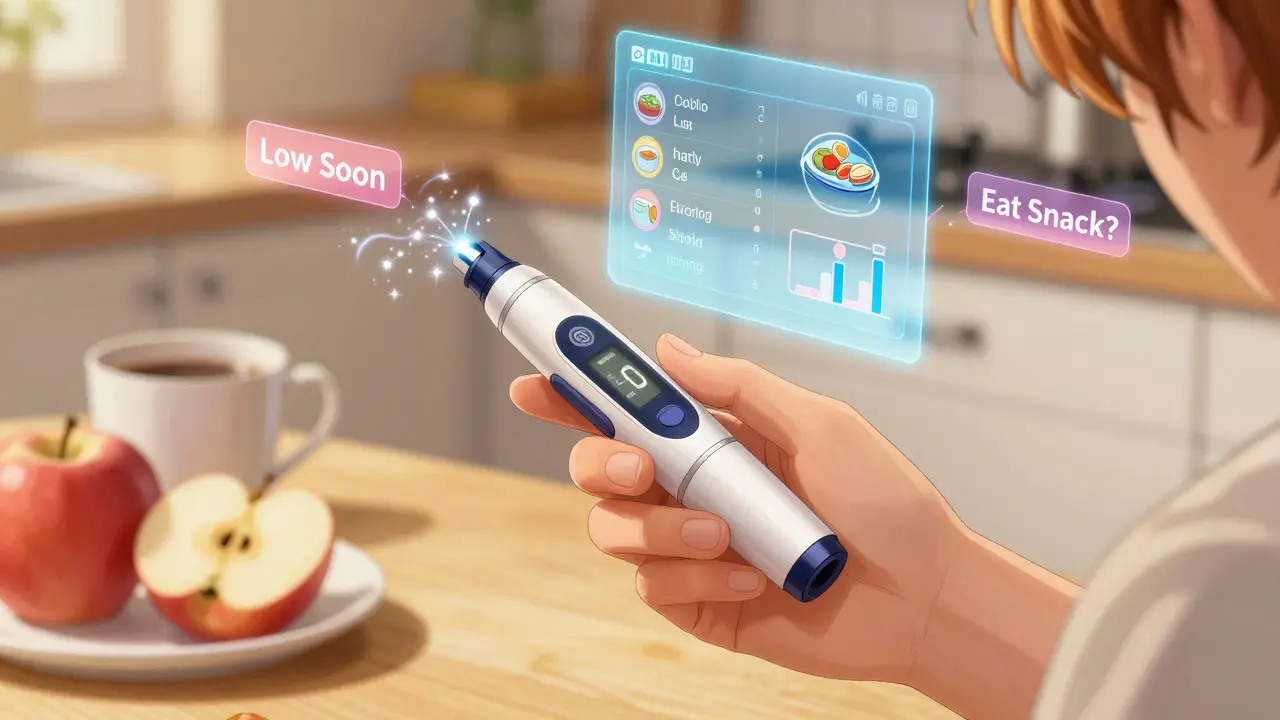
The next wave isn’t just about monitoring - it’s about prediction. Dexcom and EarlySense are launching a machine learning system in Q2 2026 that forecasts glucose changes up to 30 minutes ahead with 89% accuracy. Imagine your phone telling you: "Your sugar will drop in 20 minutes. Eat a snack now." That’s not science fiction. It’s coming.
And then there’s Glucotrack - a tiny implantable sensor, about the size of three nickels, meant to last three years. No more changing sensors every two weeks. No more tape falling off during workouts. Just a small device under your skin, quietly measuring your blood glucose directly. If approved, it could prevent 12,000-15,000 severe low-blood-sugar events in the U.S. each year.
Even insulin delivery is changing. Vaxess Technologies is testing a needle-free patch for semaglutide (Ozempic), which could make it easier for people to stick with weight-loss and glucose-lowering meds. Combine that with automated insulin delivery systems like Tandem’s Control-IQ, and you’ve got a system that works while you sleep, eat, or run.

But Don’t Ignore the Risks
Technology isn’t flawless. A 2025 JAMA Internal Medicine study found 63% of CGM systems had data security flaws. Someone could, in theory, manipulate your glucose readings. That’s not just a privacy issue - it’s a safety one.
And then there’s data overload. 68% of new users feel overwhelmed at first. Alarms go off constantly. You start ignoring them. That’s why personalizing alerts is non-negotiable. The ADA’s 2025 guidelines say your alerts should match your life - not the other way around.
Finally, affordability remains the biggest barrier. For low-income patients, even with Medicaid, 41% still can’t access CGMs. Tech advances won’t help if they’re only for the privileged.
Real Talk: What Works in Real Life
Here’s what actually helps:
- Start with one tool. Don’t try to use a CGM, smart pen, and five apps at once. Pick one, learn it, then add more.
- Customize your alerts. If you’re always getting woken up by a low alarm at 2 a.m., change it. Your body, your rules.
- Use your data. Don’t just look at the numbers - ask yourself: "What did I eat? How did I sleep? Did I walk today?" Patterns matter more than single readings.
- Ask for help. Diabetes educators aren’t just for new diagnoses. They’re your tech coaches.
People who stick with these tools don’t just live better - they live longer. And that’s the point.
Are CGMs accurate enough to replace fingersticks?
Yes, for most daily decisions. Modern CGMs like the Abbott Libre 3 and Dexcom G7 have accuracy levels (MARD under 9%) that match or exceed traditional blood glucose meters. The ADA now considers them reliable enough to make treatment decisions without confirmatory fingersticks - unless you feel symptoms that don’t match your reading. In that case, always double-check with a meter.
Can I use a CGM if I have Type 2 diabetes and don’t use insulin?
Yes - and increasingly, doctors recommend it. While CGMs were once only for Type 1 or insulin users, the 2025 ADA guidelines now support their use for anyone with Type 2 diabetes who’s at risk for low blood sugar, has trouble controlling glucose, or wants to understand how food and lifestyle affect their numbers. Even non-insulin users can benefit from seeing their patterns.
How much do CGMs cost without insurance?
Without insurance, CGM sensors typically cost between $150 and $300 per sensor, depending on the brand and whether you buy in bulk. Most sensors last 10-14 days, so monthly costs can reach $300-$600. Some manufacturers offer savings programs - Abbott’s Libre has a patient assistance program that can reduce costs to under $50/month for qualifying individuals.
Do smart insulin pens work with all CGMs?
Not always. The Medtronic InPen works best with Dexcom and Abbott CGMs, but compatibility varies. Some pens only sync with their own brand’s sensors. Always check the manufacturer’s website for a list of supported devices before buying. Third-party apps like mySugr can help bridge gaps by pulling data from multiple sources.
What should I do if my CGM keeps giving me false alarms?
First, don’t ignore it - that’s how people get burned out. Talk to your diabetes educator about adjusting your alert thresholds. Most CGMs let you set different alarms for high and low, day and night, and even delay alerts during exercise. You might also need to recalibrate the sensor or check if it’s properly adhered. Sensor adhesion issues, especially in heat or sweat, are common and can cause erratic readings.
Diabetes technology isn’t about perfection. It’s about control - and peace of mind. The tools exist. The data is there. What matters now is using them in a way that fits your life - not the other way around.

Comments
This is straight-up magic. 🤯 CGMs are like having a personal weather forecast for your blood sugar. No more 3 a.m. panic attacks. Just peace. I got my Libre 3 last month and I swear I’ve slept 2 hours more per night. Life changed. 💪
You people act like this is revolutionary. I’ve been using a CGM since 2018. And let me tell you - most of you are just following trends. The real issue? You’re all ignoring the fact that 63% of these devices have security flaws. Someone could hack your glucose readings and make you go into a coma. And you’re celebrating? 😅
So we’re automating diabetes now? Next thing you know, the AI will be telling us when to breathe. 🤖 But honestly? I’m here for it. My InPen suggested a dose yesterday and I trusted it. My sugar was perfect. Maybe tech isn’t the enemy after all.
I CAN’T BELIEVE PEOPLE ARE STILL USING FINGERSTICKS!!! WHY ARE YOU STILL DOING THIS TO YOURSELF?!?!?!?!!? CGMs AREN’T A LUXURY - THEY’RE A HUMAN RIGHT!!! AND DON’T EVEN GET ME STARTED ON THE FACT THAT 37% OF PEOPLE IN THE U.S. ARE STILL BEING DENIED COVERAGE!!! THIS IS A PUBLIC HEALTH CRISIS!!! WHO IS ALLOWING THIS?!?!?!
Just started with a CGM last week. Honestly didn’t expect to like it. But now I catch my spikes before they happen. Took me two days to tune the alerts. Now I’m sleeping like a baby. You don’t need five apps. Just one. And a little patience.
omg i just got my libre 3 and i’m obsessed 😭 i didn’t know my sugar would drop after coffee. now i know to eat a peanut butter cracker before my 2nd cup. life hack!!
All this tech is just a distraction. Diabetes hasn’t changed. Your body still processes sugar the same way. All these devices do is make you paranoid. I’ve been off insulin for 5 years. I eat clean. I move. I don’t need a machine to tell me when I’m human.
They’re tracking our glucose. And now they want to implant sensors? What’s next? A chip in our brain to monitor our thoughts? The FDA approved this? I bet the same people who pushed for EHRs are behind this. This isn’t healthcare. It’s surveillance. And someone’s selling the data.
I’ve been living with Type 2 for 14 years. I used to think CGMs were for ‘serious’ diabetics. Then I got one last year. I didn’t realize how much stress I was carrying until I stopped guessing. The data doesn’t lie. I’ve lost 18 pounds, my A1c dropped from 8.9 to 6.7, and I actually look forward to checking my numbers now. It’s not about the tech - it’s about reclaiming your life. I wish I’d done this 10 years ago. For anyone hesitating: start small. One sensor. One week. Just see what it shows you. You might be surprised.
I tried a CGM. It beeped every 10 minutes. I got so annoyed I threw it in the trash. Then I went back to fingersticks. Why? Because I don’t want to be nagged by a device that doesn’t even know I had a bad night’s sleep. This isn’t helping - it’s adding noise.
Technology is a mirror. It reflects our desire to control the uncontrollable. The body is not a machine. Blood sugar is not a variable to be optimized. It is a rhythm. A dance. To reduce it to data points is to lose the essence of being alive. The sensors lie. The numbers are illusions. The truth? You are not your glucose. You are your breath. Your silence. Your hunger. Your fear. Your joy. The machine will never understand that.
For anyone new to this - don’t overwhelm yourself. Start with the CGM. Learn the trends. Then add the app. Then maybe the smart pen. But here’s the secret: the most powerful tool isn’t the device. It’s your journal. Write down what you ate, how you felt, how you slept. Match it to the graph. You’ll start seeing patterns no algorithm can predict. I’ve been doing this for 8 years. My A1c has been under 6.2 since day one. It’s not magic. It’s curiosity.
I got the Libre 3. It was $280. I used it for 3 days. Then it glitched. Said I was at 210. I was fine. Felt fine. Took a meter. 98. So I called support. They told me to restart it. Restart? It’s a sensor. Not a phone. Now I just use my old meter. Save your money. And your sanity.