
Many people assume that because generic medications are cheaper, they don’t need help paying for them. But that’s not true. Even though generics cost 80-85% less than brand-name drugs, thousands of Americans still struggle to afford their monthly prescriptions. A 2023 KFF poll found that 26% of U.S. adults say they’ve skipped or delayed filling a prescription because of cost. For people taking multiple generics - like metformin, lisinopril, or levothyroxine - those $5-$10 copays add up fast. And if you’re on Medicare or just earn too much for Medicaid, you might be stuck in a gap where no help seems available.
Why Generics Still Cost Too Much
Generic drugs are supposed to be the affordable alternative. But affordability doesn’t always mean accessible. Most insurance plans put generics in Tier 1, with average copays of $5-$10 per prescription. That sounds low - until you’re taking three or four of them every month. For someone on a fixed income, $40 a month for meds can mean choosing between medicine and groceries. The bigger issue? There’s almost no manufacturer assistance for generics. Unlike brand-name drugs, where companies like Pfizer or Gilead offer copay cards that cut costs to $0 or $10, generic manufacturers rarely offer support. Why? Thin margins. They’re already selling at near-cost prices. So if you’re not on Medicare or Medicaid, you’re often on your own.Medicare’s Extra Help Program: Your Best Bet
If you’re on Medicare and have limited income, Extra Help (also called the Low-Income Subsidy) is the most powerful tool you have. Starting in 2025, this program will reduce your generic copay to exactly $4.90 per prescription. Brand-name drugs? $12.15. And if you qualify, you won’t pay a deductible at all. Eligibility is based on income and assets. In 2025, individuals earning up to $21,870 per year and couples up to $29,580 can qualify. You don’t have to apply separately if you’re already on Medicaid, SSI, or a Medicare Savings Program - you’ll be enrolled automatically. But if you’re not, you need to apply through Social Security. The process takes 45 to 90 days, and many people get denied because they miss a document - like a recent tax return or bank statement.Pharmacy Discount Programs: Free, No Application Needed
You don’t need insurance or income verification to use pharmacy discount programs. These are cash-price deals offered by major chains and independent pharmacies. Walmart’s $4/$10 list covers over 150 common generics - including metformin, atorvastatin, and amoxicillin. Kroger, Publix, and Target have similar lists. SingleCare and GoodRx offer coupons that can drop prices even lower than pharmacy discount programs. Here’s the catch: you can’t combine these with insurance. If your insurance copay is $8 and the discount coupon is $5, you have to choose one. Most people pick the coupon - because it’s cheaper. Pharmacists say 62% of patients don’t even ask for these discounts. That’s money left on the table.
The Assistance Gap: Too Rich for Medicaid, Too Poor for Help
One of the biggest problems isn’t lack of programs - it’s the gap between them. If you make just above Medicaid limits - say, $37,000 a year for a single person - you’re often shut out of every option. You don’t qualify for Extra Help. You don’t get manufacturer coupons. And your insurance still charges $10-$15 per generic. This is the “assistance cliff.” A Reddit user in May 2024 posted: “I make $2,100 a month. My three generics cost $32 a month. I make $300 too much for Medicaid. No help exists.” That’s not rare. Nonprofit NeedyMeds found that only 12% of applicants earning between 250%-400% of the federal poverty level got approved for assistance - compared to 78% for those below 250%.What’s Changing in 2025
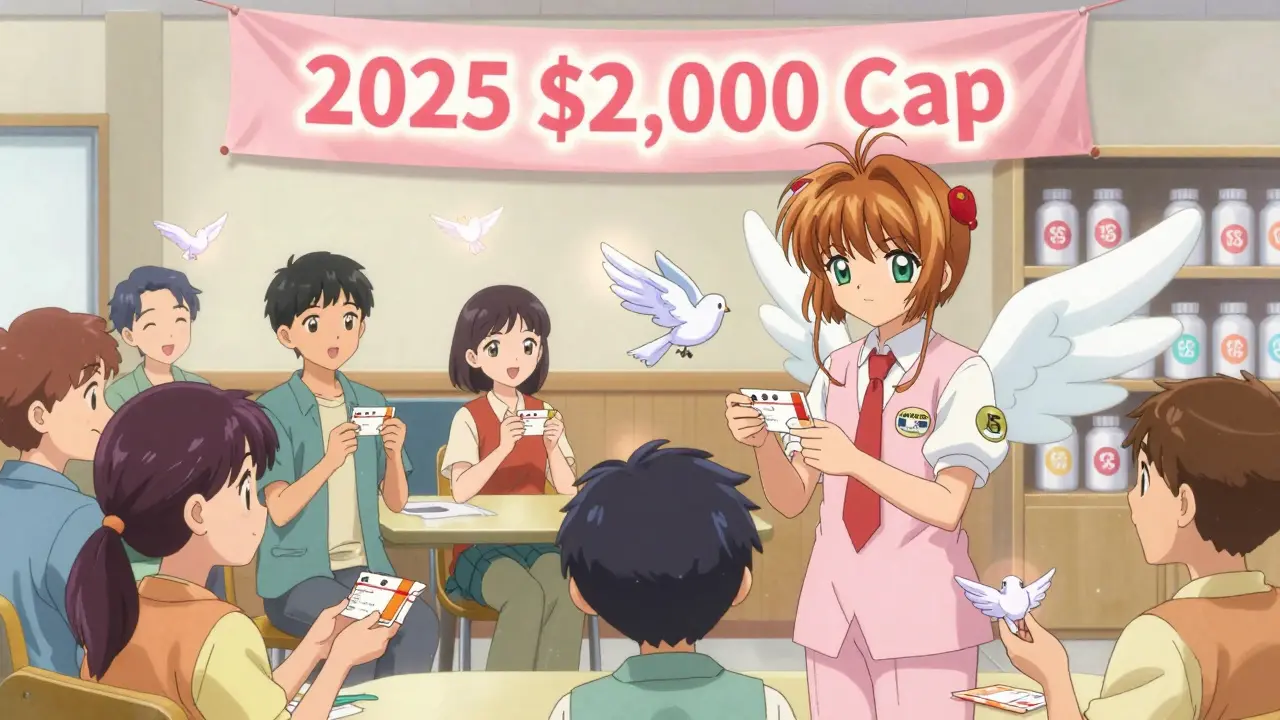
Big changes are coming January 1, 2025, thanks to the Inflation Reduction Act. The biggest? A hard cap on out-of-pocket drug costs for Medicare Part D users: $2,000 per year. Before, you had to spend $8,300 before reaching catastrophic coverage. Now, you’ll hit that cap much faster - especially if you’re on multiple generics. Also, insulin will cost no more than $2 a month. And for Extra Help recipients, deductibles are gone. The Centers for Medicare & Medicaid Services also now require plans to cap quarterly generic costs at $100 during the coverage gap. These changes will cut generic costs for most Medicare users by nearly 60%. But they won’t help people with private insurance who aren’t on Medicare. For them, the landscape stays mostly unchanged - unless new legislation passes.How to Get Help: A Step-by-Step Plan
If you’re struggling to pay for generics, here’s what to do - in order:- Check if you qualify for Medicare Extra Help - go to SSA.gov or call 1-800-772-1213. Fill out the application even if you think you earn too much - the rules are complex.
- Ask your pharmacist for discount coupons - don’t assume your copay is the lowest price. Show them your prescription and ask: “Is there a cash price cheaper than my copay?”
- Use SingleCare or GoodRx - download the apps. Compare prices at nearby pharmacies. Sometimes the discount is half the insurance copay.
- Apply to nonprofit programs - organizations like PAN Foundation, Patient Access Network, and NeedyMeds offer aid for specific conditions. Only 17 of their 72 programs cover generic-heavy conditions like diabetes or high blood pressure - but if you qualify, they can cover 80-100% of your cost.
- Ask your doctor about therapeutic interchange - if you’re on a brand-name drug that has a generic, ask if you can switch. Pharmacists can often substitute automatically, unless your doctor says no.
Common Mistakes to Avoid
Many people lose out on help because of simple errors:- Assuming generics don’t need help - 38% of people skip doses because they think they can’t afford even $10 a month.
- Using coupons with insurance - you can’t combine them. Choose the lowest price.
- Waiting to apply - Extra Help takes months to process. Apply as soon as you think you might qualify.
- Not checking every month - prices change. A drug that was $15 last month might be $5 today thanks to a new coupon.
Who Else Can Help?
State Health Insurance Assistance Programs (SHIP) offer free, one-on-one counseling. They help people navigate Medicare, Extra Help, and drug discounts. Call 1-877-839-2675 or visit SHIPhelp.org to find your local counselor. Nonprofits like NeedyMeds and RxAssist have searchable databases of programs that cover specific drugs. Just type in your medication name and see what’s available. And don’t ignore your pharmacy. Many independent pharmacies have their own discount programs or can order cheaper bulk supplies from wholesalers.Final Thought: You’re Not Alone
You don’t have to choose between medicine and rent. The system is broken in places - especially for people who earn too much for aid but too little to pay full price. But help exists. It’s scattered, it’s confusing, and it’s not perfect. But it’s real. Start with your pharmacist. Ask about discounts. Then check Extra Help. Then search NeedyMeds. Most people who use even one of these options save hundreds a year. And with the 2025 changes coming, it’s getting easier - just not fast enough for everyone.Can I use GoodRx with Medicare?
Yes, but you can’t use it at the same time as your Medicare copay. You have to choose: either pay your Medicare copay or use the GoodRx coupon for the lower cash price. Many Medicare beneficiaries find that GoodRx offers a lower price than their plan’s copay - especially for generics. Always ask your pharmacist to compare both options before paying.
Why don’t generic drug companies offer copay cards?
Generic manufacturers operate on razor-thin profit margins - often less than 10% per pill. Unlike brand-name companies that charge $1,000 a month and can afford to give away $500 in copay assistance, generics sell for $5-$10. Offering coupons would mean selling at a loss. So instead, assistance comes from pharmacies, nonprofits, and government programs.
What if I make too much for Extra Help but still can’t afford my meds?
You’re in the “assistance gap.” Apply anyway - income limits are flexible and sometimes include assets like savings or property. Also, check nonprofit programs like PAN Foundation or NeedyMeds. Some have disease-specific criteria that don’t rely on income alone. And always ask your pharmacy for cash discounts - they often beat insurance prices.
Do copay assistance programs count toward my Medicare out-of-pocket maximum?
Only if the assistance comes from your insurance plan or Medicare. Manufacturer copay cards (which rarely exist for generics) and pharmacy coupons do NOT count toward your out-of-pocket maximum. That’s why the 2025 $2,000 cap is so important - it caps what you pay directly, not what’s covered by discounts.
Can I get help for insulin even if it’s generic?
Yes. Starting January 1, 2025, all Medicare Part D plans must cap insulin costs at $2 per month - regardless of whether it’s brand-name or generic. This applies to all types of insulin, including generic versions like NPH or regular insulin. Private insurers are not required to follow this, but many are adopting it voluntarily.
Comments
So let me get this straight: we’re supposed to be grateful that generics are ‘only’ $5-$10 when that’s still more than my weekly bus fare? And the system’s fine because ‘help exists’? Lol. I’ve been skipping my levothyroxine every other month just to make the rest last. My cat gets better care than I do. 🤡
People need to stop expecting handouts. If you can’t afford your meds, maybe you shouldn’t have taken on so many financial obligations. There are food banks, community centers, even free clinics. It’s not the government’s job to subsidize poor life choices.
I called my pharmacy yesterday asking about discounts. They acted like I was asking for a kidney. I showed them my prescription for metformin. They said, 'Oh, that's on the $4 list.' I said, 'Then why did I pay $12?' They shrugged. I’ve been doing this for three years. Nobody tells you. Nobody cares.
We’ve turned healthcare into a game of financial Tetris. You stack coupons, you rotate discounts, you beg pharmacists for mercy - and still, you’re one missed paycheck from becoming a statistic. The real tragedy isn’t the $10 copay - it’s that we’ve normalized this. We’ve made survival into a side hustle. And now they’re patting themselves on the back for capping insulin at $2? That’s not progress. That’s damage control after decades of neglect.
It is a matter of profound regret that in a nation of such wealth, citizens are compelled to choose between pharmaceuticals and sustenance. The structural failure of the American pharmaceutical pricing model is not merely an economic issue - it is a moral failing of the first order. One cannot speak of liberty when one’s life depends on the whim of a corporate balance sheet.
Why are you all crying? In India, we pay $0.50 for the same metformin. You have insurance. You have GoodRx. You have pharmacies. You have government programs. You have TIME to apply. Stop whining. Get off your couch. Go to the pharmacy. Ask. Do. Not. Complain.
Hey, I get it. It’s rough. But you’re not alone. I’ve helped three friends in my neighborhood get on Extra Help. It takes paperwork, sure - but you can do it. Go to the library. Ask a volunteer. They’ll help you fill out the forms. And always, always ask the pharmacist: ‘Is there a cheaper way?’ I saved my mom $200 a month just by switching from insurance to GoodRx. Small steps, friends. You got this.
This is all just a socialist plot to make us dependent on the government. Who paid for this article? Big Pharma? The WHO? The UN? They want you to think you need help so they can take your guns, your freedom, and your tax dollars. The real solution? Stop taking meds. Let your body heal naturally. Or move to Canada. They’ve got free stuff there.
Wow. So the solution to $40/month meds is… asking nicely? And applying to programs that take 90 days? And hoping a pharmacy coupon works? What a joke. The real problem? The FDA lets generics be made in China by companies that pay $2/hour. That’s why they’re cheap. But you’re still paying $10. Who’s really getting rich here? Not you.
Just apply for Extra Help. Done.
I just found out my CVS has a $4 list for metformin... I’ve been paying $11 through my plan for two years. I didn’t even know. I’m not mad, just… tired. Like, why does it take this much effort to stay alive? Why is this a secret? I’m gonna start posting this on my Facebook. Someone’s gotta tell people.
The empirical evidence suggests that the proliferation of discount programs and state-level interventions constitutes a symptom of systemic failure rather than a solution. The absence of universal price regulation, coupled with the fragmentation of pharmaceutical reimbursement mechanisms, perpetuates inequity under the guise of consumer choice. A coherent policy framework is required - not piecemeal coupons.
Thank you for this. I’ve been sharing the GoodRx tip with my mom and my neighbors. One lady cried when she found out her lisinopril was $3 at Walmart. I’m going to print out a list of the $4 drugs and leave it at the community center. We’re all just trying to survive. You’re not alone. 💛