Travel Medication Safety & Packing Calculator
Trip Details & Supply Calculation
Quick Reference
- TSA Liquid Limit Exempt*
- *Must be declared at checkpoint
- Storage Temp < 86°F
- Planning Window 3 Weeks
Your Required Supply
Total Days to Pack For
0
Includes trip duration + safety buffer
Packing Rules & Alerts
Pre-Flight Checklist
Imagine standing in a long security line or facing strict customs officials at an international airport. You reach into your bag for your daily pills, but suddenly you realize two things: the bottles are unlabeled, and the local laws might actually ban what you consider standard medicine. It is a nightmare scenario that happens more often than you think. In fact, the U.S. Department of State reported over 1,200 cases in 2022 where travelers faced legal trouble simply because they mishandled their medications.
If you rely on prescription drugs, over-the-counter remedies, or even specific supplements, traveling requires more than just packing a toothbrush. You need a solid plan to manage travel medication safety. This guide covers everything from getting through airport security without hassle to keeping your insulin cool in a tropical climate and adjusting your schedule when crossing multiple time zones.
The Golden Rules of Packing Your Medicine
Before you even look at flight schedules, you need to organize your pharmacy supplies. The biggest mistake people make is transferring pills into those cute little plastic organizers. While they look neat, they strip away vital information that authorities need to see.
You must keep all medications in their original containers with the pharmacy labels intact. This rule applies whether you are flying domestically within the U.S. or heading overseas. The label proves the medication was prescribed to you by a licensed physician. If you take injectables like insulin or EpiPens, this is non-negotiable. According to guidelines from Harvard Global Support Services and the Transportation Security Administration (TSA), original packaging is your best defense against confusion or detention.
How much should you pack? Never pack exactly enough for your trip. Emergencies happen-flights get canceled, luggage gets lost, or you catch a bug and need to stay longer. Experts recommend carrying a supply for your entire trip plus an extra 7 to 14 days. Northwestern University’s Global Safety and Security team specifically advises keeping a two-week buffer. If you run out, it is much harder to get a refill abroad than it is to find a pharmacy back home.
| Item | Why It Is Needed | Pro Tip |
|---|---|---|
| Original Containers | Proves ownership and dosage; required by TSA and customs. | Keep them together in one clear zip-lock bag. |
| Physician's Letter | Details medical condition and necessity, especially for controlled substances. | Get it on official letterhead and sign it recently. |
| Copies of Prescriptions | Backup if originals are lost; helps with refills abroad. | Laminate them and keep digital copies in your cloud storage. |
| Extra Supply | Covers delays, lost luggage, or extended stays. | Aim for 7-14 days extra beyond your planned return date. |
Navigating Airport Security and Liquids
Airport security can be stressful, but the rules for medicine have become clearer. The TSA updated its policies in January 2023 to help travelers. You do not need to declare your pills, but you do need to handle liquids carefully.
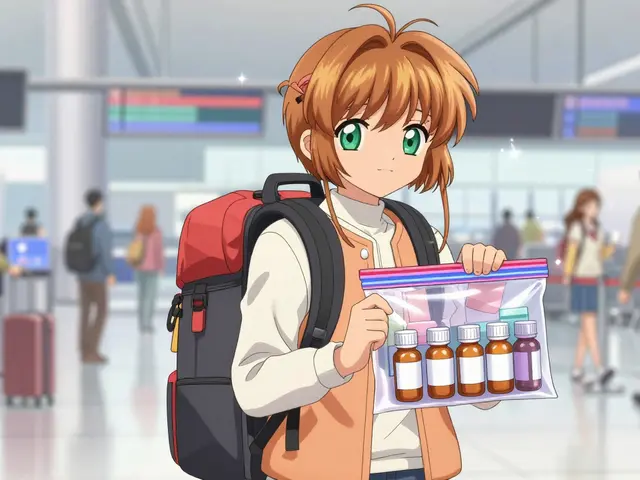
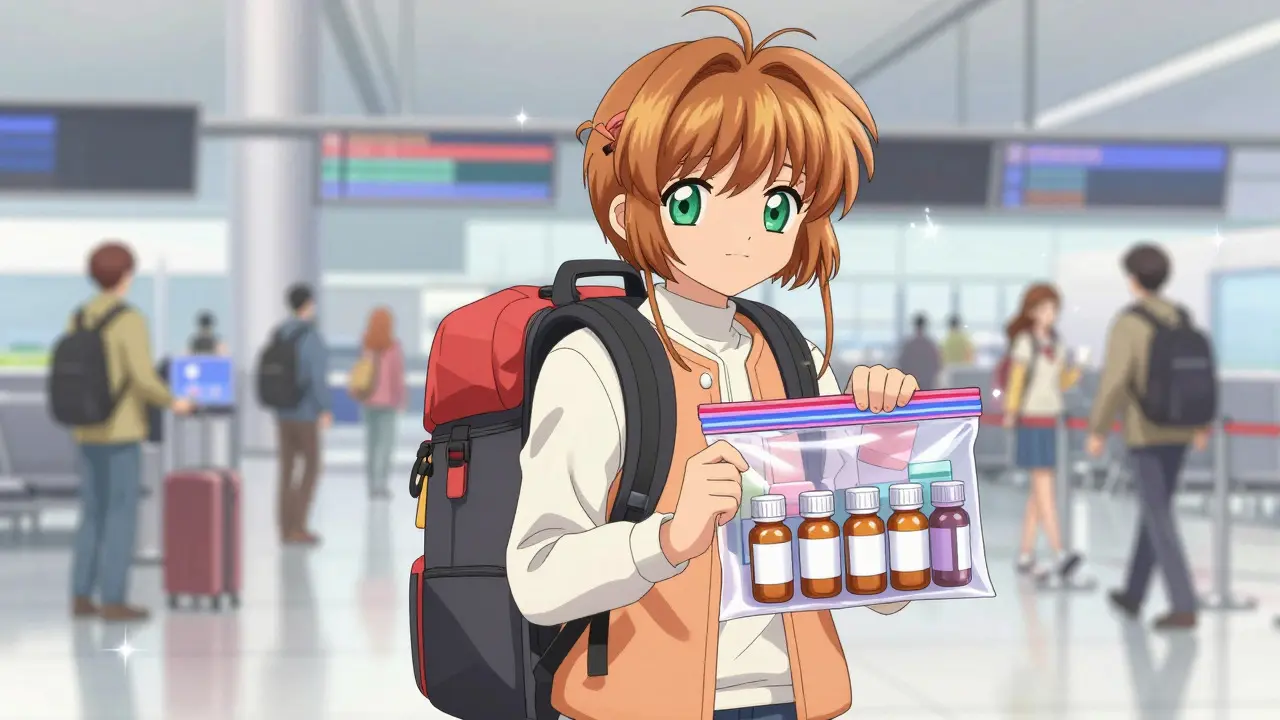
Remember the 3-1-1 rule for carry-ons? That limit usually caps liquids at 3.4 ounces. However, medication is exempt. You can bring liquid medicines, gels, and aerosols in reasonable quantities exceeding 3.4 ounces. But here is the catch: you must declare them to security officers at the checkpoint. Place these items in a separate clear plastic bag so they can be screened individually. This saves you from having to throw away expensive eye drops or cough syrup because they were buried under your socks.
For solid pills, there is no volume limit, but X-ray screening is standard. If you prefer not to have your medicine scanned, you can ask for a visual inspection, though this is less common now. Always keep your medications in your carry-on luggage. Checked bags can go missing, get delayed, or suffer extreme temperature changes in the cargo hold. The Customs and Border Protection (CBP) directive emphasizes that you should travel only with your own medication prescribed to you. Do not carry drugs for friends or family unless you have explicit documentation, as this can look like smuggling.
International Laws: What Is Legal at Home Might Be Banned Abroad
This is where most travelers get into serious trouble. Just because a doctor prescribed it in the United States does not mean it is legal in Japan, Thailand, or Brazil. The U.S. State Department notes that 67% of countries restrict at least one common U.S. medication.
Controlled substances are the biggest risk. Drugs containing codeine, certain ADHD treatments like Adderall, and sleep aids like Ambien are prohibited or strictly controlled in many nations. For example, Japan prohibits 14 common U.S. medications. A high-profile case involved a Toyota executive who was detained for 23 days in Tokyo in 2019 after customs found a controlled pain medication she had mailed to herself. She had proper intent, but she lacked the correct paperwork and understanding of local laws.
Even over-the-counter items can cause issues. Sudafed, which contains pseudoephedrine, is restricted in 28 countries. Hormone medications are controlled in 35 countries. Before you book your ticket, check the U.S. embassy website for your destination. They often list banned substances. Additionally, the U.S. State Department launched an interactive Medication Check Tool in March 2023. Use it. Enter your medication name and see if it is allowed in your destination country. Ignorance of local laws is rarely accepted as an excuse by foreign police.

Managing Time Zones and Dosage Schedules
Crossing time zones messes up your internal clock, and it messes up your medication schedule too. Taking your morning pill at midnight can lead to side effects like drowsiness or stomach upset at the wrong time. Conversely, skipping a dose can be dangerous for conditions like epilepsy or heart disease.
WebMD suggests that for most medications, it is safe to take your dose 1 to 2 hours early or late. The key rule is: never double up doses to "catch up." Instead, shift your schedule gradually. If you are traveling east (losing time), try taking your medication slightly earlier each day before you leave. If you are traveling west (gaining time), push it later.
Use technology to your advantage. Set alarms on your phone for both your home time and your destination time. Many travelers report using apps like Medisafe Travel to track doses across different zones. For critical medications, consult your doctor before you go. They might adjust your dosage or switch you to a long-acting version that is less sensitive to timing errors.
Storage and Temperature Control
Medicines are sensitive. Heat, cold, and humidity can degrade their effectiveness. Most solid tablets and capsules should be stored below 86°F (30°C). If you are visiting a tropical destination, your hotel room or car could easily exceed this temperature. Keep your meds in a cool, dry place, away from direct sunlight.
Refrigerated medications like insulin require more care. Insulin needs to stay between 36°F and 46°F (2°C to 8°C). You cannot rely on a hotel mini-fridge being set correctly. Invest in a pharmaceutical-grade cooling pack designed for travel. These packs can maintain the correct temperature for 48 hours or more. When going through security, frozen gel packs are allowed as long as they are frozen solid when presented for screening. If they are partially melted, they may be subject to additional screening.
If you are traveling for an extended period, talk to your pharmacist about multi-dose packaging. Some pharmacies offer blister packs that protect individual doses from moisture and heat better than loose bottles.
What To Do If You Get Sick Abroad
Despite your best plans, you might run out of medicine or develop a new symptom. Here is the hard truth: U.S. prescriptions are generally not valid abroad. You cannot walk into a pharmacy in Paris or Bangkok and show your American script for a refill. As Dr. William Schaffner from the CDC noted, overseas pharmacies cannot refill U.S.-based prescriptions.
If you run low, contact your doctor back home immediately. They might be able to send an electronic prescription to a pharmacy near you, but this depends on local regulations and the pharmacy's willingness to accept it. Alternatively, visit a local clinic. Bring your original medication container with you so the local doctor can see exactly what you are taking. This helps avoid duplicate therapy or dangerous interactions.
Language barriers can be a major hurdle. Carry a laminated card with your medical history, allergies, and current medications translated into the local language. Apps can help, but a physical card works even if your phone dies. In emergencies, know the local emergency number. In Europe, it is 112. In many Asian countries, it varies, so check your embassy guide beforehand.
Planning Ahead: The Three-Week Rule
Do not wait until the night before your flight. Start your medication travel planning at least three weeks before departure. This timeline allows for:
- Getting refills from your pharmacy (insurance often allows early refills for travel).
- Scheduling a visit with your doctor for letters and consultations.
- Verifying legality in your destination country.
- Ordering special cooling equipment if needed.
Consulting a travel health clinic can also be worthwhile. There are about 1,200 travel clinics in the U.S., charging between $50 and $150 for a consultation. They provide expert advice on vaccines, malaria prevention, and medication logistics. For complex needs, this small investment can save thousands in medical bills or legal fees later.
Can I bring my medication in checked luggage?
It is strongly recommended that you keep all medications in your carry-on luggage. Checked bags can be lost, delayed, or exposed to extreme temperatures in the cargo hold, which can ruin temperature-sensitive drugs. If your carry-on is confiscated or lost, you will be left without your essential medicine.
Do I need a doctor's note for domestic flights?
For domestic flights within the U.S., a doctor's note is not strictly required by the TSA if your medications are in their original labeled containers. However, carrying a note is helpful if you have large quantities of pills, injectables, or controlled substances, as it speeds up the screening process and reduces questions from agents.
Is Adderall legal in other countries?
Adderall is heavily restricted or banned in many countries, including Japan, South Korea, and several European nations. Even if it is legal, you often need special permits and significant documentation. Always check the specific regulations of your destination country via the U.S. State Department website before traveling.
How do I handle liquid medication at airport security?
Liquid medications are exempt from the 3.4-ounce limit. You must declare them to TSA officers at the checkpoint. Place them in a separate clear plastic bag. They may be subjected to additional screening, such as a vapor test or X-ray. Frozen gel packs are allowed if they are frozen solid when presented.
What should I do if I forget my medication at home?
Contact your prescribing physician immediately. They may be able to fax or email a prescription to a local pharmacy near you. Have a friend or family member mail your medication to your hotel address, but ensure it is tracked and insured. Note that some countries restrict incoming mail containing medications, so verify this first.