
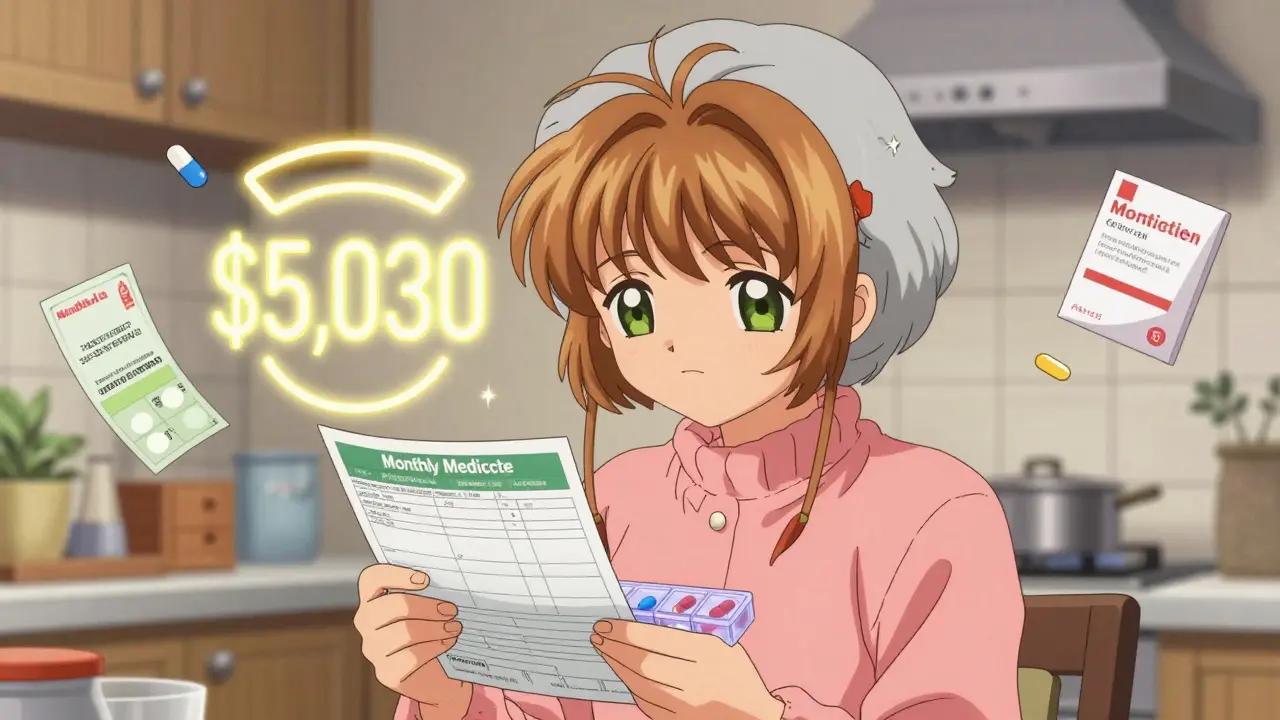
By the end of 2024, millions of Medicare beneficiaries will face a final year of the donut hole-a confusing and costly gap in prescription drug coverage. After hitting a certain spending threshold, you suddenly pay much more out of pocket for your meds. For many, this means choosing between pills and groceries. But you don’t have to wait for 2025 to take control. Even though the donut hole is disappearing next year, what you do now can save you hundreds or even thousands before it’s gone.
What the Donut Hole Actually Means in 2024
The donut hole isn’t a mystery-it’s a phase in Medicare Part D where your plan stops paying most of your drug costs. In 2024, you enter this phase after you and your plan have spent $5,030 combined on covered drugs. That total includes what you pay, what your plan pays, and manufacturer discounts on brand-name drugs. Once you hit that number, you’re in the coverage gap. You still get some help: you pay 25% of the cost for both brand-name and generic drugs. But here’s the catch: for brand-name drugs, 70% of the price is covered by the drugmaker, and 5% by your plan. Only your 25% counts toward getting out of the gap. For generics, your plan pays 75%, you pay 25%, and no manufacturer discount applies. That means if you’re on expensive brand-name drugs, you’ll hit catastrophic coverage faster than someone taking generics.
For example, someone taking Humira ($1,200/month) might spend $3,300 out of pocket before reaching catastrophic coverage. Someone on a generic blood pressure med might spend $6,000 before getting the same relief. That’s why knowing your drugs’ tier and how discounts work matters more than ever.
How to Know If You’re Heading Into the Gap
You won’t get a letter saying, “You’re entering the donut hole next week.” You have to track it yourself. Every time you fill a prescription, your pharmacy or plan sends you a statement showing your year-to-date spending. Check it monthly. If you’re on multiple medications, add up what you’ve paid so far, plus what your plan has paid. Don’t forget: manufacturer discounts on brand-name drugs count toward your out-of-pocket total. Use the Medicare Plan Finder tool to estimate your spending based on your exact drugs. Input your medications, dosage, and pharmacy. It will show you exactly when you’ll hit the $5,030 mark. If you’re close, start planning now.
Switch to Generics When You Can
One of the biggest savings moves you can make is switching from brand-name drugs to generics-when your doctor agrees. A 2023 GoodRx analysis found that common brand-name drugs like Lipitor, Nexium, and Synthroid have generic versions that cost 80-90% less. For someone taking three brand-name drugs, switching could save $1,200 to $2,500 a year. That’s not just a few bucks-it’s rent money. Talk to your doctor about alternatives. Ask: “Is there a generic version that works just as well?” Many doctors assume you know the difference, but most beneficiaries don’t. You have the right to ask.
Use Manufacturer Patient Assistance Programs
Big drug companies offer programs that cut your costs dramatically-sometimes to just $5 a month. Amgen’s Repatha program, for instance, helped one beneficiary drop from $560 to $5 per dose during the donut hole. Eli Lilly, Pfizer, and AbbVie all have similar programs for Humira, Enbrel, and other high-cost drugs. These aren’t hidden secrets-they’re listed right on the drugmaker’s website. Search “[Drug Name] patient assistance program.” You’ll need your prescription, income info, and Medicare number. Most take less than 15 minutes to apply. And if you’re approved, they’ll mail you coupons or cards to use at the pharmacy. Don’t wait until you’re in the gap to start. Apply early. Some programs require you to reapply every year.
Get a 90-Day Supply Through Mail Order
Buying a 90-day supply instead of three 30-day fills can cut your copay by 15-25%. That’s because mail-order pharmacies often charge a flat fee, not a percentage. For example, if your 30-day copay is $45, your 90-day might be $90 instead of $135. That’s $45 saved every three months. Many Medicare Part D plans encourage mail order by offering lower costs for it. Check your plan’s formulary to see which drugs are available through mail order. Then call your pharmacy or log into your plan’s portal to switch. Some plans even deliver automatically. It’s one of the easiest ways to stretch your budget without changing your meds.
Apply for Extra Help (Low-Income Subsidy)
If your income is below $22,590 (single) or $30,660 (married), you may qualify for Extra Help. This federal program pays your Part D premiums, deductibles, and copays-and it completely eliminates the donut hole. In 2023, over 12.6 million people got it. But only about half of those eligible actually applied. Why? Many think it’s too complicated or that they make “too much.” They don’t. The income limits are higher than most realize. Apply online at SSA.gov/extrahelp or call Social Security at 1-800-772-1213. You can also ask your local State Health Insurance Assistance Program (SHIP) for free help. They’ll walk you through it. If you qualify, your out-of-pocket costs could drop to $0 for most drugs.
Check Your State’s Medicare Savings Programs
Thirty-seven states run programs that help low-income Medicare beneficiaries pay premiums and out-of-pocket costs. These are separate from Extra Help but often work together. For example, in New York, the Medicare Savings Program can cover your Part D deductible and copays. In California, it pays for both Part B and Part D. These programs have different names in each state-QMB, SLMB, QI-but they all help. Visit the National Council on Aging’s website (ncoa.org) and enter your state to find what’s available. You don’t need to be poor to qualify. Many middle-income seniors get help.
Don’t Skip or Split Pills
One in three people in the donut hole cut their doses to save money. That’s dangerous. Skipping pills for blood pressure, diabetes, or heart meds can land you in the hospital. A 2023 survey by the Medicare Rights Center found that 32% of beneficiaries skipped doses, and 19% split pills. That might save $10 a month now-but it could cost you $10,000 in emergency care later. If you can’t afford your meds, talk to your doctor or pharmacist. They can help you find cheaper options, delay refills strategically, or connect you with assistance programs. Never guess your way through a prescription.
Use the Medicare Plan Finder Before 2025
Even though the donut hole is ending in 2025, your plan might not. Premiums, formularies, and pharmacy networks change every year. If you’re spending a lot now, you might be stuck in a plan that doesn’t match your needs. Use the Medicare Plan Finder tool to compare plans based on your exact medications. Filter by “lowest out-of-pocket cost for my drugs.” You might find a plan with lower premiums and better coverage that saves you $1,000+ a year. Don’t wait until Open Enrollment. Start now. You can switch plans during the Annual Enrollment Period (October 15-December 7), but if you’re in the donut hole, you might want to switch earlier if your plan changes mid-year.
What’s Changing in 2025 (And Why It Matters)
Starting January 1, 2025, the donut hole disappears. Instead, you’ll pay no more than $2,000 out of pocket for all your Part D drugs in a year. After that, your plan covers everything. That’s a huge win. But here’s what’s new: manufacturer discounts no longer count toward your $2,000 cap. That means drugmakers will pay less upfront, and plans might raise premiums slightly to make up for it. The average monthly premium in 2025 is projected to be $34.70-down slightly from 2024. Still, if you’re on expensive drugs, your total savings could be $900-$1,200 a year. The key is to keep taking your meds. The cap is designed to stop people from rationing. It’s not a loophole-it’s a safety net.
Final Tip: Talk to Your Pharmacist
Your pharmacist knows more about your meds than you think. They see your refill history, know which drugs have coupons, and can spot when a cheaper alternative is available. Ask them: “Is there a way to lower my cost this month?” or “Do you know if my drug has a patient program?” Many pharmacies offer free discount cards or have partnerships with drugmakers. Don’t assume they’ll tell you unless you ask. Take your pill bottles with you. Be specific. A quick chat could save you $50 a month.
Is the donut hole gone in 2025?
Yes. Starting January 1, 2025, the Medicare Part D coverage gap (donut hole) will be eliminated. Instead of entering a phase where you pay more for drugs, you’ll pay no more than $2,000 out of pocket for all your prescription medications in a year. After that, your plan covers everything. This change comes from the Inflation Reduction Act of 2022.
How do I know if I’m in the donut hole?
You’re in the donut hole when you and your plan have spent $5,030 combined on covered drugs in 2024. Your pharmacy or plan sends you a statement each time you fill a prescription. It shows your year-to-date spending. If you’re close to $5,030, you’re nearing the gap. Use the Medicare Plan Finder tool to estimate your spending based on your specific drugs and pharmacy.
Do manufacturer discounts count toward getting out of the donut hole?
Yes-for brand-name drugs only. In 2024, 70% of the cost of brand-name drugs is covered by the manufacturer, and that amount counts toward your out-of-pocket total to exit the donut hole. For generics, no manufacturer discount applies, so you pay 25% and your plan pays 75%. Only your 25% counts toward getting out. That’s why people on brand-name drugs get out of the gap faster.
Can I switch Medicare Part D plans if I’m in the donut hole?
Yes, but only during the Annual Enrollment Period (October 15 to December 7). You can’t switch mid-year unless you qualify for a Special Enrollment Period-for example, if you move or lose other coverage. If you’re spending a lot in the donut hole, use the Medicare Plan Finder to compare plans now. You can switch to a better one next fall to avoid high costs next year.
What if I can’t afford my meds even with these strategies?
Talk to your doctor or pharmacist immediately. You may qualify for Extra Help (Low-Income Subsidy), state assistance programs, or patient assistance programs from drugmakers. Never skip or split pills-this can lead to serious health problems. There are resources available. Contact your State Health Insurance Assistance Program (SHIP) for free, personalized help. You’re not alone.
Comments
I literally cried reading this. My mom’s on Humira and we were about to choose between her meds and her insulin until we found the patient assistance program. Now she pays $5 a dose. I wish I’d known this sooner.
THIS IS WHY AMERICA IS BROKE. Drug companies are ROBBING seniors blind and the government lets them. Why don’t we just nationalize pharma like every other civilized country??
so i just checked my statement and i’m at $4800 already and i’m only in june?? and i take 3 generics and one brand name and the brand name is the one that counts?? wait so if i switch to generic now will it reset?? or does it just keep adding??
OMG YES TO MAIL ORDER!!! 🙌 I switched my blood pressure med to 90-day and saved $60 a month. Also got a free $25 coupon for my next refill from the pharmacy. Life-changing. 🏥💸
Let’s be real. None of this matters if your plan’s formulary changes next month. You think you’re safe with your generics until they move them to tier 4 and jack up the copay. This whole system is a scam wrapped in a checklist.
While the article provides useful guidance, it is regrettably lacking in structural rigor. The absence of statistical references to peer-reviewed studies on cost-shifting mechanisms undermines its credibility. One must question whether anecdotal savings truly reflect systemic reform.
I’ve been thinking a lot about how we treat health as a commodity instead of a right. These strategies help, sure-but they’re Band-Aids on a broken system. The fact that someone has to spend hours researching coupons just to stay alive… that’s not efficiency. That’s moral failure.
It’s imperative to leverage the formulary tiering architecture and optimize pharmacoeconomic alignment via manufacturer rebate cascades. If you’re not leveraging the 340B program or engaging in prior authorization arbitrage, you’re leaving 30-40% of potential savings on the table. This isn’t healthcare-it’s financial engineering.
Thanks for this. I shared it with my neighbor who’s on insulin and she didn’t even know about Extra Help. We filled out the application together last week. She’s going to get approved. Small wins matter.
My dad split his pills for 6 months. Ended up in the ER with a stroke. Don’t be that person. Just ask. Someone’s always got a coupon, a program, or a friend who works at the pharmacy. Seriously. Just ask.
USA is weak. In Nigeria we just pay cash and get meds from the local chemist for 1/10 the price. Why you all need so many papers and forms? Just give the money and get the pill. This system is a joke.