
Antihistamine Overdose Risk Calculator
This calculator helps you determine if an antihistamine dose may be dangerous based on the type of antihistamine, amount ingested, and the person's body weight. Remember: This is not medical advice. Always call Poison Control at 1-800-222-1222 immediately if you suspect an overdose.
When someone takes too much antihistamine, minutes matter. It’s not just about feeling drowsy - it can mean a racing heart, seizures, trouble breathing, or even cardiac arrest. Antihistamine overdoses are more common than most people think, especially with kids getting into medicine bottles or adults doubling up on doses out of confusion. The good news? If you act fast, survival rates are nearly 100%. The key is knowing exactly what to do before emergency help arrives.
Recognizing the Signs of an Overdose
Not all antihistamine overdoses look the same. First-generation antihistamines like diphenhydramine (Benadryl), chlorpheniramine, and promethazine are the most dangerous. They cross the blood-brain barrier and block acetylcholine, leading to anticholinergic toxicity. Symptoms usually show up within 30 minutes to 2 hours after ingestion.- Extreme drowsiness or unresponsiveness
- Fast or irregular heartbeat (over 120 bpm)
- Blurred vision or dilated pupils
- Dry mouth, flushed skin, no sweating
- Difficulty urinating
- Confusion, hallucinations, or agitation
- Seizures or loss of consciousness
The most critical red flag? A QRS complex wider than 100 milliseconds on an electrocardiogram. That’s a sign of sodium channel blockade, which can lead to ventricular arrhythmias. Diphenhydramine is the biggest culprit here - it’s involved in 83% of serious pediatric overdoses and 62% of all severe cases.
Immediate First Aid Steps
If you suspect an overdose, don’t wait for symptoms to get worse. Time is your most valuable resource.- Call Poison Control immediately. In the U.S., dial 1-800-222-1222. This is free, confidential, and staffed by toxicology experts 24/7. They’ll ask for the person’s age, weight, the medication name, how much was taken, and when. Don’t guess - bring the bottle with you.
- Do NOT induce vomiting. This is a common mistake. If the person is drowsy or unconscious, vomiting can cause aspiration - meaning stomach contents enter the lungs, which can be fatal. The American Association of Poison Control Centers says 98% of cases are managed safely without vomiting.
- Remove any remaining pills or liquid from the mouth. If it’s a child who swallowed a tablet, gently wipe out the mouth with a damp cloth. Don’t force anything.
- If the substance got on the skin or in the eyes, rinse immediately. For skin contact, wash with soap and water for at least 15 minutes. For eye exposure, flush with cool running water for 20 minutes. Don’t rub.
- Keep the person awake and sitting up. If they’re drowsy, lay them on their side to prevent choking. Don’t let them sleep until medical help arrives.
Parents often think, “They’re just sleepy - I’ll watch them for a bit.” But symptoms can spike suddenly. One Reddit user shared that their 2-year-old took 50 mg of Benadryl - five times the dose - and seemed fine for an hour. Then they started having seizures. Poison control told them to go to the ER right away. That delay could have cost them everything.
What Happens at the Hospital
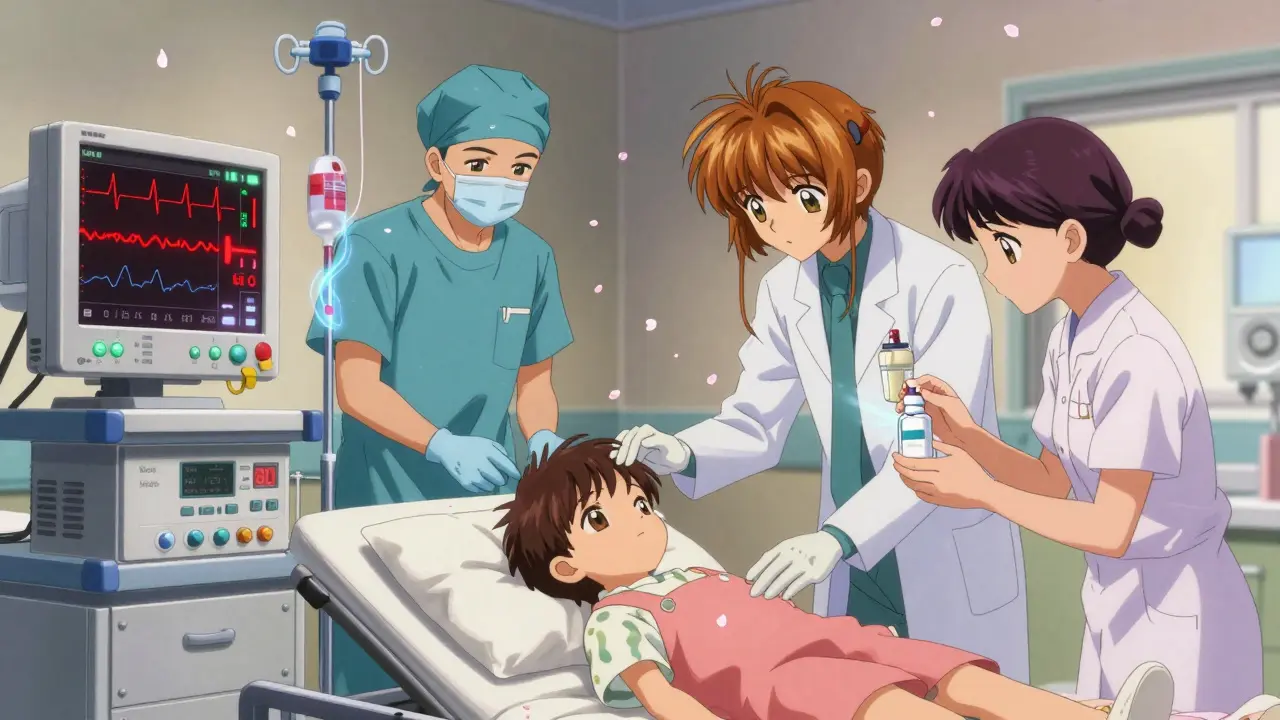
Once you get to the emergency room, the team will assess the situation fast. They’ll check vital signs, run an EKG, and ask for details about the medication. If it’s a first-generation antihistamine overdose, they’ll likely start these interventions:- Activated charcoal. Given within 1-2 hours of ingestion, it binds to the drug in the gut and stops more from being absorbed. Adults get 25-100 grams; kids get 0.5-1 gram per kilogram of body weight.
- Continuous EKG monitoring. For doses over 300 mg of diphenhydramine, or any case with QRS widening, the patient will be monitored for at least 6 hours - sometimes up to 24.
- Benzodiazepines. If the person is agitated, having seizures, or in delirium, lorazepam or midazolam are given. These calm the central nervous system without worsening heart problems. Physostigmine, once used to reverse anticholinergic effects, is no longer recommended - it can trigger dangerous heart rhythms.
- Sodium bicarbonate. If the QRS interval is over 120 ms and the heart rate is above 120 bpm, doctors may give IV sodium bicarbonate. This helps narrow the QRS complex and stabilize the heart. A 2022 study in the New England Journal of Medicine showed it cuts arrhythmia risk by nearly half.
- IV fluids. Used to maintain blood pressure and support kidney function. Antihistamines are highly protein-bound (70-95%), so dialysis or urine alkalinization won’t help.
Most patients stay in the hospital for 24-48 hours. The median length of stay is just over 22 hours, according to a 2022 study in the Journal of Medical Toxicology. Recovery is usually complete, but complications like prolonged QT interval or respiratory depression can linger.
Why Some Antihistamines Are Far More Dangerous
Not all antihistamines are created equal. The difference between first and second-generation drugs isn’t just about sedation - it’s about toxicity.| Antihistamine | Generation | Typical Toxic Dose | Major Risks | Severity Rate in Children |
|---|---|---|---|---|
| Diphenhydramine (Benadryl) | First | > 7.5 mg/kg or 300 mg | QRS widening, seizures, cardiac arrest | 1.8% serious outcomes |
| Chlorpheniramine | First | > 4 mg/kg | Respiratory depression, coma | 1.5% serious outcomes |
| Promethazine | First | > 25 mg | Sudden infant death, hypotension | High risk in infants |
| Cetirizine (Zyrtec) | Second | > 100 mg | Mild tachycardia, dizziness | 0.2% serious outcomes |
| Loratadine (Claritin) | Second | > 100 mg | Very rare severe effects | 0.1% serious outcomes |
| Fexofenadine (Allegra) | Second | > 1,000 mg | Minimal risk | 0.05% serious outcomes |
Here’s the kicker: diphenhydramine makes up only 28% of all antihistamine sales, but causes 62% of serious overdoses. Why? It’s cheap, widely available, and often used as a sleep aid. Many adults don’t realize how little it takes to overdose - just 10 tablets of 25 mg can be toxic. And in kids, a single dose of children’s liquid Benadryl (12.5 mg) can be dangerous if they get two or three.
Preventing Overdose in the First Place
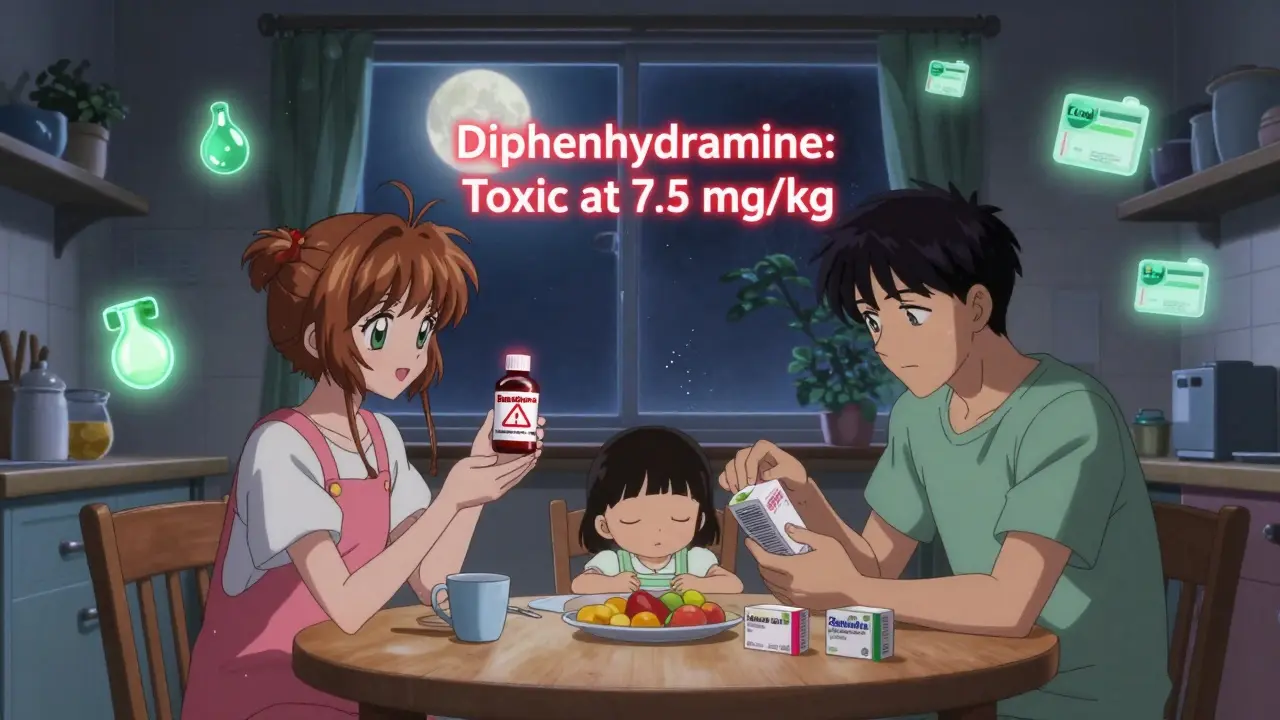
Most antihistamine overdoses aren’t intentional. They’re accidents.- Keep all meds out of reach. The AAPCC reports 67% of pediatric cases involve children under 6 who found bottles on counters or in purses.
- Use child-resistant caps - and keep them closed. Even with child-resistant packaging, 42% of pediatric exposures happen because caregivers misread dosing cups.
- Don’t mix medications. Many cold and sleep aids contain diphenhydramine. Taking Tylenol PM with Benadryl doubles your dose without realizing it.
- Check labels for active ingredients. “Non-drowsy” doesn’t mean safe in overdose. Always look for “diphenhydramine,” “chlorpheniramine,” or “doxylamine.”
- Don’t use antihistamines to sedate kids. The FDA banned this for children under 2 in 2008. Promethazine has a black box warning for sudden infant death.
One mother on Reddit said she used Benadryl to help her toddler sleep on a long flight. Her child ended up in the ER. She didn’t know the dose was for adults. That’s the problem - most people think antihistamines are harmless because they’re sold over the counter.
What to Do After the Emergency
Once the crisis is over, don’t assume everything’s fine. Follow up with your doctor or a poison control specialist.- Ask for a copy of the hospital’s treatment notes - especially the EKG results.
- Review all medications in your home. Get rid of expired or unnecessary antihistamines.
- If the overdose was accidental, talk to your pharmacist about safer alternatives. For allergies, consider second-generation options like fexofenadine or loratadine.
- If it was intentional (even once), seek mental health support. Only 18% of adult overdoses are suicide attempts, but that number rises sharply in people with depression or anxiety.
The bottom line? Antihistamine overdoses are preventable. They’re treatable. But they’re not harmless. If you ever suspect someone has taken too much - even if they seem fine - call poison control. Don’t wait. Don’t guess. Just call.
What should I do if my child swallows a whole bottle of Benadryl?
Call Poison Control at 1-800-222-1222 immediately. Do not try to make them vomit. Keep them awake and sitting up. Bring the bottle with you to the ER. Even if they seem fine, they need to be monitored for at least 6 hours. A single bottle of 25 mg tablets can contain 20-30 doses - far beyond the toxic threshold of 7.5 mg/kg.
Can I treat an antihistamine overdose at home?
Only if poison control tells you to. For very small doses - under 7.5 mg/kg in children or under 300 mg in adults - they may advise home observation. But you must watch for symptoms: rapid heartbeat, trouble urinating, extreme drowsiness, or confusion. If any appear, go to the ER. Never assume it’s safe just because the person is sleeping.
Is it safe to use activated charcoal at home?
No. Activated charcoal is a medical treatment and should only be given in a hospital or under direct supervision by poison control. Taking it incorrectly can cause choking, aspiration, or bowel blockage. It’s not something to keep on your shelf.
Why can’t they just flush the drug out with fluids or dialysis?
Antihistamines like diphenhydramine bind tightly to proteins in the blood (70-95%) and spread widely into body tissues - up to 5 liters per kilogram of body weight. That means they’re not floating freely in the bloodstream where dialysis or urine alkalinization can remove them. The body has to metabolize them naturally, which takes hours. That’s why supportive care - not elimination - is the focus.
Are second-generation antihistamines completely safe in overdose?
Mostly, yes. Cetirizine, loratadine, and fexofenadine rarely cause serious problems. But massive overdoses - like 100 mg of cetirizine or 1,000 mg of fexofenadine - can still cause dizziness, fast heart rate, or QT prolongation. While death is extremely rare, it’s not impossible. Always call poison control even if you think it’s "just Zyrtec."
How long should someone be monitored after an overdose?
At least 4-6 hours for mild cases. For doses over 300 mg of diphenhydramine or any sign of QRS widening, monitoring should last 24-48 hours. Cardiac effects can peak between 4 and 6 hours after ingestion, and arrhythmias can appear even after symptoms seem to improve. Don’t leave the hospital early just because you feel better.
Can antihistamine overdose cause long-term damage?
In most cases, no - if treated promptly. But delayed treatment can lead to brain injury from seizures or lack of oxygen, kidney damage from rhabdomyolysis, or heart damage from prolonged arrhythmias. The earlier you get help, the lower the risk of lasting harm.
Comments
Why are we even talking about this like it's a big deal? In Nigeria we just give them water and wait if they wake up. These American hospitals overcomplicate everything with EKGs and bicarbonate. It's just a pill. People need to chill.
Okay but like... have you seen the dosage on Benadryl bottles?? It's literally 25mg per tablet and people think it's candy?? I had a roommate who took 12 because she 'wanted to sleep harder' and then she was hallucinating that her cat was singing opera. Like. We called poison control and they were like 'yep that's a medical emergency' and I was like 'I thought it was just a sleepy pill??' I still don't understand how this isn't common knowledge. Like. Why is this even a thing??
Correct. The QRS widening is the critical marker. Not sedation. Not dry mouth. Not even tachycardia. It's the widened QRS that predicts ventricular arrhythmia risk. That's why activated charcoal only works within 1-2 hours-and why sodium bicarbonate is the only antidote that actually targets the sodium channel blockade. This isn't folklore. It's pharmacokinetics. Please stop treating antihistamines like they're aspirin.
As someone who works in rural India, I see this ALL the time. Grandmas give Benadryl to babies for colds because 'it helps them rest.' Moms give it to toddlers on flights because 'they're so hyper.' And then they panic when the kid goes quiet. The real problem? No one knows the difference between first-gen and second-gen. We need community health workers to go door-to-door with simple posters: 'Benadryl = Danger. Zyrtec = Safe.' No jargon. Just pictures. A pill with a red X and a pill with a green check. And we need to make sure pharmacies stop selling big bottles of diphenhydramine without a warning label. This isn't just about knowledge-it's about access, culture, and design. We can fix this if we stop blaming parents and start fixing the system.
Bro I took 40 Benadryl once just to see what would happen. I thought I was gonna die. I didn't. I just slept for 14 hours and woke up with the worst headache of my life. Like. Why is everyone acting like this is some kind of death sentence? I'm not saying it's safe. But the fear-mongering is out of control. You're telling me a 2-year-old getting 25mg is a cardiac emergency? My cousin's kid took 30mg and was back to playing with Legos in 3 hours. Maybe we need to stop panicking and start trusting bodies a little more?
Just want to say... this post is 🔥. I shared it with my whole family. My aunt used to give her grandkids Benadryl to make them 'behave' at weddings. Now she uses Zyrtec. I'm so proud. 🙌 Also, if you're reading this and you're a parent-please, please, please check your medicine cabinet. I found 3 different bottles with diphenhydramine in mine. Threw them all out. Life is too short for accidental overdoses. Stay safe out there 💪❤️
So... we're spending 48 hours in the hospital because someone took 10 pills... but we're not doing anything about the fact that these drugs are sold next to candy in every gas station? The real emergency is capitalism.
Agreed. This is why we need standardized dosing labels. Not just 'adult dose' but 'max per kg' printed right on the bottle. And why is this still OTC? It should be behind the counter like pseudoephedrine. Simple fix. No new drugs. Just better regulation.
People are literally treating life-threatening poison like it's a sleep aid. And you wonder why our healthcare system is broken? This isn't a mistake-it's negligence. If you give your kid Benadryl to calm them down, you're not a parent. You're a liability. And if you think 'it's just one pill' you're one step away from a coroner's report. Stop being careless. People die because of this laziness.
While the clinical data presented is largely accurate, one must consider the broader epidemiological context. The incidence of anticholinergic toxicity is disproportionately influenced by socioeconomic factors, particularly in low-resource settings where polypharmacy and lack of pharmaceutical literacy converge. The over-reliance on first-generation antihistamines as sedatives reflects a systemic failure in public health education-not merely individual error.
Wow. Just wow. You wrote a whole article about something that's literally in every pharmacy. And yet somehow you missed the fact that diphenhydramine is also in NyQuil, Tylenol PM, and Advil PM? So people aren't taking 'Benadryl'-they're taking three things that all have it. And you think they're reading labels? Please. Most people don't even know what 'active ingredient' means. This isn't about education. It's about packaging. Put a skull and crossbones on the bottle. Or make it prescription only. Or both. Stop pretending people are rational actors when they're exhausted and in pain.
Interesting. The 2022 NEJM sodium bicarbonate study had a sample size of 87 patients. That's not statistically significant for a population-level recommendation. And the J Med Toxicology study on median LOS? They included mixed poisonings. This post reads like a marketing brochure for ER protocols, not evidence-based medicine. Let's not confuse correlation with causation.
My grandma in Mexico used to say, 'If you feel weird after a pill, drink milk and sit down.' Turns out she was right about the milk-it helps slow absorption. Not a cure. But a buffer. We don't need fancy hospitals for every case. We need community wisdom. And people who listen.
Call poison control. Don't wait. Don't guess. Just call.