
If you’re flying with controlled medications-like oxycodone, Adderall, Xanax, or zolpidem-you’re not just packing pills. You’re carrying legal documents that could make or break your trip. One wrong step at customs, and your medicine gets seized. You could be delayed for hours. In worst-case scenarios, you might even face detention. This isn’t fear-mongering. It’s reality. The CDC reports that 23% of travelers who bring controlled substances without proper paperwork have their meds confiscated. But if you do it right? That number drops to 5%.
What Counts as a Controlled Medication?
Not every prescription is treated the same at borders. Controlled substances are drugs regulated under international treaties because of their potential for abuse or dependence. These include:- Narcotics: oxycodone, hydrocodone, codeine
- Sedatives: alprazolam (Xanax), diazepam (Valium), clonazepam
- Sleep aids: zolpidem (Ambien)
- ADHD stimulants: amphetamine/dextroamphetamine (Adderall), lisdexamfetamine (Vyvanse)
- Decongestants: pseudoephedrine (Sudafed)
These aren’t just any pills. In countries like Japan, Adderall is illegal-even with a U.S. prescription. In the UAE, even a small bottle of Xanax can land you in jail. The key isn’t just having your prescription. It’s proving you need it, and that you’re not smuggling.
The Three Must-Have Documents
You need more than a pill bottle. You need proof. Here’s what every traveler with controlled meds should carry:- Your original prescription-in the pharmacy’s original bottle, with your name, the doctor’s name, and clear labeling. Never repack into travel containers. Customs officers see that as suspicious. 53% of U.S. customs issues come from repackaged meds.
- A doctor’s letter-printed on official letterhead, signed, and dated. It must include: your full name (matching your passport), medication names (brand and generic), dosage, how often you take it, why you need it, and your doctor’s contact info and license number. The CDC says this single document cuts border issues by 89%.
- A copy of your passport and visa-if you’re not a citizen of the country you’re entering. Some countries require this even if you’re just transiting.
And if your prescription isn’t in English? Get it translated. Not by Google Translate. Use a certified translator. The American Translators Association says 41% of travelers face delays because their documents weren’t properly translated.
How Much Can You Bring?
There’s no universal limit, but most countries follow a 90-day personal-use rule. The FDA allows foreign visitors to bring in up to a 90-day supply for personal use. If you’re staying longer, you can bring more-but you must prove it.But here’s the catch: some countries set stricter caps. For example:
- The U.S. allows up to 50 dosage units of Schedule II drugs (like oxycodone) without special paperwork. More than that? You need a DEA-registered prescription.
- Japan bans all Schedule I and II substances. That means Adderall, oxycodone, and even some ADHD meds are illegal-even with a letter.
- The UK lets you bring a 3-month supply with a valid prescription, but for narcotics, you need a special import certificate.
- Australia requires pre-approval from the Therapeutic Goods Administration for any Schedule 8 drug.
Don’t assume your U.S. prescription is enough. Always check the destination country’s rules before you book your flight.
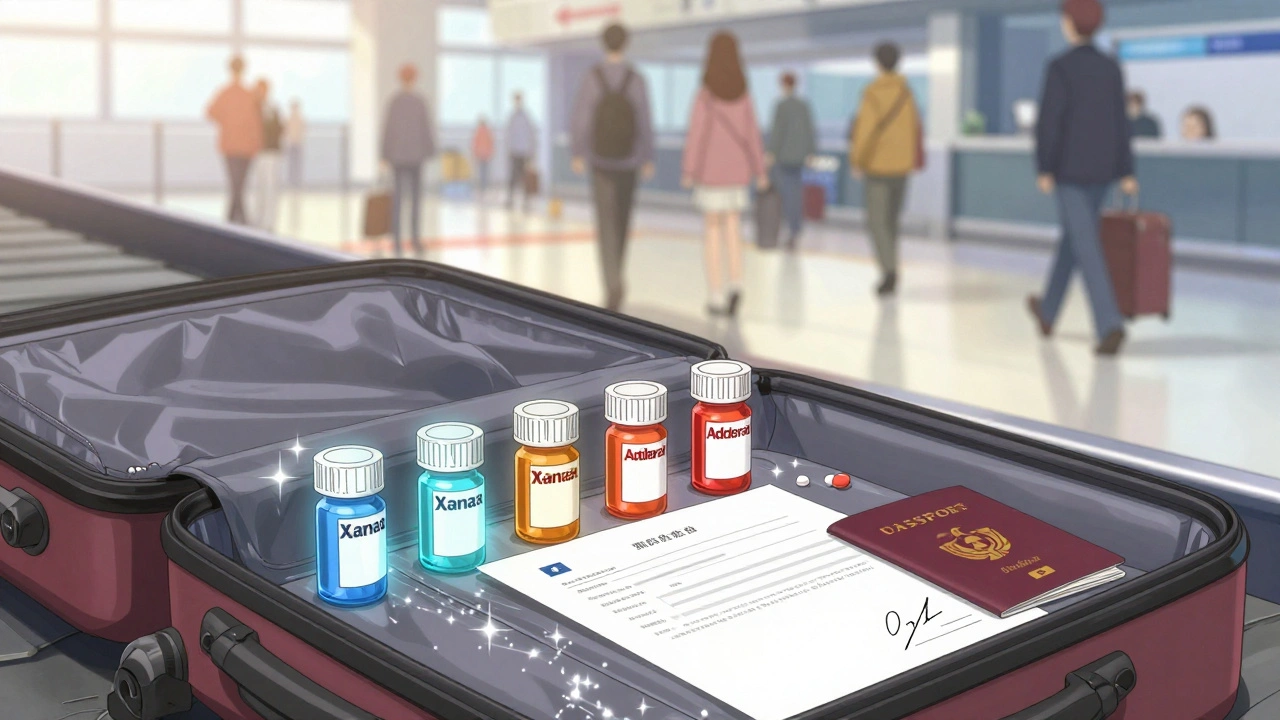
Country-Specific Rules You Can’t Afford to Miss
Some countries are strict. Others are impossible. Here’s what you need to know:- Japan: You need a Yakkan Shoumei import certificate. Apply at least 2 weeks ahead. Cost: $50. Processing time: 7-10 business days. Even with it, you can’t bring more than a 30-day supply.
- United Arab Emirates: Any benzodiazepine (Xanax, Valium) is a controlled drug. Bring a doctor’s letter and your prescription. Still, some travelers get detained. It’s risky.
- Singapore: All stimulants are banned. Adderall? Illegal. No exceptions.
- Thailand: You can bring up to a 30-day supply if you have a doctor’s letter and original packaging. But if you’re caught with more, you could face prison.
- Canada and EU countries: Generally more lenient. A doctor’s letter and original prescription are usually enough. The EU now offers digital prescriptions through the Digital Health Certificate-use it if you have it.
Pro tip: Visit the U.S. State Department’s travel website for your destination. It has up-to-date medication rules. Or use the International Association for Medical Assistance to Travellers (IAMAT) Medication Abroad tool. It’s free, accurate, and updated monthly.
How to Get the Perfect Doctor’s Letter
Don’t wing it. A weak letter gets you flagged. A strong one gets you through fast. Here’s what your letter must include:- Your full legal name (exactly as on passport)
- Each medication: brand name AND generic name
- Exact dosage (e.g., “10 mg tablets, one daily”)
- Reason for use (e.g., “treatment of chronic lower back pain,” “diagnosed ADHD”)
- Duration of trip
- Doctor’s full name, license number, phone, and clinic address
- Doctor’s signature and official stamp
- Date issued (must be within 6 months of travel)
Ask your doctor to print it on letterhead. If they’re unsure how to write it, give them this template: “I, [Doctor’s Name], confirm that [Patient’s Name] is under my care for [condition]. They are prescribed [medication] at [dosage] for [purpose]. This medication is necessary for their health and well-being during their travel from [date] to [date].”
What Happens at the Airport or Border?
You’ll likely be asked about your meds during security or customs. Stay calm. Don’t wait to be asked-be proactive.At U.S. airports, if you’re flying internationally, keep your meds and documents in your carry-on. Never check them. If you’re entering another country, go to customs first, not baggage claim. Have your letter and prescription ready. Say clearly: “I have prescription medication for a medical condition. Here’s my doctor’s letter and original prescription.”
Don’t lie. Don’t hide. Officers have databases. If you say you have 30 pills and they find 60, you’re in trouble. If you’re nervous, practice with a friend. One traveler on Reddit said: “I rehearsed my script three times before flying to Japan. I got waved through in 90 seconds.”
What If You Get Stopped?
It happens. Even with perfect paperwork. If you’re detained:- Stay polite. Arguing makes it worse.
- Ask to speak to a supervisor.
- Call your country’s embassy. They can’t get your meds back, but they can help you get legal support.
- Don’t sign anything without understanding it.
One traveler at JFK in August 2023 was held for 47 minutes because he had 60 oxycodone tablets but no doctor’s letter. He called his doctor, who faxed a letter. He was released with his meds. He didn’t get fined. He didn’t get arrested. He just didn’t prepare.
Future Changes: What’s Coming
The system is slowly getting better. The FDA is testing a new app called “Traveler Medication Pre-Clearance” that lets you upload your docs before you fly. Pilot results show it cuts inspection time by 65%. It’s expected to roll out in late 2025.The International Narcotics Control Board is also working on a global standard travel certificate for meds-set to launch in 2026. Until then, you’re stuck with the patchwork system. But you can outsmart it.
Final Checklist Before You Fly
Do this 3 weeks before departure:- ✅ Confirm your meds are legal in every country on your itinerary
- ✅ Get your doctor’s letter with all required details
- ✅ Translate your prescription if needed (certified translator)
- ✅ Keep all meds in original pharmacy bottles
- ✅ Carry copies of your passport and visa
- ✅ Put everything in your carry-on
- ✅ Print 2 copies of your letter-one for your bag, one for your phone
- ✅ Save your doctor’s contact info in your phone
If you follow this, you’re not just prepared. You’re protected. You’re not risking your health, your trip, or your freedom. You’re traveling smart.
Can I bring my controlled medication in a pill organizer?
No. Always keep controlled medications in their original pharmacy bottles with clear labels. Customs officers see repackaged pills as suspicious-even if they’re yours. 53% of U.S. customs issues happen because people moved meds into travel containers. Keep the bottle, carry the letter, and you’ll be fine.
Do I need a letter if I’m only carrying a 7-day supply?
Technically, no-but you should still bring one. Even small amounts can trigger alarms if they’re controlled substances. A letter removes doubt. It saves time. And in countries like Japan or the UAE, even a 7-day supply of Adderall or Xanax can get you arrested without proof you need it.
What if my doctor won’t write a letter?
Most doctors will. If yours refuses, ask if they’ll sign a simple statement. If not, contact a travel clinic or urgent care center. Many offer travel medicine consultations for under $100. Some pharmacies, like CVS MinuteClinic, can help too. Don’t skip this step-your meds aren’t worth risking your trip.
Can I mail my medication ahead of time?
Almost never. The FDA blocks personal shipments of controlled substances unless they’re from a licensed pharmacy and meet strict criteria. Even then, customs may still seize them. It’s far safer-and faster-to carry your meds with you in your carry-on with proper documentation.
Are over-the-counter meds like melatonin or ibuprofen an issue?
No. Melatonin, ibuprofen, acetaminophen, and most OTC drugs are fine anywhere. But if you’re bringing large quantities (like 100 pills of something), customs might question it. Keep it reasonable. Stick to a 90-day supply, even for OTCs, just to avoid questions.
Comments
Let’s be unequivocal: the pharmacopeia of controlled substances demands a regulatory compliance framework that transcends mere bureaucratic formalities. Repackaging pills into travel containers constitutes a prima facie violation of the UN Single Convention on Narcotic Drugs, and customs officials are trained to detect such non-compliance with algorithmic precision. The 53% seizure rate isn’t anecdotal-it’s statistically significant and rooted in international treaty obligations. If you’re not carrying the original blister pack with FDA-compliant labeling and a physician’s attestation on letterhead bearing a notarized seal, you’re not a traveler-you’re a liability.
Wow. Just... wow. 😒 You people think you’re so smart bringing your Adderall to Japan like it’s a souvenir? Bro, that’s a Class A narcotic there. You think your ‘doctor’s letter’ means anything to a Japanese cop who’s seen 300 Americans try to smuggle stimulants in their toothbrush cases? You’re not ‘traveling smart’-you’re gambling with your freedom. And if you get arrested? Don’t cry to the embassy. They’ll just send you a pamphlet and a pat on the head. 🇯🇵💊
There’s something deeply human in the way we treat medication-not as a tool of survival, but as a moral test. We’ve turned medical necessity into a performance of legitimacy, where your right to health is contingent upon the aesthetic of your prescription bottle and the font size of your doctor’s letter. It’s absurd, really. The same people who demand dignity for mental illness demand you carry a notarized affidavit just to breathe. And yet, we comply-not because we believe in the system, but because we’ve learned that survival in a bureaucratic world requires performing its rituals with perfect sincerity. The real tragedy isn’t the seizure of pills. It’s the erosion of trust in the very institutions meant to protect us.
i tried bringing my xanax to dubai once… thought i had the letter but forgot the passport copy. got held for 5 hours. no jail but my nerves were fried. next time i just took my meds in original bottle + letter + printed pdf of the uae health ministry rules. they looked at it, nodded, and waved me through. peace of mind > hassle. also, dont trust google translate for med stuff. my friend got flagged because his ‘anxiety’ was translated as ‘mental illness’ lol
In India we dont even ask about meds unless its opioids. But I know people who got stopped in Singapore for melatonin. Its not about the pill. Its about the fear. Carry the letter. Keep it simple. Stay calm. Youll be fine
So let me get this straight. I need a 5-page legal document just to bring my ADHD meds on vacation? Meanwhile, my cousin flew to Thailand with a bottle of OxyContin he bought off a guy in the airport parking lot and got a free beachside villa and a complimentary massage. 🙄 I’m not sure if I’m the villain or the victim here. But I’m definitely not the one who needs a notary.
As an American, I’m tired of being treated like a criminal just because I take medication for my brain. We spend billions on border security to catch drugs… but the real drug problem is that our healthcare system makes it so damn hard to get proper documentation. My doctor charges $250 just to sign a letter. That’s a joke. If you’re not a millionaire, you’re expected to risk jail for your mental health. This isn’t travel advice. This is systemic cruelty dressed up as ‘safety’.
You got this. Seriously. Just do the 3 things: original bottle, doctor’s letter, carry-on. No drama. No panic. You’re not breaking the law-you’re following it. And if someone gives you grief? Smile, hand them the letter, and say ‘thank you for keeping us safe.’ They’ll usually back off. You’re not a suspect. You’re a patient. And you deserve to be treated like one.
It is imperative to recognize that the current regulatory architecture governing the transnational transport of controlled pharmaceuticals is a patchwork of sovereign discretion, historical precedent, and often arbitrary enforcement. The FDA’s 90-day allowance is not a right, but a tolerance. The UAE’s prohibition of benzodiazepines is not irrational-it is culturally and religiously grounded. To dismiss these frameworks as ‘overreach’ is to misunderstand the geopolitical reality of pharmacological sovereignty. The solution is not to demand global standardization, but to master the local protocols. Preparation is not a burden-it is the ethical obligation of the globally mobile patient. The fact that you are reading this means you are already on the right path.
Just wanted to say thank you for this. I’ve been on Vyvanse for 12 years and flew to Canada last year with just my bottle and a printed email from my doctor (no letterhead). They asked me two questions and waved me through. I cried in the airport bathroom. It’s not about being perfect-it’s about being prepared. And you? You’re already ahead of 90% of travelers. Take a breath. You’ve got this. 💪❤️