

A sudden, pounding headache. Sweating so heavy it soaks your shirt. Your heart races like you just ran a marathon-even though you’ve been sitting still. Then, just as quickly, it’s over. You feel fine again. If this has happened to you more than once, and your doctor keeps calling it anxiety or migraines, you might be missing something serious: a pheochromocytoma.
This isn’t just another case of high blood pressure. It’s a rare tumor, usually on one of your adrenal glands, that’s spewing out adrenaline and norepinephrine like a broken faucet. These are the same chemicals your body releases when you’re scared or in danger. But with this tumor, there’s no danger-just your body stuck in overdrive.
What Exactly Is a Pheochromocytoma?
A pheochromocytoma is a tumor that grows in the adrenal medulla, the inner part of the adrenal glands that sit on top of your kidneys. These glands normally make hormones to help you respond to stress. But when a tumor forms there, it doesn’t know when to stop. It pumps out too much epinephrine (adrenaline), norepinephrine, and sometimes dopamine-constantly.
It’s rare. Only about 1 in every 200 people with high blood pressure have it. But here’s the kicker: it’s one of the few causes of high blood pressure that can be completely cured-with surgery. That’s why finding it matters.
Most of these tumors are benign-around 90%. But even benign ones can be deadly if they’re not treated. The hormones they release can cause blood pressure spikes so extreme they trigger heart attacks, strokes, or sudden death during surgery, childbirth, or even a routine dental visit.
Why Does It Cause Such Extreme High Blood Pressure?
Essential hypertension-what most people mean when they say "high blood pressure"-is steady. It’s like a faucet dripping slowly all day. Pheochromocytoma is different. It’s a firehose turned on and off at random.
Episodes, or "spells," can last minutes to hours. During them, systolic blood pressure can shoot above 180 mmHg. That’s higher than most people ever see-even in the ER. These spikes happen without warning. You might feel fine one minute, then suddenly:
- Your head pounds like it’s going to split
- You’re drenched in sweat, even in a cool room
- Your heart feels like it’s trying to jump out of your chest
- You turn pale, feel nauseous, or have chest tightness
These spells are often triggered by things you wouldn’t expect: lifting something heavy, getting scared, going under anesthesia, or even urinating (if the tumor is in the bladder wall, which happens in about 10% of cases).
Some people also have low blood pressure when standing up-called orthostatic hypotension. That’s because the tumor messes with your body’s ability to regulate blood pressure. It’s like your system has no brakes and no gas at the same time.
Why Is It So Often Misdiagnosed?
Most doctors see one or two cases in their entire career. The symptoms look like panic attacks, migraines, menopause, or even drug use. In fact, 25% of patients are first told they have an anxiety disorder.
One woman in Portland spent four years seeing therapists, neurologists, and cardiologists. She was prescribed anti-anxiety meds, migraine preventatives, and beta-blockers. Nothing helped. Then, during an ER visit for chest pain, her blood pressure hit 240/130. That’s when someone finally ordered the right test.
The gold standard for diagnosis is a 24-hour urine test for fractionated metanephrines-the breakdown products of adrenaline and norepinephrine. This test is 96-99% sensitive. If it’s positive, you have a tumor. Blood tests for plasma-free metanephrines are almost as good.
Here’s the problem: some labs use outdated cutoffs. If your levels are only slightly high, your doctor might dismiss it. But experts say: if it’s more than three times the upper limit of normal, it’s almost certainly a tumor. Don’t let borderline results slide.
How Do Doctors Find the Tumor?
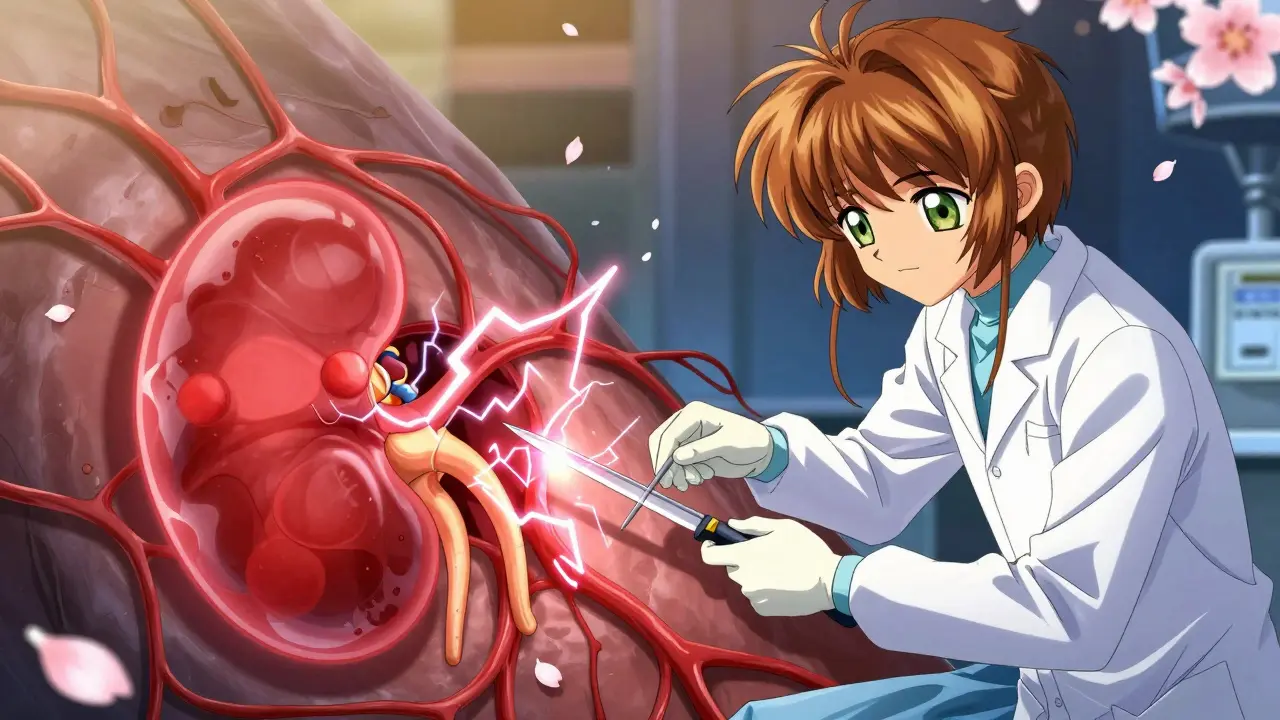
Once the blood or urine test confirms excess hormones, imaging finds the tumor. The old rule was the "10-10-10 rule": 10% are bilateral, 10% are outside the adrenal gland (called paragangliomas), and 10% are cancerous. But newer data shows those numbers are higher in people with genetic mutations.
CT or MRI scans are the first choice. But if those don’t show anything and you still have symptoms, a special PET scan called 68Ga-DOTATATE is now the most accurate-it finds tumors 98% of the time, even tiny ones.
And here’s something many don’t realize: up to 40% of pheochromocytomas are inherited. Mutations in genes like SDHB, SDHD, VHL, RET, and NF1 are common. That’s why genetic testing isn’t optional-it’s required. Even if no one in your family has had it. You could be the first.
Why Surgery Is the Only Real Cure
Medications can control symptoms. But they don’t fix the problem. Only removing the tumor does.
But you can’t just go in and cut it out. That’s where things get dangerous. If the tumor is still releasing adrenaline during surgery, your blood pressure could skyrocket. The heart can go into fatal arrhythmias. That’s why preoperative preparation is non-negotiable.
At least 7-14 days before surgery, you start alpha-blockers-usually phenoxybenzamine. These drugs block the effects of adrenaline on your blood vessels. You also drink plenty of fluids and eat a high-sodium diet. Why? Because the tumor has kept your blood vessels tight for so long, your body is low on fluid. You need to expand your volume before surgery, or you’ll crash when the tumor is removed.
The surgery itself is usually done laparoscopically-through small cuts, with a camera. Most people go home in 1-2 days. Recovery is quick: 85% are back to work within two weeks.
And the results? Amazing. After surgery, 85-90% of patients see their blood pressure return to normal. Many stop all their blood pressure meds within weeks. One man from Oregon posted on a patient forum: "My BP was 170/100 for years. Two days after surgery, it was 118/76. I haven’t taken a pill since."
What Happens After Surgery?
If only one adrenal gland was removed, your body usually adjusts fine. You might need a short course of steroids to help your body recover, but that’s temporary.
If both glands were removed-which happens in about 10% of cases-you’ll need lifelong hormone replacement: hydrocortisone and fludrocortisone. That’s because your body can’t make cortisol or aldosterone anymore. Without them, you risk Addisonian crisis-a life-threatening drop in blood pressure and energy.
Even with successful surgery, some people feel exhausted for months. Fatigue lasting over six months happens in about 12% of cases. It’s not fully understood, but it’s real. Don’t brush it off as "just recovery."
What About Cancer?
Only about 10% of pheochromocytomas are malignant. But telling the difference between benign and malignant isn’t always possible by looking at the tumor under a microscope. It’s based on whether it spreads-usually to bones, liver, or lymph nodes.
If it spreads, surgery isn’t enough. Treatments like 177Lu-DOTATATE (a type of targeted radiation) are now being used. Early results show a 65% response rate. New drugs like Belzutifan are also showing promise for people with VHL-related tumors.
Long-term survival for benign cases is excellent-95% at 10 years. For metastatic disease, it drops to about 50% at 5 years. That’s why lifelong follow-up is critical, especially if you have an SDHB mutation. These patients have up to a 50% risk of cancer and need annual whole-body MRIs.
What You Should Do If You Suspect This
If you’ve had unexplained spells of:
- Severe headaches
- Profuse sweating
- Heart palpitations
- High blood pressure that doesn’t respond to meds
-and you’ve been told it’s stress or anxiety-ask for a 24-hour urine metanephrine test. Don’t wait. Don’t assume it’s "just something else."
Find an endocrinologist who’s seen this before. Most primary care doctors haven’t. If your local hospital doesn’t have one, go to a major medical center. This isn’t a condition you want to learn on the job.
And if you’re diagnosed: get genetic testing. Talk to a genetic counselor. Tell your siblings, parents, and children. This isn’t just your problem-it could be theirs too.
Pheochromocytoma is rare. But it’s one of the few medical conditions where a simple test can lead to a cure. Don’t let it slip through the cracks. Your life might depend on it.
Can pheochromocytoma be cured without surgery?
No. While medications like alpha-blockers can control symptoms and lower blood pressure, they don’t remove the tumor. Only surgical removal offers a cure. Without surgery, the tumor continues to release dangerous levels of hormones, putting you at risk for sudden cardiac events, stroke, or death. Medications are used only to prepare you for surgery-not as a long-term solution.
Is pheochromocytoma hereditary?
Yes. Between 35% and 40% of cases are linked to inherited genetic mutations, including SDHB, SDHD, VHL, RET, and NF1. Even if no one in your family has had it, you could still carry a mutation. That’s why genetic testing is now recommended for every patient diagnosed with pheochromocytoma. If you test positive, your close relatives should be screened too.
What happens if pheochromocytoma is not treated?
Untreated pheochromocytoma can lead to life-threatening complications. The constant surges of adrenaline can cause heart rhythm problems, heart attacks, strokes, or sudden death. Even without a dramatic event, long-term high blood pressure can damage your kidneys, heart, and blood vessels. In malignant cases, the tumor can spread to other organs. Early diagnosis and treatment are critical to survival.
Can pheochromocytoma come back after surgery?
Yes, but it’s uncommon. For benign, single tumors removed completely, recurrence is less than 5% over 10 years. But if you have a genetic mutation-especially SDHB-or if the tumor was malignant, the risk goes up. Lifelong monitoring with annual blood tests and imaging is essential. Some people develop new tumors in the other adrenal gland or elsewhere in the body (paragangliomas).
What’s the difference between pheochromocytoma and paraganglioma?
They’re the same type of tumor, just in different locations. Pheochromocytoma grows in the adrenal gland. Paraganglioma grows outside the adrenal gland-often along the spine, in the chest, or in the bladder. Both produce catecholamines and cause similar symptoms. The term "paraganglioma" is used when the tumor is extra-adrenal. About 10% of these tumors are malignant, and genetic testing is just as important for both.

Comments
I used to work in endocrinology and saw a case like this back in '19. Patient came in thinking it was panic attacks - four years of SSRIs, therapy, you name it. Then one day, BP hits 230/120 during a routine blood draw. Urine metanephrines were through the roof. Turned out to be a 3cm adrenal tumor. Surgery, two days in the hospital, and he’s been off all meds since. No more midnight sweats, no more ‘anxiety.’ Just normal life. This isn’t just rare - it’s life-changing if caught.
From a biochemical standpoint, the catecholamine dysregulation here is textbook. The tumor’s constitutive secretion of epinephrine and norepinephrine bypasses normal autonomic feedback loops, leading to episodic adrenergic storm. The key diagnostic differentiator from essential hypertension is the paroxysmal nature - it’s not a chronic volume-overload state, it’s intermittent receptor overstimulation. Plasma-free metanephrines >3x ULN have >95% PPV. If your lab’s using old cutoffs, push back. This isn’t borderline - it’s diagnostic.
My sister had this. They thought it was menopause at first. She’d collapse after climbing stairs, drenched in sweat, heart racing - then be fine 20 minutes later. Doctors kept saying ‘stress.’ I begged her to get the urine test. Took three tries to find a doctor who listened. After surgery, she cried because she realized she hadn’t breathed normally in years. If you’re reading this and feel like your body’s betraying you - trust your gut. Ask for the test. You deserve to feel normal again.
So you just cut it out and boom you’re fixed? No meds forever? That’s wild. I thought all high blood pressure was forever.
Bro, this is the kind of shit that makes you question every damn doctor you’ve ever met. I’ve got a cousin who got diagnosed after a near-fatal episode during a dental cleaning - they gave her novocaine and her BP spiked to 260. They thought she was on cocaine. Turns out, she had a tumor the size of a lime chilling on her adrenal. Genetic testing found her dad had the same mutation. He died of a stroke at 52. No one knew why. Now? We all got tested. This isn’t just medical - it’s family legacy stuff. Don’t sleep on the SDHB gene. It’s a silent killer.
There’s something deeply poetic about this - your body screaming for help in the only way it knows how: adrenaline floods, panic attacks, heart palpitations. We’ve been trained to numb these signals with pills and therapy, but sometimes, the body isn’t broken - it’s warning you. Surgery isn’t just a fix, it’s a homecoming. You’re not losing a tumor - you’re reclaiming your nervous system. That man from Oregon? He didn’t just lower his BP - he got his life back. That’s not medicine. That’s magic.
So you’re telling me this whole time I thought I was just anxious… I had a ticking time bomb in my kidney?
Yeah but what if it’s just your diet? Or you’re too stressed? Maybe you just need to chill. I’ve had heart palpitations too. I drank chamomile tea and it went away. This surgery thing sounds like a money grab.
So let me get this straight - we’ve got a tumor that acts like a caffeinated ghost inside your body, and the cure is basically ‘cut it out and hope you don’t die on the table’? And the only reason we didn’t find this sooner is because doctors are too lazy to order a $200 urine test? Classic. Next up: ‘Your chronic migraines are caused by a tiny alien in your sinuses. Here’s a scalpel.’