
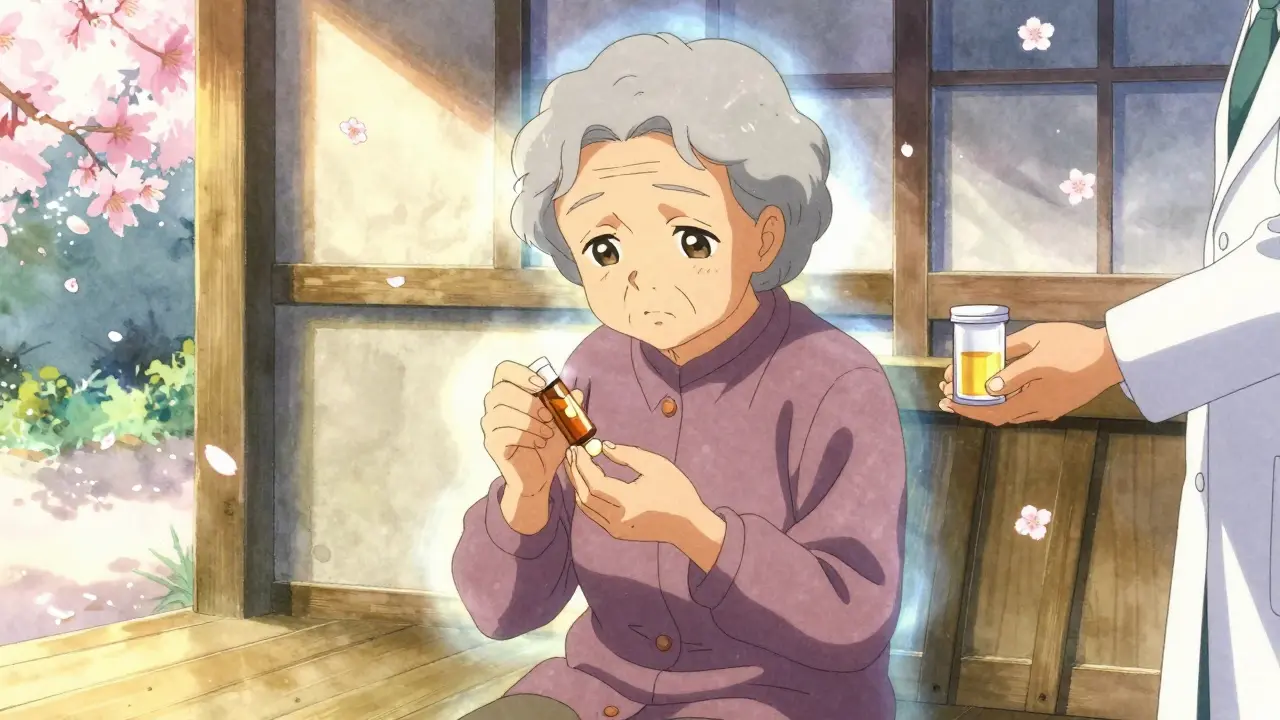
Why Opioids for Seniors Need a Different Approach
Seniors don’t respond to pain medications the same way younger adults do. As we age, our bodies change - kidneys and liver don’t filter drugs as efficiently, body fat increases, muscle mass declines, and the brain becomes more sensitive to sedatives. These changes mean that a standard opioid dose for a 40-year-old could be dangerous for a 75-year-old. Yet, pain is common in older adults, especially from arthritis, nerve damage, or cancer. The challenge isn’t avoiding opioids entirely - it’s using them safely.
For years, doctors were told to cut opioid doses sharply after the 2016 CDC guidelines. But many seniors, especially those with cancer or advanced illness, ended up in unnecessary pain. The 2022 CDC update fixed this mistake. It now clearly says: opioids are still the best option for moderate to severe cancer pain in seniors, and rigid dose limits shouldn’t block relief. The goal isn’t to avoid opioids - it’s to use them wisely.
Starting Low: The Golden Rule for Elderly Patients
If a senior has never taken opioids before, start at 30% to 50% of the usual adult dose. That means 2.5 mg of oxycodone or 7.5 mg of morphine - not the full 5 mg or 15 mg pills you might see on a prescription label. Many pharmacies can split pills or offer liquid forms to get even smaller doses. Never begin with patches or long-acting pills like extended-release oxycodone or fentanyl. These deliver steady doses over days, and if the body can’t clear the drug properly, levels build up dangerously.
One real case from a Manchester clinic: an 82-year-old woman with hip pain was given a 10 mg oxycodone tablet. Within 24 hours, she was confused, wobbly, and nearly fell. Her dose was cut to 2.5 mg twice daily. Within three days, her pain was controlled, and her alertness returned. That’s the difference between guessing and measuring.
Which Opioids Are Safer - and Which to Avoid
Not all opioids are equal for seniors. Some are outright risky. Meperidine (Demerol) and codeine should never be used. Meperidine breaks down into a toxic chemical that causes seizures and delirium, especially in older kidneys. Codeine turns into morphine slowly, but seniors often can’t metabolize it properly, leading to overdose even at low doses.
Tramadol and tapentadol are tricky. They work like opioids but also affect serotonin. If a senior is taking an SSRI antidepressant, or even an over-the-counter cough medicine with dextromethorphan, this combo can trigger serotonin syndrome - a life-threatening surge in brain chemicals. Stick to safer options: oxycodone, hydrocodone (without acetaminophen if liver is weak), hydromorphone, or morphine.
Buprenorphine stands out. It’s a partial opioid agonist, meaning it helps with pain but has a ceiling effect - it won’t cause severe breathing problems like full opioids can. Transdermal patches (like Belbuca or Butrans) are especially useful. Studies show fewer cases of constipation and no dizziness or confusion when used at low doses. Some seniors even use low-dose buprenorphine daily, with a small amount of immediate-release oxycodone for breakthrough pain - no withdrawal, no crashes.

What About Non-Opioid Alternatives?
Non-opioid options have their place, but they’re often overhyped. NSAIDs like ibuprofen or naproxen might seem safe, but they raise the risk of stomach bleeding, kidney failure, and heart problems in seniors. Use them only for short bursts - no more than one or two weeks - and never in someone with high blood pressure or heart failure.
Gabapentin and pregabalin are frequently prescribed for nerve pain. But studies show they only reduce pain by about 1 point on a 10-point scale - barely better than a placebo. Worse, they cause dizziness, confusion, and falls. A 2023 JAMA study found that after the 2016 CDC guidelines, many seniors were switched from opioids to gabapentinoids - and their pain got worse. Their balance got worse too.
Physical therapy, heat, ice, and gentle movement are underused but powerful. Cognitive behavioral therapy (CBT) helps seniors cope with chronic pain by changing how they think about it. These aren’t magic fixes, but they reduce the need for pills - and the risks that come with them.
Monitoring: The Only Way to Know If It’s Working
Starting an opioid isn’t the end of the story - it’s the beginning of careful watching. Every senior on opioids needs regular check-ins. At first, that’s every 1 to 2 weeks. After stability, monthly is enough.
Doctors should ask: Are you sleeping better? Can you walk to the bathroom without help? Has your pain dropped enough to do things you care about? Not just ‘Is the pain gone?’ - because that’s unrealistic. The goal is function, not zero pain.
Watch for red flags: new confusion, excessive drowsiness, slowed breathing, or falls. Constipation is almost universal - start a stool softener and laxative on day one. Don’t wait for it to become a problem. Check kidney and liver function every 3 months. Test urine for other drugs - not to accuse, but to catch hidden risks like mixing with benzodiazepines or alcohol.
For anyone on opioids longer than three months, a written treatment agreement is required. It outlines goals, risks, and what happens if the medication stops working or causes harm. This isn’t bureaucracy - it’s safety.
Dosing Limits and What They Really Mean
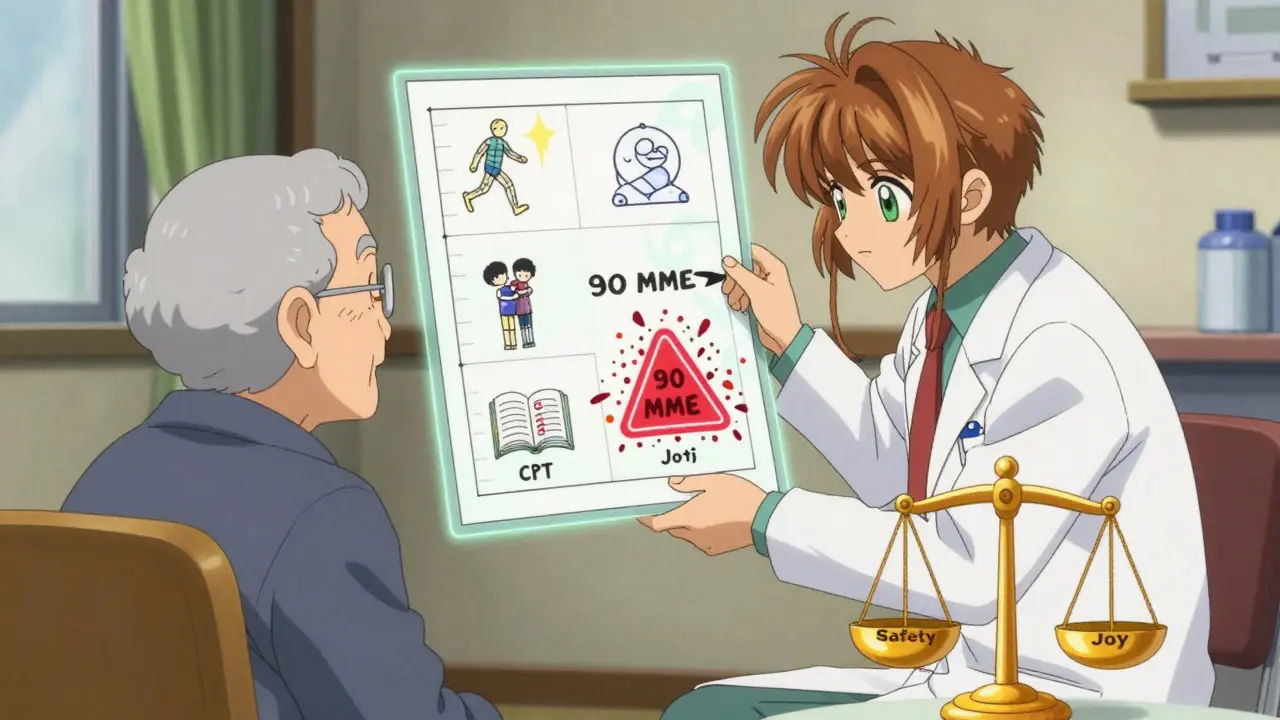
Don’t get trapped by the number 90. That’s the CDC’s threshold for ‘high-dose’ opioids - 90 morphine milligram equivalents (MME) per day. But that number was never meant for seniors. A 70-year-old with cancer might need 80 MME safely. Another might overdose at 40 MME. The real question isn’t ‘Is this over 90?’ - it’s ‘Is this helping without hurting?’
Low-dose opioids: up to 40 MME/day Medium-dose: 41-90 MME/day High-dose: over 90 MME/day
But here’s the truth: even low-dose can be too much if the patient is frail, has sleep apnea, or takes other sedatives. The dose isn’t the problem - the mismatch between the drug and the person is.
Acetaminophen: The Hidden Danger
Many opioid prescriptions for seniors include acetaminophen (Tylenol). But too much can wreck the liver. The safe limit for seniors is 3 grams per day - that’s six 500 mg pills. For those over 80, or who drink alcohol regularly, cut that to 2 grams. That’s four pills. Many seniors don’t realize they’re taking acetaminophen in cold meds, sleep aids, or combo pills. Always check the label. If a senior is on oxycodone/acetaminophen, consider switching to plain oxycodone and taking acetaminophen separately - so you can control the dose.
What Comes Next? The Future of Senior Pain Care
There’s growing interest in personalized pain treatment. Genetic testing can now show if someone metabolizes opioids slowly - meaning they’re at higher risk of overdose. That’s not routine yet, but it’s coming.
Non-drug options are improving too. Nerve blocks, spinal cord stimulators, and targeted injections are helping seniors avoid pills altogether. Physical therapists trained in geriatric care are becoming more common in clinics.
The biggest shift? Doctors are finally listening to patients. Pain isn’t just a number. It’s about being able to hug your grandchild, sit through church, or sleep through the night. Treatment plans must reflect that. No more one-size-fits-all rules. No more shutting off relief because of a number on a chart.
Key Takeaways
- Start opioids at 30-50% of adult doses - never with patches or long-acting forms.
- Avoid meperidine, codeine, and tramadol unless absolutely necessary and closely monitored.
- Buprenorphine patches are among the safest options for long-term use.
- Never exceed 3 grams of acetaminophen per day (2 grams if over 80 or drink alcohol).
- Monitor for confusion, falls, breathing issues, and constipation - not just pain scores.
- Function matters more than pain numbers. Can they walk? Sleep? Eat? That’s the real goal.
- Opioids are still the best choice for moderate-to-severe cancer pain in seniors - don’t deny them because of outdated rules.
Are opioids safe for seniors with cancer pain?
Yes, opioids remain the first-line treatment for moderate to severe cancer pain in seniors. Studies show a 75% response rate and an average 50% reduction in pain intensity. The 2022 CDC guidelines corrected earlier mistakes that wrongly restricted opioids for cancer patients. When used carefully - starting low and monitoring closely - they provide essential relief without unnecessary risk.
Why shouldn’t seniors start with opioid patches?
Opioid patches (like fentanyl or buprenorphine) release medication slowly over days. Seniors often have slower metabolism and reduced kidney/liver function, so the drug can build up to dangerous levels. Starting with immediate-release pills lets doctors adjust the dose quickly. Patches should only be used after the patient has already tolerated oral opioids safely.
Can seniors take gabapentin instead of opioids?
Gabapentin is sometimes used for nerve pain, but it’s not a good substitute for opioids in seniors. Studies show it reduces pain by less than 1 point on a 10-point scale - barely better than a placebo. It also causes dizziness, confusion, and increases fall risk. Many seniors were switched to gabapentin after 2016 guidelines - and ended up with worse pain and more falls. It’s not safer - just less effective.
How often should seniors on opioids be checked?
Every 1 to 2 weeks for the first month, then monthly once stable. Each visit should check pain levels, function (can they walk, sleep, eat?), side effects (confusion, constipation, drowsiness), and signs of misuse. Urine drug screens and liver/kidney tests should be done every 3 months. Regular check-ins prevent problems before they become emergencies.
Is 90 MME a hard limit for seniors?
No. The 90 MME/day threshold is a general warning, not a rule for seniors. Many elderly cancer patients safely use 70-80 MME. Others overdose at 40 MME. The real question is whether the dose improves function without causing harm. Individual response varies wildly - it’s about the person, not the number.
What should I do if my senior parent seems confused on opioids?
Confusion is a red flag. Stop the opioid immediately and call the doctor. It could be opioid toxicity, especially if they’re on long-acting forms or multiple sedatives. Delirium in seniors can be life-threatening. Don’t wait. Bring all medications - including supplements and OTC drugs - to the appointment. The doctor may lower the dose, switch to buprenorphine, or add a stimulant to counteract drowsiness.
Comments
I've seen too many elderly patients suffer because doctors were scared to prescribe opioids. The 2022 CDC update was long overdue. Pain isn't a moral failing. It's a medical reality. If a 78-year-old with metastatic bone cancer can sleep through the night because of 30 mg of oxycodone, that's a win. Not a failure.
Letting someone live in constant discomfort because of a number on a chart is cruel.
My grandma was on buprenorphine patches for 2 years after her hip replacement and she never had a single episode of confusion or constipation. She could walk to the garden again. She could hold my baby. That’s worth more than any fear of addiction. Doctors need to stop treating seniors like fragile porcelain and start treating them like people who deserve to feel human again.
The pharmacokinetics of opioids in geriatric populations are well-documented. Reduced hepatic metabolism, decreased renal clearance, increased volume of distribution due to higher adipose tissue, and heightened CNS sensitivity all necessitate dose reduction. The 30-50% rule isn't arbitrary-it's evidence-based. Additionally, CYP2D6 polymorphisms affect tramadol and codeine metabolism, making them particularly hazardous in older adults. Buprenorphine’s partial agonist profile and ceiling effect on respiratory depression make it ideal for long-term use in frail seniors.
I’m not a doctor but my dad’s on oxycodone 5mg twice a day and he’s been stable for 8 months. No falls. No confusion. Just less pain. Sometimes the simplest answer is the right one.
The 90 MME threshold exists for a reason. It's not a suggestion. It's a safety buffer. Ignoring it puts patients at risk. You can't just say 'it worked for my grandma' and ignore population-level data.
Let me guess-next they’ll say we should give seniors fentanyl patches because ‘it worked for my cousin’s neighbor’s dog.’ This whole opioid thing is just Big Pharma’s way of keeping elderly people docile. You think they care about your grandma’s hip pain? They care about the 200% profit margin on oxycodone. Wake up. The system is rigged.
I know a nurse who works at a nursing home. She told me they give half the patients opioids just so they stop screaming. No one checks if they’re even in pain. They just want quiet. That’s not medicine. That’s chemical sedation. And don’t get me started on how the VA pushes gabapentin like it’s candy. My uncle went from walking to bedridden in 3 months after switching. Coincidence? I think not.
In India, we don’t have the luxury of fancy guidelines. My 80-year-old father takes morphine 10mg twice daily. He’s not in a hospital. He’s at home. He eats. He laughs. He argues with the neighbor over cricket scores. We don’t have genetic testing or urine screens. We have love, observation, and a doctor who listens. The West overthinks everything. Sometimes, the human touch beats the algorithm.
I used to think opioids were the devil. Then my mom got cancer. I watched her go from reading books to just lying there, silent. The first time she took a low dose of hydromorphone? She smiled. She asked for tea. She held my hand. That wasn’t addiction. That was dignity. I’m so glad we didn’t listen to the fear-mongers.
This is why Western medicine fails. You overcomplicate everything. In India, we don’t need 12-page guidelines. We use what works. My grandfather took codeine for 15 years. He lived to 94. He walked. He danced at weddings. You think your CDC rules matter when someone’s in pain? No. What matters is whether they can hold their grandchild. That’s it.
I’m a physiotherapist in Delhi. We don’t have opioids everywhere. But we do have yoga, heat packs, and family support. One woman with arthritis couldn’t walk until her daughter started massaging her legs every night. Pain isn’t just chemical. It’s emotional. Sometimes the best medicine is someone who sits with you in silence.
I just wanted to say thank you for writing this. My mom was terrified of opioids after hearing all the news about overdoses. But after reading this, she finally talked to her doctor. She’s on buprenorphine now. She’s sleeping. She’s smiling. I’m so grateful someone finally said the truth out loud.
The notion that opioids are 'the best option' for cancer pain in seniors is a dangerous oversimplification. The opioid epidemic did not emerge in a vacuum. It was the direct consequence of institutionalized medical overprescribing. To elevate opioids to a first-line status without addressing systemic failures is to repeat history.
You say 'function over pain scores'-but what if the function is just being able to sit upright without screaming? What if the 'goal' is not walking to the bathroom, but not crying when you try? You think that’s not worth a pill? You think that’s not worth a life? Stop talking in buzzwords and start seeing people.
I’ve been on low-dose oxycodone for 4 years after spinal surgery. I take 2.5 mg twice a day. I have monthly check-ins. I use stool softeners. I avoid alcohol. I don’t take anything else that sedates me. I can garden. I can play with my dog. I can hug my grandkids. This isn’t addiction. This is management. And it saved my life.