
Imagine buying a bottle of ibuprofen. You pop one out, take it for a headache, and two weeks later, you buy another bottle from the same brand. Every single molecule in that second bottle is identical to the first. Now imagine taking a life-saving injection for rheumatoid arthritis or cancer. Even if you get the exact same brand name, the protein inside that syringe is not chemically identical to the last one you took. It is slightly different. This is lot-to-lot variability, defined as the inherent natural variation between production batches of biological products caused by their complex manufacturing using living cells. For patients, doctors, and pharmacists, understanding this difference is crucial. It explains why biosimilars are highly similar but not identical copies of reference biologics, distinct from generic drugs which are exact chemical replicas. Unlike small-molecule generics, biologics carry natural variations that regulators must carefully manage to ensure safety and efficacy.
The Biological Reality: Living Cells Don't Print Identical Copies
To understand lot-to-lot variability, you have to look at how these drugs are made. Small-molecule drugs, like aspirin or statins, are created through chemical synthesis. Scientists mix precise amounts of ingredients in a lab, resulting in a product where every molecule is structurally identical. It’s like printing the same page from a printer-page one looks exactly like page ten thousand.
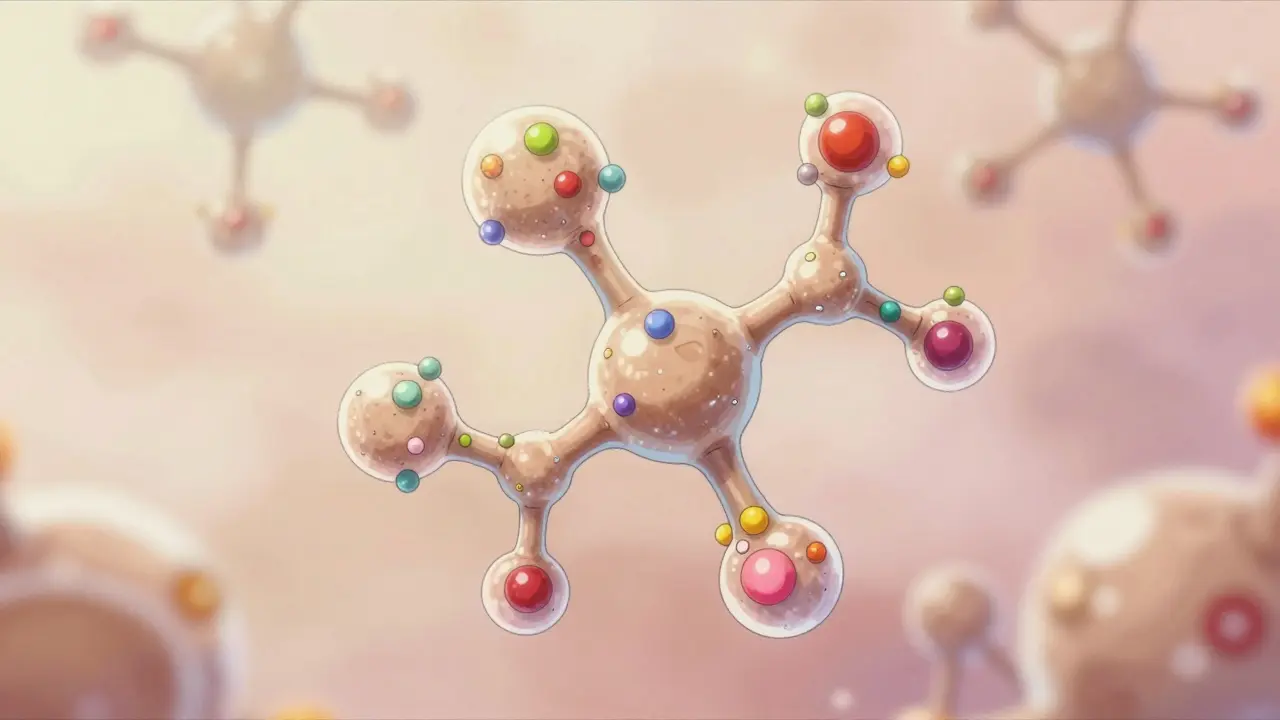
Biologics work differently. They are large, complex molecules made inside living cells, such as yeast or mammalian cells. Think of it less like printing and more like farming. If you grow wheat in a field, no two stalks are perfectly identical, even if they come from the same seed and soil. Similarly, when cells produce proteins, they introduce minor variations. According to the U.S. Food and Drug Administration (FDA), a single lot of a biologic can contain millions of slightly different versions of the same protein or antibody.
These differences usually happen after the protein is built, a process called post-translational modification. The most common example is glycosylation, where sugar molecules attach to the protein. The pattern of these sugars can vary slightly from batch to batch due to factors like cell health, temperature, or nutrient levels during production. While these changes sound alarming, they are normal. The key question isn't whether variation exists-it does-but whether those variations affect how the drug works in your body.
Biosimilars vs. Generics: A Fundamental Distinction
This natural variability is the primary reason why the pharmaceutical industry distinguishes sharply between generics and biosimilars. Many people use the terms interchangeably, but the science says otherwise. The FDA explicitly states that "Biosimilars Are Not Generics." Here is why:
| Feature | Generic Drugs | Biosimilars |
|---|---|---|
| Molecular Structure | Identical to the original brand-name drug | Highly similar, but not identical, due to natural biological variation |
| Manufacturing Process | Chemical synthesis (lab-created) | Living cell culture (biological process) |
| Regulatory Pathway | Abbreviated New Drug Application (ANDA) | 351(k) Pathway under the Biologics Price Competition and Innovation Act |
| Proof Required | Pharmaceutical equivalence and bioequivalence | Analytical, functional, and clinical studies showing no clinically meaningful differences |
| Variability | None; exact copy | Inherent lot-to-lot variability exists |
Generics follow the ANDA pathway, requiring proof that they are chemically equivalent to the brand-name drug. Biosimilars, however, follow the 351(k) pathway established in 2010. Because they cannot be identical, manufacturers must prove that any differences are not "clinically meaningful." This means the biosimilar must perform just as safely and effectively as the reference product, despite the slight structural variations.
How Regulators Manage Natural Variation
If every batch of a biologic is slightly different, how do we know it will work? The answer lies in rigorous analytical characterization. Dr. Sarah Y. Chan, Director of the FDA's Office of Therapeutic Biologics and Biosimilars, notes that inherent variations occur in both reference products and biosimilars. The goal is not to eliminate variation-that’s impossible-but to control it.
Manufacturers use a "totality of the evidence" approach. They run extensive tests to map out the variations in their product. They then compare this map to the reference product. If the biosimilar’s variations fall within the same range as the reference product’s natural lot-to-lot variability, it passes. The FDA assesses the manufacturer’s strategy to control these patterns to ensure consistent safety and effectiveness.
For a biosimilar to earn the higher designation of "Interchangeable," it must meet even stricter criteria. As of May 2024, only 12 biosimilars in the U.S. held this status. Interchangeable products must undergo additional switching studies, where patients alternate between the reference product and the biosimilar multiple times. These studies prove that switching back and forth does not increase risk or decrease effectiveness. This is critical because pharmacists may substitute interchangeable biosimilars without a doctor’s specific authorization, depending on state laws.
Challenges in the Lab: When Variation Matters
While therapeutic biologics are tightly controlled, lot-to-lot variability poses significant challenges in diagnostic laboratories. Reagents used for blood tests and other diagnostics are also biologics. If a new lot of reagent behaves differently than the old one, patient results can shift, leading to misdiagnosis or incorrect treatment adjustments.
A 2022 survey by the Association for Diagnostics & Laboratory Medicine found that 78% of laboratory directors consider reagent lot-to-lot variation a "significant challenge." Dr. James H. Nichols from Vanderbilt University Medical Center points out a tricky issue: quality control (QC) materials might not react the same way as real patient samples. A new lot might pass QC checks but still skew patient results. In one documented case, a change in HbA1c reagent lots led to an average increase in patient results of 0.5%, which could alter diabetes management plans.
To combat this, labs use statistical methods like moving averages to monitor long-term stability. The College of American Pathologists recommends verifying new lots with at least 20 patient samples using duplicate measurements. This high level of scrutiny ensures that the natural variability of the reagent doesn’t translate into clinical error.

The Market Landscape: Growth Despite Complexity
Despite the complexity of managing lot-to-lot variability, the market for biosimilars is booming. As of May 2024, there are 53 approved biosimilars in the United States. The global biosimilars market was valued at $10.6 billion in 2023 and is projected to reach $35.8 billion by 2028. This growth is driven by the need for affordable alternatives to expensive biologic therapies, particularly in oncology and autoimmune diseases.
Major companies like Amgen, Pfizer, and Sandoz are leading the charge. Biosimilars now represent approximately 32% of all biologic prescriptions in the U.S. by volume. The competitive landscape is shifting, with advancements in analytical technologies like mass spectrometry allowing manufacturers to characterize minor variations with greater precision. Industry analysts predict that by 2026, about 70% of new biosimilar applications will include interchangeability data, up from 45% in 2023.
This expansion suggests that the industry is becoming more adept at managing natural variation. However, as therapies become more complex-including antibody-drug conjugates and gene therapies-the challenge of controlling lot-to-lot variability will only intensify. The balance between cost savings and clinical consistency remains the central tension in this sector.
Practical Implications for Patients and Providers
For patients, the takeaway is reassurance. Lot-to-lot variability is expected and managed. It does not mean your medication is unsafe or inconsistent in its clinical effect. Doctors prescribe biologics knowing that minor molecular differences exist, relying on the robust regulatory framework to ensure those differences don’t impact health outcomes.
For providers, staying informed about interchangeability status is key. If a patient is switched to a non-interchangeable biosimilar, some physicians prefer to monitor them closely initially, though guidelines generally support seamless switching for biosimilars. Open communication with pharmacists about lot numbers can also help track any potential issues, although adverse events linked solely to lot variation are rare.
Understanding that biologics are living products, not static chemicals, helps demystify the concept of biosimilarity. It highlights the sophistication of modern medicine, where science embraces natural complexity rather than trying to force rigid uniformity. The result is access to life-saving treatments that are highly effective, safe, and increasingly affordable.
Is lot-to-lot variability dangerous for patients?
No, lot-to-lot variability is not considered dangerous. It is a natural characteristic of biologics produced in living cells. Regulatory agencies like the FDA require manufacturers to demonstrate that these variations do not lead to clinically meaningful differences in safety or effectiveness. The variations are typically minor, such as slight changes in sugar attachments, and are strictly monitored.
Can I switch between a brand-name biologic and a biosimilar?
Yes, switching is generally safe. For biosimilars designated as "Interchangeable," pharmacists can often substitute them automatically. For non-interchangeable biosimilars, doctors can prescribe them directly. Studies show that switching between reference products and biosimilars does not typically increase risks or reduce effectiveness, provided the switch is managed according to medical guidelines.
Why aren't biosimilars called generics?
The term "generic" implies an exact chemical copy, which is possible for small-molecule drugs but not for biologics. Because biologics are made in living cells, they have inherent natural variations. Therefore, they are "highly similar" but not identical. The term "biosimilar" accurately reflects this scientific reality and the different regulatory pathway required to prove their safety and efficacy.
How do labs ensure test results remain accurate despite lot changes?
Laboratories use rigorous verification protocols when switching to a new lot of reagents. This includes testing at least 20 patient samples with duplicate measurements and comparing results against predefined performance specifications. They also use statistical tools like moving averages to monitor long-term trends and detect any subtle shifts in results that might indicate a problem with the new lot.
What is the difference between a biosimilar and an interchangeable biosimilar?
All interchangeable biosimilars are biosimilars, but not all biosimilars are interchangeable. To earn the "Interchangeable" designation, a product must undergo additional switching studies proving that alternating between the reference product and the biosimilar multiple times does not pose increased safety risks. This allows for pharmacy-level substitution in many jurisdictions, whereas standard biosimilars may require a specific prescription.