

Have you ever stared at your watch mid-flight, heart pounding, wondering if you just missed a critical dose of insulin or blood thinner? You are not alone. For millions of travelers managing chronic conditions, crossing time zones is less about sightseeing and more about navigating a complex pharmacological minefield. The stakes are high: missing a window for certain drugs can trigger seizures, cause dangerous blood clots, or spike blood sugar levels.
The good news? You do not have to guess. With the right preparation and a clear understanding of how your body processes medicine across longitudes, you can fly safely. This guide breaks down exactly how to manage time-sensitive medications when traveling, drawing on the latest guidelines from the CDC, FDA, and top travel medicine specialists.
Understanding Time-Sensitive Medications
Not all pills are created equal when it comes to travel. To manage your schedule effectively, you first need to know where your medication falls on the sensitivity spectrum. According to the Centers for Disease Control and Prevention (CDC) Yellow Book 2024, approximately 38% of travelers with chronic conditions need help adjusting their dosing schedules, and this jumps to 62% for those crossing five or more time zones.
We categorize these medications based on their pharmacokinetics-how quickly they leave your system. Drugs with a half-life of less than 8 hours usually require strict twice-daily dosing. These include many anti-epileptic drugs, where a missed dose can trigger a seizure within 12 to 24 hours. Then there are biologics and immunosuppressants, which require precise maintenance of therapeutic trough levels. Even anticoagulants like warfarin fall into this category, requiring INR monitoring within 24 to 48 hours of any schedule change.
If you take medications with a narrow therapeutic index-where the line between an effective dose and a toxic one is razor-thin-you cannot afford even minor deviations. Understanding this classification is the first step in building a safe travel plan.
The Golden Rule: Consult Your Doctor Early
Do not wait until you are at the airport to figure this out. Expert recommendations consistently emphasize personalized scheduling over generic advice. The American Pharmacists Association (APhA) notes that while 78% of time-sensitive medications can safely accommodate a 1-2 hour variation, the remaining 22% (primarily transplant immunosuppressants and certain anti-epileptics) demand exact timing.
Schedule a consultation with your pharmacist or doctor at least two weeks before departure. Data from a Banner Health case series in April 2024 shows that 89% of travelers who consulted professionals ahead of time managed their meds successfully, compared to only 47% of those who made last-minute adjustments.
Your doctor will likely recommend one of two strategies:
- Maintain Home Time: For medications with short half-lives crossing three or more time zones, Dr. Sarah Thompson of Johns Hopkins University suggests keeping your home schedule for the first 48-72 hours after arrival, then gradually shifting to local time.
- Immediate Adjustment: For longer half-life medications, the CDC advises switching to the destination time zone immediately upon departure.
Navigating TSA Security with Confidence
Security checkpoints are often the most stressful part of the journey for medical travelers. Fear of confiscation or delays can lead to panic. However, the Transportation Security Administration (TSA) has clear, traveler-friendly rules.
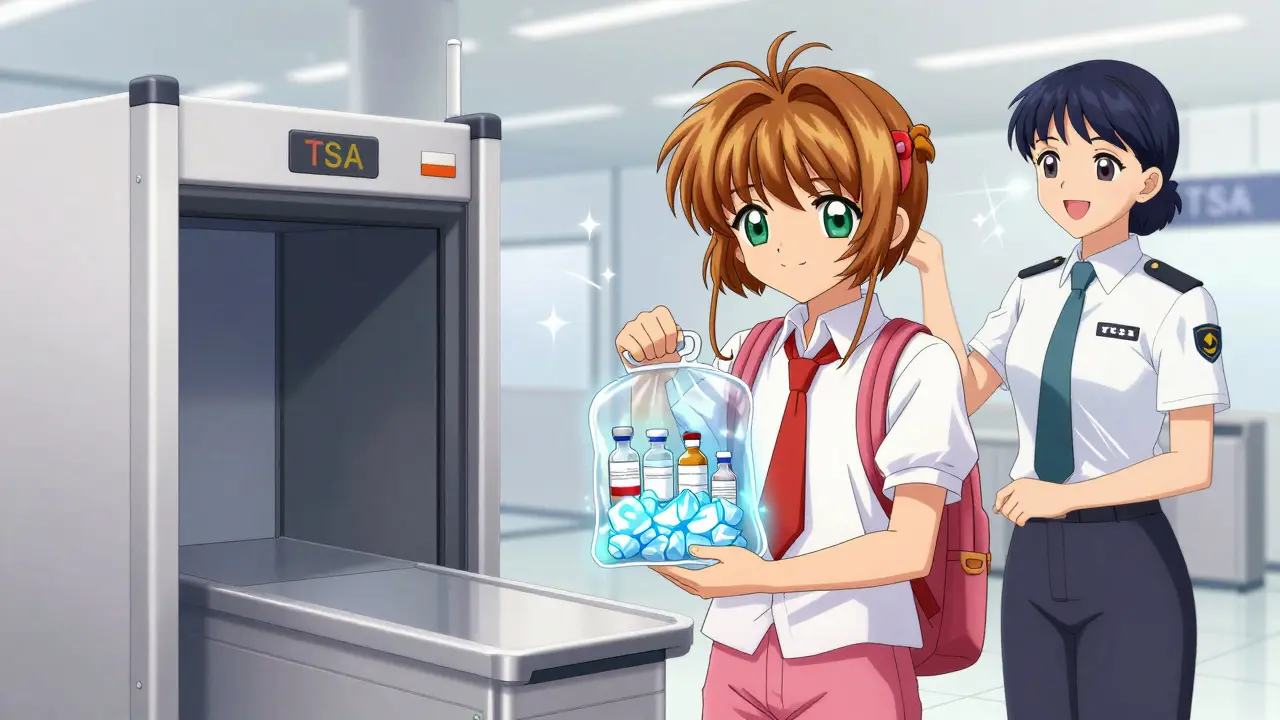
You are permitted to carry all necessary medications in their original containers through security checkpoints. There are no quantity restrictions for solid forms like pills. If you have liquid medications, such as insulin or liquid antibiotics, they are exempt from the standard 3.4-ounce limit. You simply need to declare them to the officer and separate them from your other liquids for screening.
Crucially, if your medication requires cooling, gel ice packs are allowed even if they are partially melted, provided they are clearly marked as medically necessary. Always keep your medications in your carry-on bag, never in checked luggage. Checked bags can get lost, delayed, or exposed to extreme temperatures in the cargo hold, rendering temperature-sensitive drugs useless.
Mastering the Time Zone Shift
Here is where the math gets tricky. How do you adjust your clock without shocking your system? Pharmacists at the University of Michigan Health System developed a protocol that reduces timing errors by 76%. The key is incremental adjustment.
If you are traveling eastbound, you are losing time, so you must advance your schedule. If you are traveling westbound, you are gaining time, so you delay your schedule. Adjust your dosing time by one hour for each time zone crossed, spread out over the days leading up to your trip or during the flight itself.
| Direction | Action | Example (Crossing 3 Zones) |
|---|---|---|
| Eastbound | Advance Schedule | Take doses 1 hour earlier per day before flight, or shift by 3 hours total on flight day. |
| Westbound | Delay Schedule | Take doses 1 hour later per day before flight, or shift by 3 hours total on flight day. |
For example, if you normally take a pill at 8:00 AM and are flying across three time zones eastward, you might start taking it at 7:00 AM two days before, 6:00 AM the day before, and 5:00 AM on the day of travel. This gradual shift helps your internal clock-and your drug levels-adjust smoothly.
Essential Tools for Travelers
Memory fails under stress. Do not rely on your brain alone. Use technology to anchor your schedule.
Dedicated apps like Medisafe have become industry standards. Downloaded over 1.2 million times, these apps automatically adjust your alarm times based on your flight itinerary and current location. They sync with your phone’s world clock, ensuring you never miss a beat.
For those who prefer analog solutions, the MedTime Zone Watch is a popular physical tool. It allows you to track multiple time zones simultaneously, helping you visualize when your next dose is due relative to both your home and destination clocks.
Additionally, create a physical medication list. The CDC recommends including brand and generic names, dosages, frequency, your prescribing doctor’s name, and pharmacy contact info. Having this document ready can speed up interactions with healthcare providers if you experience an emergency abroad.

Storage and Temperature Control
Temperature is the silent killer of medication efficacy. Approximately 35% of time-sensitive medications require storage between 35-46°F (2-8°C). Insulin accounts for 58% of these specialty cases.
Airplane cabins are pressurized and temperature-controlled, but cargo holds are not. Never check your meds. For carry-on protection, invest in a portable cooler like the Travelport 3.0. Using phase-change technology, it maintains the correct temperature for up to 48 hours without power. Remember, TSA allows these coolers and their ice packs through security, so you won’t face issues at the checkpoint.
Regulatory Red Flags and International Travel
What is legal in the UK or US might be prohibited elsewhere. The International Air Transport Association (IATA) reports a 22% increase in medication-related incidents among passengers, partly due to regulatory confusion.
Before booking, check the regulations of your destination country. Thirty-seven countries now require special permits for common US medications. For instance, pseudoephedrine is banned in 12 countries, and zolpidem (Ambien) requires advance permission in 24 others. Failure to declare these can result in fines, confiscation, or even detention. Always carry a letter from your doctor explaining your condition and medication necessity, translated into the local language if possible.
Emergency Preparedness
Despite best efforts, things can go wrong. Flights get delayed, luggage gets stuck, or you feel unwell. Here is your emergency checklist:
- Carry Extra Supply: Pack at least three days’ worth of extra medication in your carry-on, separate from your main supply.
- Know Local Resources: Identify hospitals or pharmacies near your destination before you arrive.
- Avoid New Meds: The FAA warns never to try a new medication for the first time while flying. Wait at least 48 hours after starting a new drug to ensure no adverse side effects occur before boarding.
- Hydrate: Dehydration can alter how your body metabolizes drugs. Drink water regularly during the flight.
By planning ahead, using the right tools, and respecting the science behind your prescriptions, you can turn a potentially stressful journey into a smooth transition. Safe travels.
Can I bring my medication through TSA security?
Yes. The TSA allows all medically necessary medications in original containers. Solid medications have no quantity limits. Liquid medications exceed the standard 3.4-ounce limit but are permitted if declared. Gel ice packs for cooling are also allowed even if frozen or partially melted.
Should I take my medication according to home time or destination time?
It depends on the medication's half-life. For short half-life drugs (less than 8 hours), experts often recommend maintaining your home schedule for the first 48-72 hours, then gradually shifting. For longer half-life medications, immediate adjustment to the destination time is usually advised. Always consult your doctor for a personalized plan.
Is it safe to double up on doses if I miss one while flying?
Generally, no. WebMD and most pharmacists advise against doubling doses unless specifically instructed by your doctor. Doubling can lead to toxicity, especially with narrow therapeutic index drugs like warfarin or anti-epileptics. Follow your pre-travel plan for missed doses.
Do I need a doctor's note for international travel?
While not always required for domestic flights, a doctor's note is highly recommended for international travel. Many countries require proof of medical necessity for controlled substances or injectables. Ensure the note includes your diagnosis, medication names, dosages, and the doctor's contact information.
How do I keep insulin cold during a long flight?
Use a portable medication cooler like the Travelport 3.0, which maintains 35-46°F (2-8°C) for up to 48 hours without electricity. Keep it in your carry-on bag, never checked luggage. Inform TSA agents that you have medically necessary cooling equipment.

Comments
i totally get the anxiety around this stuff because managing chronic conditions while traveling can feel overwhelming but there is real value in having a plan. pharmacokinetics isn't just jargon it's literally how your body processes the medicine so understanding those half-lives helps you stay safe. maybe try framing it as an adventure in self-care rather than a chore? using apps like Medisafe can be a game changer for keeping track without stressing out.
the article fails to mention that tsa agents are notoriously incompetent at distinguishing between medical necessities and threats. i have seen insulin confiscated multiple times despite clear documentation. the protocol described is theoretical nonsense. in practice security checkpoints operate on fear and ignorance not science. do not trust the system.
hey guys i know this seems super complicated but i found that talking to my pharmacist before i fly really helped me relax. they gave me a printed list of my meds which made going through customs way easier. also i started using a little cooler bag for my insulin and it worked great. hope this helps anyone else who is nervous about flying with meds!
one must consider the philosophical implications of entrusting one's life to a piece of paper signed by a physician 📜🧐 the concept of 'medical necessity' is inherently subjective yet we treat it as objective truth. furthermore the reliance on technology such as Medisafe suggests a societal decay where human memory is deemed insufficient. truly a dystopian trajectory we find ourselves upon ✈️💊
wait so if im taking warfarin i cant just double up if i miss a dose?? seriously?? i thought that was common sense to just catch up. this guide is kinda scary honestly. but good info i guess. i def need to talk to my doc before my trip to japan next month. thanks for sharing this!
this article is completely useless for indian travelers. our regulations are different. you cannot just follow american advice here. in india we have specific rules for bringing foreign medicines. you need prior permission from the drug controller general of india. this generic western advice ignores local context entirely. shame on you for publishing this misinformation.
let's empower ourselves with knowledge instead of fear. understanding your medication schedule gives you control over your health journey. i encourage everyone to reach out to their healthcare providers early. remember that preparation is key to a stress-free travel experience. you got this. stay proactive and informed.
i understand how stressful this can be; many people worry about missing doses. please ensure you carry extra supplies; it provides peace of mind. hydration is also very important during flights. let us support each other in managing these challenges safely.
navigating international travel with chronic conditions requires strategic planning and emotional resilience. utilizing phase-change cooling technology ensures pharmacological stability. furthermore maintaining a comprehensive medical dossier facilitates seamless border crossings. let us foster a community of informed travelers who prioritize safety protocols.