

When you hear you might be allergic to a drug, it’s easy to panic. What if you need that medicine in an emergency? What if you’ve been told you’re allergic but never actually tested? Many people carry a drug allergy label for years-only to find out later they weren’t allergic at all. That’s where drug allergy skin testing comes in. It’s not just a quick poke on the arm. It’s a precise, safe, and powerful tool that can clear up confusion, open up better treatment options, and even save lives.
What Exactly Happens During a Drug Allergy Skin Test?
There are three main types of skin tests used for drug allergies: skin prick, intradermal, and patch tests. Each one works differently and is used for different kinds of reactions.
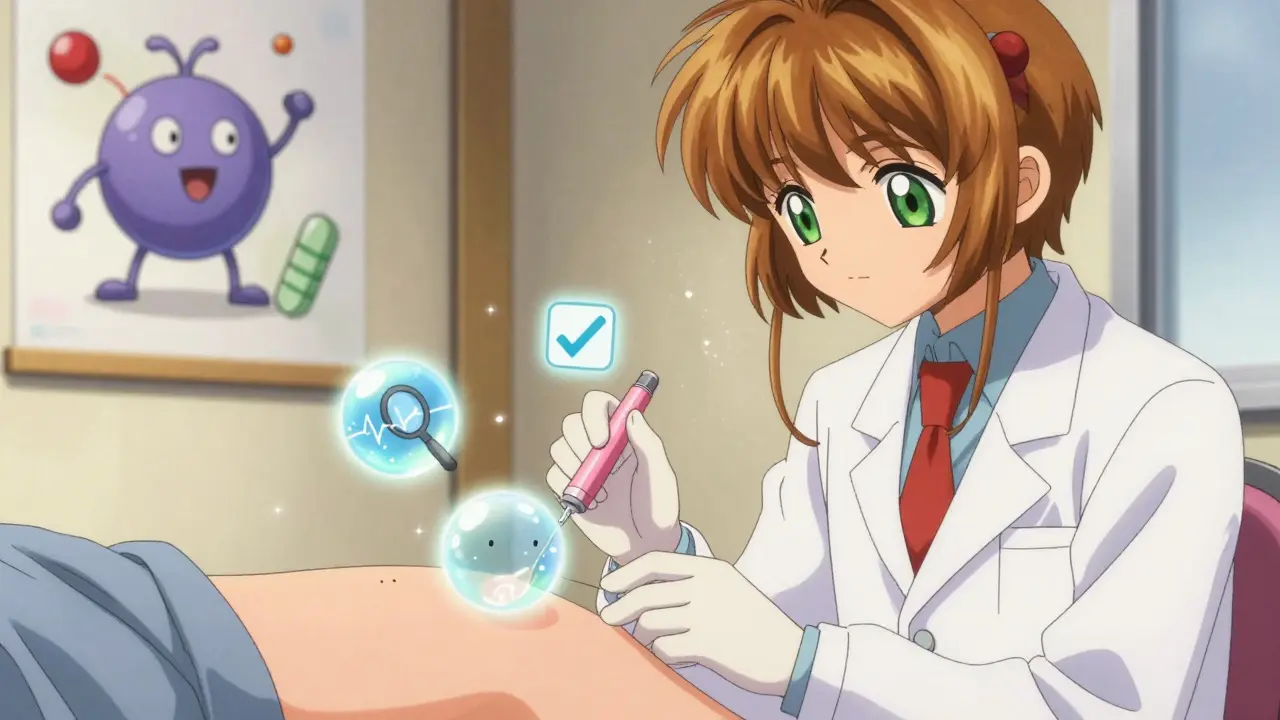
The skin prick test is the first step. A tiny drop of the drug (diluted in saline) is placed on your skin-usually your forearm or back. Then, a small plastic or metal device lightly pricks the skin through the drop. It doesn’t draw blood. It doesn’t hurt much. Most people describe it as a quick, mild sting-like a mosquito bite. This test checks for immediate reactions, which happen within minutes.
If the skin prick test is negative, your doctor may move to the intradermal test. This one involves a tiny needle injecting a small amount (0.02-0.05 ml) of the drug just under the top layer of skin. You’ll see a small bubble form, like a tiny mosquito bite that’s been filled with water. The doctor waits 15 to 20 minutes to see if it swells, turns red, or gets itchy. A positive result means the area grew by at least 3 mm in size. This test is more sensitive than the prick test, meaning it can catch allergies the first test might miss.
The patch test is different. It’s used for delayed reactions-things like rashes that show up hours or even days after taking a drug. A patch with the drug is taped to your back for 48 hours. You come back to have it removed and checked. This one isn’t used for penicillin or other antibiotics that cause quick reactions. It’s for slower, non-life-threatening skin responses.
Every test includes two controls: a drop of histamine (to make sure your skin reacts) and a drop of saline (to make sure nothing happens when there’s no allergen). If the histamine doesn’t cause a reaction, the test is invalid. If the saline causes swelling, something’s wrong with your skin. These controls aren’t optional-they’re essential.
Why Skin Testing Matters More Than You Think
Here’s the hard truth: up to 90% of people who say they’re allergic to penicillin aren’t actually allergic. They had a rash as a kid, got labeled, and never got tested again. But avoiding penicillin isn’t harmless. Doctors end up prescribing broader, more expensive, and sometimes less effective antibiotics. That increases the risk of side effects, longer hospital stays, and even infections like C. difficile-a dangerous gut bug that thrives when normal bacteria are wiped out by strong antibiotics.
At Johns Hopkins Hospital, after they started routinely testing patients with penicillin allergies, they cut their use of broad-spectrum antibiotics by 30%. That’s not just a number. That’s fewer side effects, lower costs, and better outcomes for real people.
For other drugs, like cephalosporins or NSAIDs (ibuprofen, naproxen), skin tests are less reliable. But for beta-lactam antibiotics-penicillin, amoxicillin, ampicillin-they’re highly accurate. When both the skin prick and intradermal tests are negative, there’s a 95% chance you can safely take the drug again. That’s huge.
What You Need to Do Before the Test
You can’t just walk in and get tested. Preparation matters. The biggest mistake patients make? Taking antihistamines.
Antihistamines-like cetirizine, loratadine, or diphenhydramine-block the allergic reaction. If you take them in the days before testing, your skin won’t react even if you’re allergic. That gives you a false negative. You need to stop them for 5 to 7 days before the test. That includes over-the-counter allergy pills, sleep aids with antihistamines, and even some cold medicines.
Also, avoid steroid creams or lotions on the test area. Don’t get a sunburn. Don’t have an active rash. If you’re wheezing or having a severe asthma flare, the test gets postponed. Skin testing isn’t safe during an active allergic reaction.
One patient on Reddit said she had to reschedule because she didn’t know about the antihistamine rule. “I took my allergy pill the night before,” she wrote. “They had to cancel everything. Frustrating.” Don’t be that person. Ask your doctor or nurse: “What do I need to stop before the test?” Write it down.
What You’ll Feel During and After
Most people feel fine. The prick test? Barely noticeable. The intradermal test? A little sting, then a bit of itching or warmth. Some people say it feels like a bee sting that fades after a few minutes. The histamine control? That one gets itchy. A lot. But it’s supposed to. It tells you your skin is working.
After the test, the doctor marks the results with a pen. They might take photos. Why? Because reactions can fade. Having a record helps future doctors know what happened.
Side effects are rare. The allergens are in tiny amounts and stay in the top layer of skin. They don’t enter your bloodstream in significant amounts. You won’t get full-body symptoms. You won’t go into anaphylaxis from the test itself. That’s why it’s safe to do in an outpatient clinic.
But you’ll still be watched for 20-30 minutes after the last test. That’s standard. If something unusual happens, the staff is trained to handle it. They have epinephrine on hand. They’ve done this before.
What the Results Mean-And What They Don’t
A positive result? That means you likely have an allergy. But it’s not a death sentence. It just means you should avoid that drug. And your doctor should note it in your records.
A negative result? That’s where things get interesting. For penicillin, a negative test means you’re probably not allergic. That opens up a world of better, cheaper, safer antibiotics. Many patients go on to take a small, supervised dose of the drug (a drug challenge) to confirm the result. That’s the final step-and it’s often done right after a negative skin test.
But here’s the catch: not all drugs can be tested reliably. For drugs like sulfa antibiotics, vancomycin, or some NSAIDs, skin tests are less accurate. A negative result doesn’t always mean you’re safe. Sometimes, you still need a drug challenge. That’s why testing isn’t one-size-fits-all. It’s a tool, not a magic answer.
There are cases where people test negative but still react later. A 2022 Medscape report shared a case where a patient had negative skin tests to cephalosporins, then went into anaphylaxis during treatment. That’s rare, but it happens. That’s why doctors still watch you closely during the first dose-even if you’ve been cleared.

Who Should Get Tested?
You should consider skin testing if:
- You’ve been told you’re allergic to penicillin or another beta-lactam antibiotic
- You’ve had a reaction to a drug but aren’t sure if it was truly allergic
- You need a specific antibiotic and are being offered a less effective alternative
- You’re planning surgery or long-term treatment and want to avoid unnecessary drug restrictions
It’s not for everyone. If you’ve had a life-threatening reaction like anaphylaxis or Stevens-Johnson syndrome, skin testing may not be safe. Those cases are handled differently, often in a hospital setting with extreme caution.
And if you’ve never had a reaction? No need to test. This isn’t a screening tool for healthy people. It’s for those with a history.
The Bigger Picture: Why This Test Is Changing Medicine
This isn’t just about avoiding a rash. It’s about smarter medicine.
Hospitals in Europe have been doing this for years. In France and Germany, over 70% of suspected drug allergies are tested. In the U.S., it’s still under 40%. But things are changing. The FDA approved standardized penicillin reagents in 2022. The NIAID updated its guidelines in early 2023 to include opioid allergy testing. Clinical trials are now testing reagents for ciprofloxacin and vancomycin.
And the results are clear: hospitals with formal allergy testing programs see fewer cases of C. difficile, shorter hospital stays, and lower antibiotic costs. That’s not just good for patients. It’s good for the system.
Drug allergy skin testing isn’t magic. But it’s one of the most underused tools we have. It’s safe, it’s accurate for key drugs, and it can completely change your medical future.
What Comes Next?
If your test is negative, you might be asked to take a small, controlled dose of the drug under medical supervision. This is called a drug challenge. It’s the final step to confirm you’re truly not allergic.
If it’s positive, you’ll get a medical alert card or bracelet. Your doctor will update your records. You’ll know what to avoid-and what you can safely use instead.
Either way, you’re no longer guessing. You’re informed. And that’s the best medicine of all.
Can I take antihistamines before a drug allergy skin test?
No. You must stop all antihistamines-prescription and over-the-counter-for 5 to 7 days before the test. These medications block your skin’s allergic response, which can lead to a false negative result. This includes pills like cetirizine, loratadine, diphenhydramine, and even some sleep aids or cold medicines. Always check with your doctor before stopping any medication.
Does the skin test hurt?
The skin prick test feels like a quick, light sting-similar to a mosquito bite. The intradermal test involves a small injection and may cause a brief stinging or burning sensation that lasts a few minutes. The histamine control often causes itching, but that’s normal and expected. Most people tolerate the procedure well, and discomfort is usually mild and short-lived.
How long does the entire test take?
The full process usually takes between 45 and 60 minutes. The skin prick test is done first, followed by a 15-20 minute wait. Then the intradermal test is performed, followed by another 15-20 minute wait. After that, the doctor checks and records the results. You’ll be monitored for a short time afterward to ensure no delayed reactions occur.
Can skin testing miss a drug allergy?
Yes. Skin tests are highly accurate for penicillin and related antibiotics, with a negative predictive value of over 90%. But for other drugs like cephalosporins, sulfa drugs, or NSAIDs, sensitivity drops to 30-50%. A negative result doesn’t guarantee safety. In some cases, a supervised drug challenge is needed to confirm tolerance. Never assume a negative test means you’re completely risk-free for all drugs.
Is skin testing safe if I’ve had a severe reaction before?
If you’ve had a life-threatening reaction-like anaphylaxis, Stevens-Johnson syndrome, or toxic epidermal necrolysis-skin testing is usually avoided. These reactions are handled differently, often in a hospital setting with extreme caution. Skin testing is designed for patients with milder or uncertain histories. Always discuss your past reactions in detail with your allergist before any testing.
Comments
This is so helpful. I had a penicillin label since I was 5 and never got tested. Just found out last year I'm not allergic. Changed my whole life. 🙌
I work in a hospital and have seen firsthand how many patients are unnecessarily avoiding life-saving antibiotics because of outdated allergy labels. This kind of education needs to be front and center in every primary care office. Thank you for breaking it down so clearly.
I never knew about the histamine and saline controls. That's actually brilliant. It makes so much sense to validate the test that way. I feel like I learned more in 10 minutes reading this than in all my years of doctor visits.
OMG I DID THIS LAST MONTH AND IT WAS THE BEST THING EVER I WAS SCARED TO DEATH BUT IT WAS JUST A LITTLE STING AND NOW I CAN TAKE AMOXICILLIN AGAIN I CANT BELIEVE I NEVER GOT TESTED BEFORE IVE BEEN AVOIDING IT FOR 20 YEARS
I hate how doctors just label you without testing. My sister got misdiagnosed with a sulfa allergy and ended up on vancomycin for a UTI. Cost her $12k and gave her C. diff. This should be standard. We need to stop being passive patients.
The data presented here is statistically flawed. The 90% false allergy claim is based on outdated cohorts. Modern studies show only 60-70% of penicillin labels are inaccurate. Also the Johns Hopkins statistic ignores confounding variables such as patient age and comorbidities. This is dangerously oversimplified
Of course it's 'safe'-they use microscopic amounts. But have you ever seen what happens when someone gets a false negative and then goes into anaphylaxis during surgery? It's not a game. The system is built on convenience, not safety. And now they want us to believe this is 'medicine'?
i dont trust this at all. why do they always say penicillin but never talk about how the test solutions are made? i read somewhere the dilutions have preservatives that can trigger reactions. theyre not testing the drug theyre testing a cocktail. and who made the rules anyway? big pharma?
The assertion that skin testing is 'highly accurate' for beta-lactams is misleading. Sensitivity varies by manufacturer, region, and technician training. The 95% negative predictive value cited is from a single-center study with selection bias. Real-world validation across U.S. clinics shows a 78% accuracy ceiling. This piece is an advertisement disguised as medical education.
Wait... so you're telling me I could have taken amoxicillin for my sinus infection last year instead of the $400 Zithromax? And I didn't even know? This is insane. Why isn't this on the news? Why aren't we screaming about this? I'm furious.
They say it's safe but have you ever looked at the FDA's adverse event reports? There are 17 documented cases of anaphylaxis from skin testing since 2020. And the 'controls'? They're not just saline-they're laced with trace ethanol and glycerin. That's not neutral. That's a hidden trigger. They're not testing allergies. They're testing your tolerance to chemical cocktails.
You Americans think this is groundbreaking. In the UK we've been doing this since the 90s. We have national guidelines. We have trained nurses. We have public funding. You're still stuck in the 1980s with your 'trust your doctor' nonsense. This isn't innovation. It's catching up. And you're still late.
I don't care what you say. My cousin got tested and had a reaction. She didn't even have a history. They said it was 'mild' but she was in the hospital for three days. This isn't science. It's gambling with people's lives. And they call it progress?
You're telling me to stop antihistamines for a week? What if I have chronic hives? What if I can't breathe? You're asking me to suffer so you can run a test? That's not healthcare. That's cruelty dressed up as science.
The article's reliance on anecdotal evidence from Reddit is deeply unprofessional. One patient's experience does not constitute clinical validity. Furthermore, the omission of peer-reviewed meta-analyses on non-beta-lactam testing sensitivity is a significant scholarly lapse. This is not a medical resource-it is a promotional brochure.