
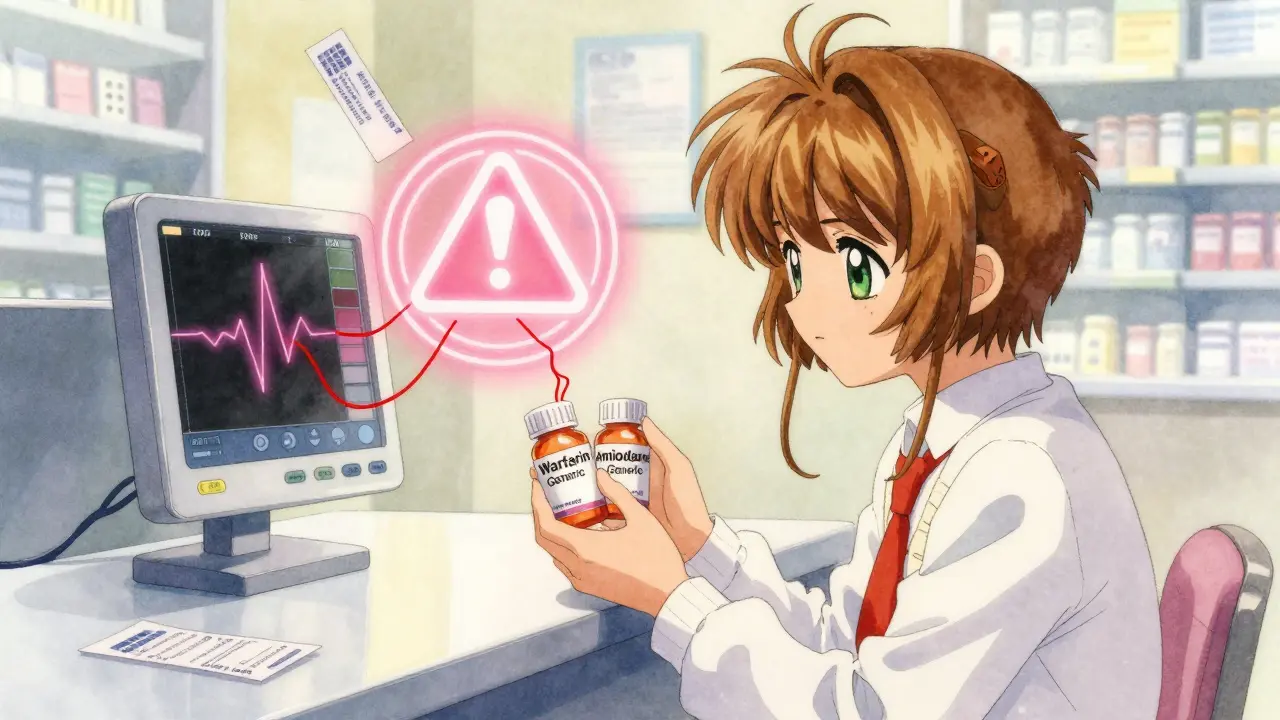
When you’re on two or more medications that each have a razor-thin line between helping you and harming you, switching to a generic version isn’t just a cost-saving move-it’s a gamble. This is the reality for patients taking combination NTI drugs, where even tiny differences in how a drug is absorbed can lead to hospitalization, organ damage, or death. Despite the push for cheaper generics across the board, these specific combinations remain nearly impossible to replicate safely-and that gap in access is leaving thousands without affordable treatment options.
What Are NTI Drugs, and Why Do They Matter?
Narrow Therapeutic Index (NTI) drugs are medications where the difference between a dose that works and a dose that kills is incredibly small. Think of them like walking a tightrope: one step too far, and you fall. Examples include warfarin (a blood thinner), levothyroxine (for thyroid function), lithium (for bipolar disorder), and phenytoin (for seizures). For these drugs, a 10% variation in blood levels can mean the difference between control and crisis. The FDA defines NTI drugs by five key traits: minimal gap between effective and toxic doses, high risk of serious side effects from small changes, the need for frequent blood monitoring, low variation within the same person over time, and the common need for tiny, frequent dose adjustments.
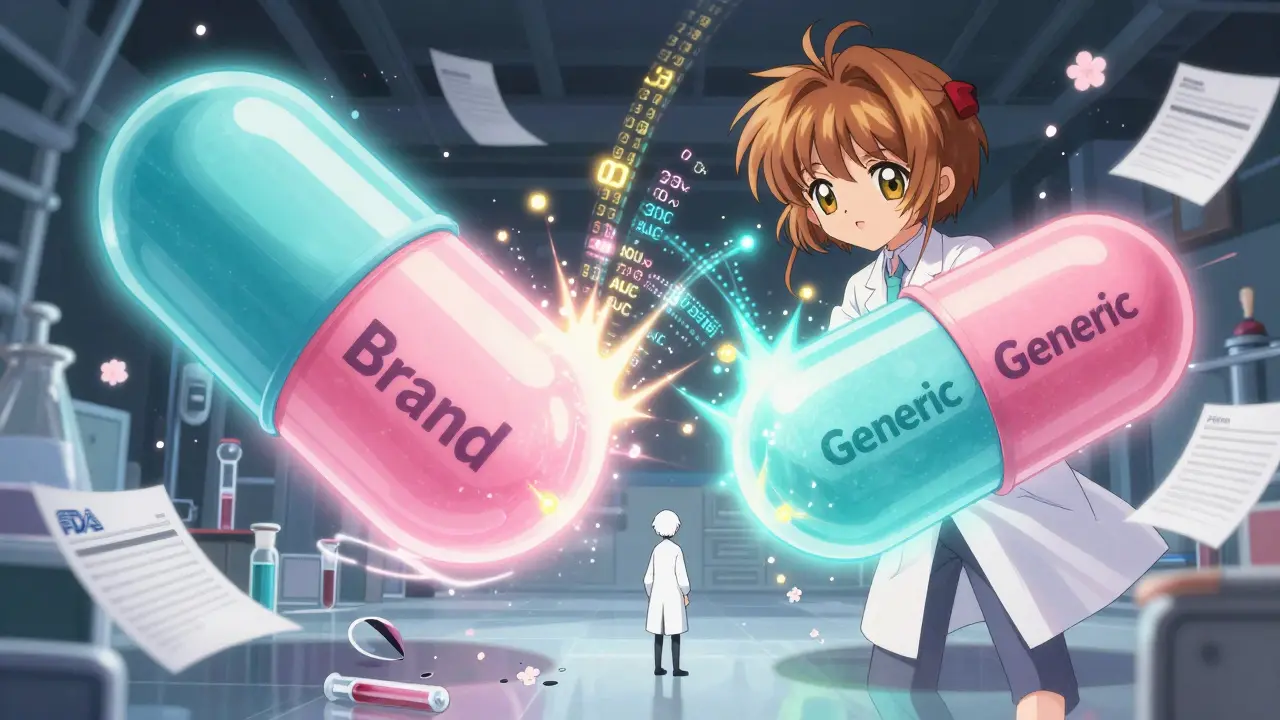
That’s why single-agent NTI drugs like warfarin have generic versions-they’re tough, but doable. The FDA requires generic versions to match the brand within 90% to 111% of the original for peak concentration (Cmax) and 90% to 112% for total exposure (AUC). That’s much tighter than the standard 80% to 125% used for most other drugs. But when you combine two NTI drugs? The math gets dangerous.
Why Combination NTI Drugs Are a Perfect Storm
Combination therapy isn’t new. In cancer, tuberculosis, and heart disease, doctors often use multiple drugs to fight resistance or improve outcomes. But when both drugs are NTI, the risks multiply. Let’s say Drug A has a 10% variation risk and Drug B has a 12% variation risk. Together, the combined variation isn’t 11%-it’s closer to 22%. That’s not theoretical. A 2020 JAMA Internal Medicine study found patients on combination therapy with one NTI drug had a 27% higher chance of adverse events after switching to generics, compared to just 8% for non-NTI combinations.
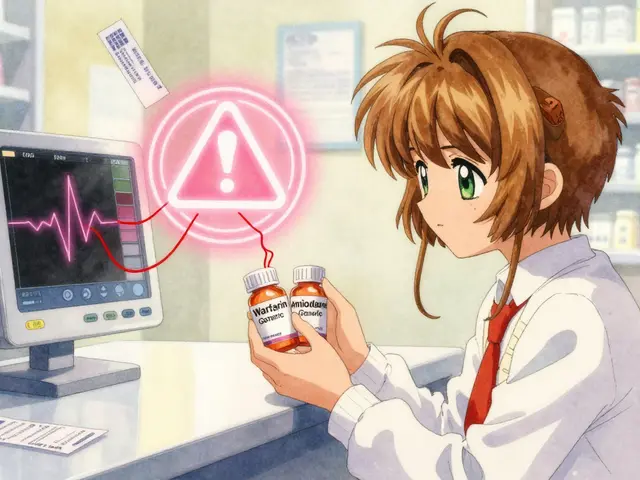
Take warfarin and amiodarone, both NTI drugs often used together in atrial fibrillation. If one generic version of warfarin delivers 10% less active ingredient and the generic amiodarone delivers 12% more, the result is a blood level that’s off by 22%. That’s enough to send INR (a clotting measure) from a safe 2.5 to a dangerous 6.8-enough to cause internal bleeding. One patient on HealthUnlocked described being hospitalized after a pharmacy switch: "Imagine this risk doubled with both drugs generic." That’s not an outlier. A 2022 Drugs.com survey of 1,247 patients found 63.4% experienced side effects after switching to generics in combination therapy, versus 18.2% on brand-name versions.
The Regulatory Wall: Why No Generic Combinations Exist
The FDA has tried to keep up. In 2022, it updated its standards for NTI drugs. In 2023, it released draft guidance for combination NTI products, proposing even tighter limits: 90% to 107.69% for Cmax and 90% to 110% for AUC. But here’s the catch: no company has successfully met these standards for a combination product. Why?
First, the testing is brutal. To prove bioequivalence, manufacturers must run 4-way crossover studies with dozens of healthy volunteers, measuring blood levels after each version. With two NTI drugs, you’re not just testing one interaction-you’re testing how each generic version of Drug A interacts with each generic version of Drug B. The number of permutations explodes. Second, the cost is prohibitive. Developing a single NTI generic can cost $50 million. A combination? Easily $150 million. Third, the payoff is tiny. Less than 0.3% of the global NTI drug market ($48.7 billion in 2023) is made up of combination products. No manufacturer wants to spend $150 million to capture 0.3% of a niche market.
The result? While 87.4% of single-agent NTI drugs have generic versions, only 12.6% of combination regimens do. In the U.S., there are zero FDA-approved fixed-dose combinations of two NTI drugs. Warfarin? Generic. Lithium? Generic. But warfarin + lithium? Nothing. Methotrexate + another NTI agent? Nothing. The market is wide open-but so is the risk.
Real-World Consequences: Who Gets Left Behind?
Patients on combination NTI therapy aren’t just inconvenienced-they’re trapped. Many are elderly, have multiple chronic conditions, or rely on Medicaid or Medicare Part D. When their pharmacy switches to a cheaper generic, they may not even know. Pharmacists aren’t required to notify them. Clinicians don’t always track it. And once the switch happens, it can take weeks to stabilize. One 2023 ASHP survey of 856 pharmacists found 78.3% had seen therapeutic failure after generic substitution in NTI combinations, with 41.6% reporting serious adverse events like bleeding, seizures, or cardiac arrest.
Cost is the driver. A brand-name combination NTI therapy can cost $1,200 to $2,500 per year just for monitoring blood levels. Generic monotherapies cost $100 to $300. But because no combination generics exist, patients are forced to take two separate pills-each with its own generic version. That means two different manufacturers, two different absorption profiles, two different risks. And that’s exactly what regulators warned against.
Where Progress Is Happening-And Where It’s Not
Europe has been slightly more open. Since 2015, some combination products with levothyroxine (an NTI drug) and selenium (not NTI) have been approved in Germany and France, with adverse event rates under 2%. But even there, regulators are cautious. The EMA tightened its standards in 2023 to match the FDA’s proposed limits. The U.S. is moving toward similar rules, but the path is slow.
The FDA’s 2024 pilot program for "precision bioequivalence" using pharmacometric modeling may help. Instead of testing hundreds of volunteers, companies could use computer models to predict how a generic will behave in real patients. It’s promising-but still unproven. Meanwhile, some big manufacturers like Teva and Sandoz argue modern production can meet the standards. But without a single success story, no one will risk the investment.

The Human Cost: Monitoring, Cost, and Uncertainty
Managing a combination NTI regimen isn’t simple. Patients need blood tests every few weeks, sometimes monthly. Each test costs $100 to $200. Annual monitoring can run $1,200 to $2,500-double what non-NTI patients pay. Pharmacists need over 120 hours of specialized training to handle these cases. And even then, mistakes happen. A 2023 GoodRx analysis found combination NTI product labels scored only 2.8 out of 5 for clarity-compared to 4.2 for single-agent NTI drugs. That means confusing instructions, unclear warnings, and patients who don’t know what they’re taking.
Only 12 of 50 major U.S. academic medical centers have dedicated NTI combination clinics. Most patients are left to navigate this alone. A Reddit user in r/pharmacy wrote: "My doctor says my combo is "safe" with generics, but I’ve been on 3 different brands in 18 months. I don’t trust any of them." That’s not paranoia-it’s experience.
What Needs to Change
There’s no easy fix. But here’s what needs to happen:
- Require explicit labeling: All combination NTI drugs should be labeled "Do Not Substitute" on the bottle and in pharmacy systems.
- Pause automatic substitution: States should ban automatic substitution for any combination containing an NTI drug, as ASHP recommends.
- Fund real-world evidence: The FDA and NIH should fund studies tracking outcomes of patients on generic combinations versus brand-name.
- Create a fast-track pathway: A limited approval process for combination NTI generics with mandatory post-market monitoring.
Until then, patients are stuck paying more for brand-name drugs-or risking their health for a few dollars in savings.
Are there any generic combination NTI drugs available in the U.S.?
No. As of 2026, there are zero FDA-approved fixed-dose combination products in the U.S. that contain two or more Narrow Therapeutic Index (NTI) drugs. While single-agent NTI drugs like warfarin, levothyroxine, and lithium have multiple generic versions, combining even two NTI drugs into one pill has proven scientifically and commercially unfeasible due to the extreme precision required in bioequivalence testing. The FDA has proposed tighter standards for such combinations, but no manufacturer has successfully met them.
Why can’t generic manufacturers just make combination NTI drugs?
It’s not a matter of will-it’s a matter of science. To get approval, a generic combination must prove it behaves exactly like the brand in the body. With two NTI drugs, even small differences in absorption rates between the two components can create dangerous variations in blood levels. The FDA requires a 90-107.69% match for peak concentration and 90-110% for total exposure-far tighter than for most drugs. Running the required clinical trials costs over $150 million, with no guarantee of approval. The market for these drugs is tiny-less than 0.3% of the $48.7 billion NTI drug market-so no company can justify the risk.
What happens if a pharmacy switches my combination NTI drug to generics?
You could be at serious risk. Even if each individual drug has a generic version, switching to different manufacturers for each component can cause unpredictable changes in blood levels. For example, one generic warfarin might be absorbed slightly slower, while one generic amiodarone might be absorbed faster. Together, that could spike your INR or trigger arrhythmia. Studies show 27% of patients on combinations with one NTI drug had adverse events after switching-risk doubles with two NTI drugs. Always ask your pharmacist and doctor before any substitution. Never accept a switch without explicit approval.
How often do patients need blood tests when on combination NTI therapy?
Patients typically need blood tests every 2-4 weeks during the first 6-8 weeks after starting or changing therapy. After that, testing may continue monthly or every other month, depending on stability. This is far more frequent than for non-NTI drugs, which usually require testing every 3-6 months. Annual monitoring costs range from $1,200 to $2,500, compared to $400-$800 for non-NTI combinations. The goal is to catch any tiny shift in drug levels before it causes harm.
Can I request brand-name combination NTI drugs even if they’re expensive?
Yes. Many insurance plans, including Medicare Part D, have exceptions for drugs where generics aren’t available or are unsafe. You or your doctor can file a prior authorization request, citing "therapeutic equivalence not established" or "risk of serious adverse events." The American Society of Health-System Pharmacists (ASHP) supports such requests for NTI combinations. If your plan denies it, ask for a formal appeal-many patients succeed on second review. Some manufacturers also offer patient assistance programs.
Comments
Let’s be brutally honest: this isn’t about science-it’s about capitalism’s failure to prioritize human life over profit margins. We’ve got a system where a 0.3% market share is deemed "not worth the $150M investment," while a single TikTok influencer can rake in $20M for selling detox tea. The FDA’s guidelines? Noble. The industry’s compliance? A farce. We’re not talking about aspirin here-we’re talking about people bleeding out because a pharmacy automated a switch without consent. This is systemic neglect dressed up as regulatory caution.
And don’t get me started on "bioequivalence modeling." It’s like saying, "We’ll simulate the crash instead of building the airbag." Real patients aren’t data points-they’re mothers, veterans, grandparents who can’t afford to die because a corporate spreadsheet said "no."
The fix? Ban automatic substitution. Now. Mandate "Do Not Substitute" labels in every EHR. Fund clinical trials with public money. And for God’s sake, stop pretending this is a "market inefficiency." It’s a moral emergency.
Did you know the FDA’s 90-107.69% range is actually based on data from 1980s rat studies? And that most generics are manufactured in India or China where quality control is outsourced to third-party labs with no FDA oversight? The whole system is a house of cards. I’ve seen lab reports where generic warfarin had 18% variation in active ingredient concentration-way outside the "acceptable" range. They call it bioequivalence. I call it Russian roulette with a prescription.
And the real kicker? Big Pharma doesn’t even want generics-they profit from the brand-name combo drugs. The "generic manufacturers" are just subsidiaries of the same conglomerates. This isn’t about cost-it’s about control. They want you dependent on two separate pills so they can charge twice. It’s all connected.
It’s not about the science. It’s about the silence.
We talk about bioequivalence like it’s a math problem. But real people are the variables here. The ones who can’t afford to miss work for a blood test. The ones who don’t know their pharmacy switched their pills. The ones who die quietly because no one asked if they were okay.
We built a system that optimizes for cost, not care. And now we’re surprised when it breaks?
Oh honey. You think this is about "regulatory hurdles"? Sweetie. It’s about who gets to be seen as a human being in this system.
My aunt died last year because her pharmacist "automatically substituted" her lithium + valproate combo. She had a seizure in her kitchen. No one told her. No one asked. The system didn’t care.
And now we’re having a *policy discussion*? Honey. We’re not debating bioequivalence-we’re debating whether someone’s life is worth $150 million.
It’s not a gap in access. It’s a chasm of indifference.
Stop the BS. This is about money. Plain and simple. Pharma doesn't want generics because they don't make enough profit. The FDA is scared of liability. Doctors don't wanna deal with the paperwork. Pharmacists just want to hit their quotas. Patients? They're collateral. Fix it or shut up.
The current paradigm of bioequivalence testing is fundamentally misaligned with the pharmacokinetic dynamics of combination NTI therapeutics. The Cmax and AUC thresholds, while statistically rigorous, fail to account for inter-individual variability in CYP450 metabolism, P-glycoprotein efflux, and gut absorption heterogeneity. A one-size-fits-all model is untenable.
What’s required is a precision pharmacogenomic framework-integrating SNP profiling, therapeutic drug monitoring telemetry, and AI-driven dose-response modeling. Only then can we achieve true personalized bioequivalence. Regulatory bodies must shift from population-based benchmarks to individualized risk stratification.
i just had a panic attack reading this. my mom’s on warfarin and lithium. she’s 74. last month the pharmacy gave her a different generic for one of them and she was dizzy for a week. i didn’t even know they could switch it without telling us. i think i’m gonna cry. why does this happen? why does no one care?
Wait-so you’re saying the FDA is the villain? That’s rich. You know who actually saves lives here? The generic manufacturers. Without them, half the country couldn’t afford insulin. You’re blaming the solution for the problem. The real issue? Insurance companies forcing substitutions. Not the generics. Not the FDA. The middlemen.
And hey, maybe the reason no combo generics exist is because they’re not needed? Maybe doctors should just prescribe separate pills and monitor closely? Maybe the problem isn’t the lack of combo pills-it’s the lack of clinical oversight?
First-thank you for writing this. I’ve been fighting this battle for my brother since 2019. He’s on warfarin and phenytoin. We’ve had three ER visits because of "generic switches." Second-I want to offer hope. Last year, a nonprofit funded a pilot program at Johns Hopkins to track patients on generic combos. They used wearable sensors + AI to detect blood level shifts before symptoms appeared. It cut adverse events by 61%.
We don’t need perfection. We need progress. And we need to stop treating patients like lab rats.
Interesting. 🤔 I’d say the real problem isn’t the science. It’s the lack of incentives. Why should a company spend $150M when they can sell two separate generics for $300 and call it a day? The system rewards fragmentation. Maybe we need to mandate combo packaging? Or tax companies that profit from split prescriptions?
This isn’t a medical issue. It’s a crime scene.
They’re playing god with people’s lives like it’s a spreadsheet. "Oh, 22% variation? That’s within the margin of error!" Margin of error? My cousin bled out in a Walmart parking lot because a pharmacy bot swapped his pills. Now he’s got a colostomy bag and a $400K debt.
Someone needs to go to jail for this. Not a fine. Not a press release. A cell. With no WiFi.
I’m a pharmacist in rural Ohio. We get maybe 2-3 NTI combo patients a month. Most can’t afford brand-name. We don’t have the staff to track every generic switch. We don’t have the training. We’re not villains-we’re drowning.
But I’ve seen what happens when someone’s INR spikes. I’ve held their hand while they waited for the ambulance. So I’m asking: give us the tools. Give us the time. Give us the mandate to say "no".
This isn’t about politics. It’s about what we’re willing to do when someone’s life is on the line.
Response to #7978: You’re not drowning. You’re the last line of defense in a system that abandoned the ship. The fact that you’re still showing up? That’s courage. But stop apologizing for the system. Demand mandatory NTI training. Demand automated alerts in pharmacy software. Demand that insurers cover the cost of monitoring. You’re not the problem-you’re the witness. And witnesses change history.