You find an old bottle of antibiotics in the back of your medicine cabinet. The date on the label is six months past. You have a sore throat that feels like it could be strep, but the pharmacy is closed, or perhaps you are just trying to save money during a shortage. Do you pop one? It is a question many people ask themselves, often driven by necessity or habit. The short answer is complicated. While some solid pills might still work, taking them carries real risks, especially when it comes to fighting bacteria.
Key Takeaways
- Expiration dates guarantee potency: They mark the last day manufacturers ensure 100% strength, not necessarily when the drug becomes toxic.
- Solid vs. Liquid matters: Tablets and capsules remain stable much longer than liquid suspensions, which degrade rapidly.
- The Resistance Risk: Sub-therapeutic doses from expired antibiotics can fail to kill bacteria, leading to stronger, resistant strains.
- Storage is critical: Heat and humidity destroy effectiveness faster than time alone; bathroom cabinets are poor storage spots.
- Official stance: Health agencies generally advise against using expired antibiotics due to safety and efficacy uncertainties.
What Expiration Dates Actually Mean
To understand whether an expired pill works, we first need to look at where these dates come from. In 1979, the U.S. Food and Drug Administration (FDA) required pharmaceutical companies to test their drugs for stability. The expiration date printed on the box is the final day the manufacturer guarantees the medication retains 100% of its labeled potency under specific storage conditions. It is a legal and quality assurance benchmark, not a cliff edge where the drug instantly turns into poison.
However, this guarantee is based on conservative testing. The FDA’s official position, reiterated in their 2022 Consumer Update, remains firm: "Expired medications should not be used because their potency and safety can no longer be assured." This caution exists because once that date passes, the manufacturer is no longer responsible for what happens to the chemical structure of the drug. For most medications, this is a minor concern. For antibiotics, it is a major one, because partial effectiveness can lead to bigger problems than just a lingering infection.
The SLEP Study: Do Expired Drugs Still Work?
If you dig into the research, you will find data that challenges the strict "throw it away" rule. Between 1986 and 2006, the U.S. Department of Defense and the FDA ran the Shelf Life Extension Program (SLEP). They tested over 122 drug products, including many antibiotics, stored in military stockpiles. The results were surprising. A 2020 review published in the Journal of Pharmacy & BioAllied Sciences noted that approximately 90% of these medications maintained 90% or more of their original potency up to 15 years past their expiration dates, provided they were stored under optimal conditions.
This suggests that for many solid dosage forms, the expiration date is a conservative estimate rather than a hard deadline. However, SLEP conditions were ideal-controlled temperature and humidity. Your home environment is rarely ideal. Furthermore, while general painkillers might lose potency without immediate danger, antibiotics require precise dosing to eradicate bacteria. If a pill has lost 10% of its strength, it might not be enough to kill the infection completely, setting the stage for antimicrobial resistance.
Solid Pills vs. Liquid Suspensions
Not all antibiotics are created equal when it comes to aging. The physical form of the medication plays a huge role in how long it stays effective. Solid tablets and capsules, such as amoxicillin tablets, cephalexin, and doxycycline hyclate, are chemically stable. High-performance liquid chromatography (HPLC) testing from a 2022 NIH study showed these solids retained 85-92% of their potency even 12 months after expiration if stored correctly.
Liquid formulations tell a different story. If you have a bottle of reconstituted antibiotic suspension, particularly those requiring refrigeration like amoxicillin oral suspension, time is your enemy. A 2023 analysis of clinical studies found that these liquids can lose up to 95% of their efficacy within weeks after the expiration date under typical home storage. Beta-lactam antibiotics, which include penicillins and cephalosporins, are particularly vulnerable to hydrolysis-the breakdown of chemical bonds by water. Once mixed with water, the clock ticks much faster. Degradation rates can jump from 0.5% per month before expiration to nearly 13% per month after, making expired liquids largely useless and potentially harmful due to incomplete treatment.
| Formulation Type | Example Drugs | Potency Retention (1 Year Post-Exp) | Risk Level |
|---|---|---|---|
| Solid Tablets/Capsules | Amoxicillin, Doxycycline | 85-92% | Moderate (Resistance risk) |
| Liquid Suspensions (Refrigerated) | Amoxicillin/Clavulanate | <50% (within weeks) | High (Treatment failure) |
| Injections (Vials) | Ceftriaxone | ~68% (14 days post-exp) | High (Sterility/Potency) |

The Hidden Danger: Antimicrobial Resistance
The biggest argument against using expired antibiotics is not that they will make you sick directly, but that they might fail to cure your infection properly. When you take an antibiotic, the goal is to deliver a high enough concentration of the drug to kill the bacteria causing the illness. If the drug has degraded, you are delivering a sub-therapeutic dose.
This creates a perfect breeding ground for resistant bacteria. The weak dose kills off the susceptible bacteria but leaves the stronger ones alive. These survivors multiply, creating a strain that is harder to treat. The Infectious Diseases Society of America (IDSA) warned in a 2022 statement that this selection of resistant mutants represents a public health threat greater than individual treatment failure. Data supports this fear: a 2023 analysis showed that expired pediatric antibiotic formulations led to a 98.7% resistance rate against Escherichia coli, compared to just 14.3% with unexpired drugs. Essentially, you might trade a simple infection for a superbug problem.
Storage Conditions: The Silent Destroyer
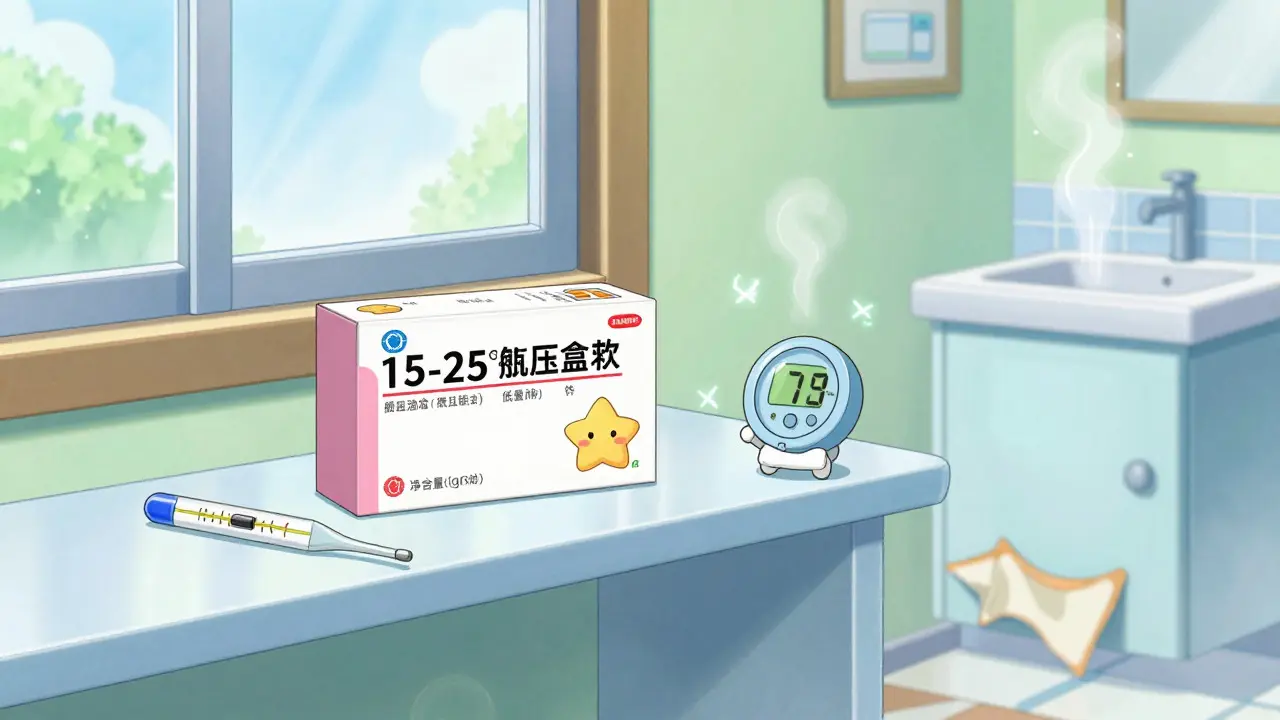
Even if the date hasn't passed, where you keep your meds matters immensely. Most people store medicines in the bathroom medicine cabinet. This is arguably the worst place in your house. Bathrooms experience significant fluctuations in temperature and humidity due to showers and baths. Studies show that antibiotics stored in bathrooms (average 28.7°C and 72.3% humidity) lose potency significantly faster than those stored in cool, dry places.
For maximum stability, antibiotics should be kept in their original containers with desiccants (the little silica gel packets) at temperatures between 15-25°C and relative humidity below 45%. Under these controlled conditions, solid antibiotics maintain potency about 37% longer than those in humid environments. If your expired antibiotics have been sitting in a hot car or a steamy bathroom, their actual shelf life is likely far shorter than the SLEP data suggests. Visual inspection helps-if you see discoloration, crumbling, or moisture damage, toss them immediately. However, remember that 89.3% of degraded antibiotics show no visible changes, so looking good doesn't mean working well.
Expert Opinions and Regulatory Stances
Health authorities are divided on how strictly to enforce expiration rules, especially during shortages. The European Medicines Agency (EMA) takes a middle ground, acknowledging that solid dosage forms stored correctly might retain acceptable potency for 6-12 months beyond expiration, but they explicitly exclude liquid formulations and drugs used for life-threatening infections. The World Health Organization (WHO) identifies inappropriate use of expired antibiotics as a significant contributor to global resistance, estimating it accounts for 4.3% of resistance cases worldwide.
In the U.S., experts like Dr. Lee Cantrell suggest that during critical shortages, properly stored solid antibiotics might be considered for use up to 24 months post-expiration after a careful risk-benefit assessment. Conversely, the CDC’s 2023 Antibiotic Stewardship Guide advises that solid antibiotics may only be considered for emergency use up to 12 months post-expiration if they are from unopened, factory-sealed containers and pass visual inspection. For serious infections like meningitis or sepsis, no major body recommends using expired drugs. The margin for error is simply too small.
User Behavior and Real-World Risks
Despite these warnings, people continue to use expired antibiotics. An analysis of online forums revealed that over 63% of users reported taking expired antibiotics, mostly for respiratory or urinary tract infections. The outcome was rarely positive: nearly 69% noted incomplete symptom resolution, and more than 22% ended up in the emergency department for complications. Many patients believe they can tell if a drug is bad by its taste or smell, but this is a myth. Most degraded antibiotics look and taste normal even when they have lost 40-75% of their potency.
In low- and middle-income countries, the issue is exacerbated by supply chain issues. A 2023 WHO study found that nearly 90% of community pharmacies in these regions routinely dispense antibiotics close to expiration, and 43.7% knowingly dispensed expired products during shortages. This practice contributed to an 18.2% higher treatment failure rate compared to facilities with adequate stock. For individuals at home, the temptation to self-medicate with old stocks is strong, but the data suggests it is a gamble with high stakes.
Future Solutions and Testing
As antibiotic shortages grow-with the FDA listing 47 antibiotic shortages in 2023 alone-regulators are looking for new ways to manage expiration dates. The FDA launched a pilot program in 2023 to validate extended expiration dates for critical antibiotics using rapid stability testing. Meanwhile, technology is catching up. Researchers at the University of Illinois developed paper-based potency test strips for amoxicillin, showing 94.7% accuracy in detecting sub-therapeutic concentrations in Phase II trials completed in March 2024. Additionally, IBM Watson Health and the FDA are collaborating on AI algorithms to predict individual drug stability based on storage history, which could replace fixed expiration dates with dynamic potency estimates in the future.
Practical Advice for Patients
So, what should you do with that old bottle? If it is a liquid suspension, throw it out. The degradation is too rapid and unpredictable. If it is a solid tablet or capsule, consider the following:
- Check the date: If it is more than 12 months past expiration, discard it.
- Assess the condition: Was it stored in a cool, dry place? If it was in a bathroom or glovebox, assume it is compromised.
- Evaluate the infection: Is it a mild, non-life-threatening issue? Even then, the risk of resistance makes fresh medication preferable.
- Consult a professional: Pharmacists are increasingly open to discussing SLEP data during shortages. Ask them if a specific expired solid antibiotic might be viable as a last resort, but never for serious infections.
Ultimately, the cost of a new prescription is usually lower than the cost of treating a resistant infection or a hospital visit. When it comes to antibiotics, freshness is not just a preference; it is a safety requirement.
Can I take expired antibiotics for a minor infection?
While solid antibiotics may retain potency for up to 12-24 months past expiration under ideal storage conditions, it is generally not recommended. Sub-therapeutic doses can lead to incomplete treatment and promote antimicrobial resistance. For minor infections, consult a pharmacist or doctor before considering expired stock, and avoid using them for serious conditions entirely.
Do expired antibiotics become toxic?
Most antibiotics do not become toxic as they expire; they simply lose potency. The primary risk is treatment failure and bacterial resistance. However, tetracycline-class antibiotics (like doxycycline) have historically been associated with kidney toxicity if severely degraded, though modern manufacturing has reduced this risk. Liquid suspensions can also develop microbial contamination if preservatives break down.
How should I store antibiotics to maximize their shelf life?
Store antibiotics in a cool, dry place away from direct sunlight and humidity. Avoid bathrooms and kitchens. Ideal conditions are 15-25°C with less than 45% relative humidity. Keep them in their original containers with desiccants intact. Refrigeration is only necessary for specific liquid suspensions or insulin-like drugs, as stated on the label.
Are liquid antibiotics safe to use after expiration?
No. Liquid antibiotic suspensions degrade much faster than solid pills. Once reconstituted with water, they begin breaking down quickly. Studies show significant potency loss within weeks of the expiration date, even under refrigeration. Using expired liquid antibiotics greatly increases the risk of treatment failure.
What is the Shelf Life Extension Program (SLEP)?
SLEP was a joint initiative by the U.S. Department of Defense and the FDA from 1986 to 2006. It tested the stability of drugs in military stockpiles. The program found that approximately 90% of medications, including many antibiotics, remained potent and safe for years past their labeled expiration dates when stored under optimal conditions. This data informs current debates on extending expiration dates during shortages.
Can I visually tell if an antibiotic has lost its potency?
Usually, no. Research indicates that nearly 90% of degraded antibiotics show no visible changes in color, texture, or smell despite losing significant potency. Visual inspection can detect obvious damage like moisture or crumbling, but it cannot confirm chemical stability. Do not rely on appearance to determine if an expired drug is safe to use.
Why is antibiotic resistance a concern with expired drugs?
Expired antibiotics may contain lower levels of active ingredients. This sub-therapeutic dose might kill weak bacteria but leave stronger ones alive. These surviving bacteria can mutate and multiply, creating resistant strains that are harder to treat with standard medications. This contributes to the global crisis of antimicrobial resistance.