Bipolar Antidepressant Risk Calculator
Antidepressant Risk Assessment
This tool helps you understand your risk of mood destabilization when taking antidepressants for bipolar depression. Based on clinical evidence, it calculates your personalized risk based on your specific clinical profile.
Your Risk Assessment
Why Antidepressants Can Make Bipolar Depression Worse
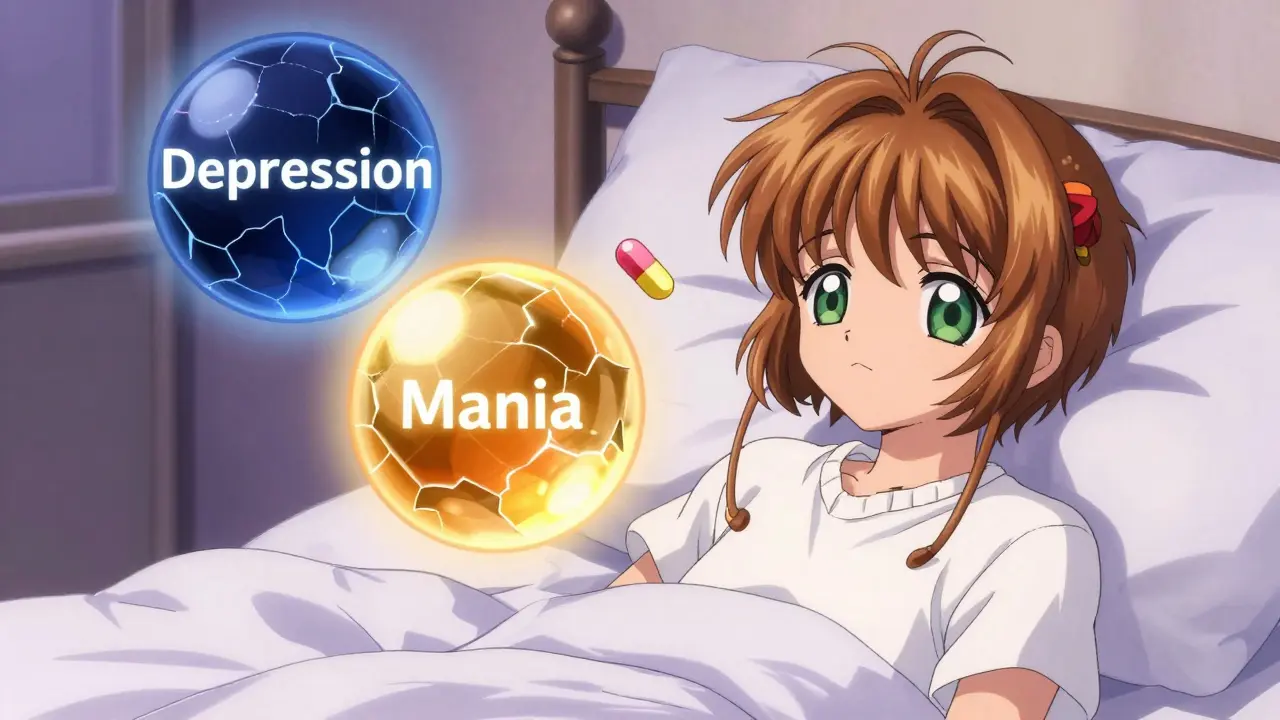
It’s a common misunderstanding: if someone is depressed, give them an antidepressant. It works for many people with unipolar depression. But for someone with bipolar disorder, that same pill can trigger something dangerous - a switch into mania or hypomania. This isn’t rare. It happens often enough that psychiatrists now treat antidepressants in bipolar patients like a loaded gun: powerful, but only safe if handled with extreme care.
When a person with bipolar disorder takes an antidepressant, their brain doesn’t respond the same way as someone with regular depression. Instead of lifting mood, it can flip the switch entirely. One week they’re struggling to get out of bed; the next, they’re sleeping three hours a night, spending money they don’t have, or making reckless decisions. This isn’t just a side effect - it’s a known risk, backed by decades of research.
The Numbers Don’t Lie: Switch Risk vs. Real Benefit
Let’s break it down plainly. In randomized trials of over 10,000 bipolar patients, about 12% experienced a manic or hypomanic switch after starting an antidepressant. In real-world, retrospective studies - where doctors look back at patient histories - that number jumps to 31%. That’s a big gap, and it tells us something important: the risk is higher than we often admit.
Now, here’s the kicker: how well do antidepressants actually work in bipolar depression? The number needed to treat (NNT) is 29.4. That means you’d need to give antidepressants to nearly 30 people with bipolar depression to help just one of them feel significantly better. Compare that to unipolar depression, where the NNT is just 6 to 8. In other words, antidepressants are far less effective in bipolar depression - and the risks are much higher.
Meanwhile, mood stabilizers like lithium or antipsychotics like quetiapine and lurasidone - FDA-approved specifically for bipolar depression - have response rates of 50% or higher, with switch risks under 5%. They don’t just work better. They’re safer.
Not All Antidepressants Are Created Equal
Some antidepressants are riskier than others. Tricyclics - older drugs like amitriptyline - carry a 15% to 25% risk of triggering mania. That’s too high for most clinicians to justify. SSRIs like sertraline or escitalopram are a bit safer, with switch risks around 8% to 10%. Bupropion (Wellbutrin) is often considered the safest option among antidepressants in bipolar patients, because it doesn’t strongly affect serotonin.
But even SSRIs aren’t risk-free. A patient with a history of rapid cycling - where mood swings happen four or more times a year - has a switch risk over 30% if they take any antidepressant. The same goes for people with mixed features during their depressive episodes: irritability, agitation, racing thoughts mixed with sadness. These aren’t just “bad days.” They’re warning signs.
And here’s something many don’t realize: antidepressants can make rapid cycling worse over time. Studies show people on long-term antidepressants are 2.1 times more likely to develop frequent mood swings. That’s not fixing the problem - it’s making it worse.

Who Should Never Take Antidepressants for Bipolar Depression
There are clear red flags that make antidepressants a bad idea:
- You’ve had a manic or hypomanic episode after taking an antidepressant before - your risk triples
- You have Bipolar I disorder - the more severe form - especially if you’ve had mania in the past
- You’re experiencing mixed features: depression plus agitation, impulsivity, or racing thoughts
- You’re a rapid cycler - four or more mood episodes in a year
- You’re not on a mood stabilizer or atypical antipsychotic - antidepressants should never be used alone
These aren’t hypotheticals. They’re clinical facts. The International Society for Bipolar Disorders (ISBD) says antidepressants should be avoided in all of these cases. Yet, in community clinics, 80% of bipolar patients still get them - often without proper monitoring.
When Might They Be Used - And How
There’s one narrow window where antidepressants might be considered: severe, treatment-resistant bipolar depression, after at least two FDA-approved treatments have failed. Even then, it’s temporary.
Here’s how it’s done right:
- Start only with a mood stabilizer (like lithium or valproate) or an atypical antipsychotic (like quetiapine or lurasidone) already in place
- Use only an SSRI or bupropion - never tricyclics or SNRIs
- Monitor weekly for the first four weeks: check for sleep loss, increased energy, impulsivity, or talkativeness
- Stop the antidepressant after 8 to 12 weeks - even if the patient feels better
- Never continue it long-term
At Tufts Medical Center, only 19% of bipolar patients ever get antidepressants. That’s because their team knows the risks. In contrast, 62% of community psychiatrists still prescribe them routinely. That’s not evidence-based care - it’s habit.
What Happens When You Don’t Stop
Most people don’t realize antidepressants aren’t meant to be long-term in bipolar disorder. But in real life, 65% of patients stay on them for more than 12 weeks. Some stay on for years.
The consequences? More episodes. More hospitalizations. More suicide risk. A 27-year study found that long-term antidepressant use increased the chance of recurrence by 37%. That’s not a small risk. That’s a major problem.
And here’s the cruel irony: people who feel better on antidepressants often don’t want to stop. They think it’s working. But what they’re feeling might not be stable recovery - it might be the early stages of mania. A patient might say, “I finally have energy again,” but if they’re sleeping 2 hours a night and cleaning the house at 3 a.m., that’s not wellness. That’s a warning.

The Bigger Picture: Why This Problem Persists
So why are antidepressants still so widely used? Three reasons:
- Clinical inertia: Doctors stick with what they know. Antidepressants are familiar. Mood stabilizers are complex.
- Patient demand: People want something that works fast. Antidepressants kick in in 2-4 weeks. Mood stabilizers take 4-6 weeks or longer.
- Lack of access: Not everyone can see a bipolar specialist. In rural areas or under-resourced clinics, general practitioners prescribe antidepressants because they don’t have other options.
The result? An estimated $1.2 billion is spent annually in the U.S. on off-label antidepressant prescriptions for bipolar disorder. Meanwhile, the FDA has approved four safer, more effective medications since 2003 - but many doctors don’t use them.
What’s Next: Better Tools, Better Choices
The field is changing. New research is pointing toward personalized approaches. One 2022 study found that people with a specific gene variant (the LL genotype of 5-HTTLPR) are 3.2 times more likely to switch into mania on antidepressants. Genetic testing isn’t routine yet - but it’s coming.
Meanwhile, new treatments are emerging. Esketamine nasal spray (Spravato), originally approved for treatment-resistant depression, showed a 52% response rate in bipolar depression with only a 3.1% switch risk in a 2023 trial. That’s better than any antidepressant. Other drugs are being developed that combine antidepressant and mood-stabilizing effects in one pill.
But until those become widely available, the best tool we have is awareness. Know the risks. Know the alternatives. And never assume an antidepressant is safe just because it’s prescribed.
What You Can Do
If you or someone you care about has bipolar disorder and is taking an antidepressant:
- Ask your doctor: “What’s the plan for stopping this? When?”
- Ask: “Have we tried FDA-approved options like quetiapine or lurasidone first?”
- Watch for signs of mania: reduced sleep, impulsivity, grandiosity, racing thoughts
- Keep a mood journal - track sleep, energy, and mood daily
- If you feel unusually “high” or wired after starting or increasing an antidepressant, call your doctor immediately - don’t wait
There’s no shame in needing help. But there’s real danger in using the wrong tool for the job. Bipolar depression is hard. But antidepressants aren’t the answer for most people. The right treatment exists - it just takes knowing what to look for.